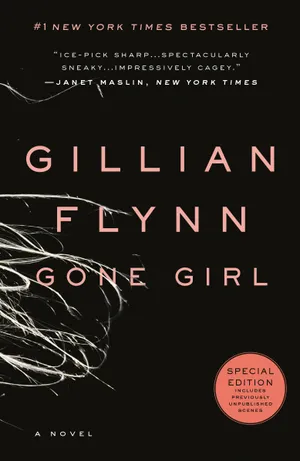
Our Review
On the morning of their fifth wedding anniversary, Nick Dunne comes home to find his wife Amy missing and their living room showing signs of a struggle. The police arrive, the media descends, and Nick — with his evasions, half-smiles, and inability to perform grief correctly — becomes suspect number one. For roughly the first half of Gone Girl, you think you are reading a taut domestic thriller about a man who probably killed his wife.
Then the floor drops out.
Gillian Flynn's masterstroke is structural. The novel alternates between Nick's present-tense narration and Amy's diary entries, and the gap between their versions of reality widens until it becomes a chasm. When the twist arrives — and it is one of the great twists in modern fiction — it reframes everything you've read. Suddenly the book isn't about whether Nick did it. It's about the performance of marriage, the curation of identity, and how well you can ever really know another person.
Flynn writes with surgical precision about resentment, about the "cool girl" archetype women are expected to perform, and about the particular cruelty of intimacy weaponized. Gone Girl is a thriller, yes, but it is also one of the most lacerating examinations of modern marriage in American fiction.
Why This Book Earned Its Place in the Top 100
Gone Girl did something rare: it created a new genre. Before Flynn, "domestic thriller" wasn't a marketing category. After Gone Girl, it became one of the most dominant forces in publishing, spawning hundreds of imitators — The Girl on the Train, The Woman in the Window, Behind Closed Doors — and permanently altering what bookstore shelves look like.
But influence alone doesn't earn a spot on this list. Gone Girl earns it through the quality of its writing, which is leagues beyond most thrillers, and through the depth of its ideas. Amy's "cool girl" monologue is one of the most quoted passages of 21st-century fiction because it articulates something millions of women recognized instantly but had never seen named. Flynn's dissection of how people perform identity within relationships — and how media amplifies those performances — feels more relevant with every passing year.
The novel also proved that genre fiction could be taken seriously as social commentary. Flynn didn't apologize for writing a page-turner; she made the page-turning velocity itself part of the argument.
Who Should Read This Book
- •Anyone who thinks thrillers can't be literary — Flynn's prose is sharp, controlled, and genuinely brilliant in ways that transcend genre expectations.
- •Readers fascinated by unreliable narrators — this is arguably the definitive example of the technique in contemporary fiction.
- •People interested in gender dynamics and performance — the 'cool girl' speech alone is worth the price of admission.
- •Fans of dark, twisty plots who want more than just shock — the twist here is shocking, but it also means something.
- •Couples, frankly — reading this book together is either a bonding experience or a deeply uncomfortable one, and either outcome is illuminating.
Key Themes and Takeaways
- The performance of marriage
- Nick and Amy's relationship reveals how couples curate versions of themselves that eventually become prisons.
- Unreliable narration and truth
- Both narrators lie, and the reader's shifting sympathies become part of the novel's argument about the impossibility of objective truth.
- Media and public perception
- The 24-hour news cycle transforms a private tragedy into a public spectacle where appearance matters more than reality.
- Gender roles and expectations
- Amy's 'cool girl' monologue dissects the impossible standard women face and the rage that festers beneath compliance.
- Identity as construction
- Both protagonists are revealed to be elaborate fictions they've built for public consumption.
- The economics of resentment
- Financial decline and thwarted ambition corrode the Dunne marriage from within, exposing class anxieties beneath the romance.
Cultural and Historical Impact
Published in 2012, Gone Girl spent over eight weeks at #1 on the New York Times bestseller list and has sold more than 20 million copies worldwide. David Fincher's 2014 film adaptation, starring Ben Affleck and Rosamund Pike, grossed $369 million worldwide and earned Pike an Academy Award nomination. The phrase "cool girl" entered the cultural lexicon as shorthand for the performative femininity women are pressured to adopt. The novel spawned the "domestic thriller" genre that dominated publishing through the mid-2010s, with publishers actively seeking "the next Gone Girl" for years afterward. Flynn also wrote the screenplay for the film, a rare feat for a novelist.
Notable Quotes
“Love makes you want to be a better man. But maybe love, real love, also gives you permission to just be the man you are.”
“Men always say that as the defining compliment, don't they? She's a cool girl. Being the Cool Girl means I am a hot, brilliant, funny woman who adores football, poker, dirty jokes, and burping.”
“There's a difference between really loving someone and loving the idea of her.”
If You Loved Gone Girl, Read These Next



Ready to read Gone Girl?
Crown Publishing Group · 432 pages
Buy Gone Girl on Amazon