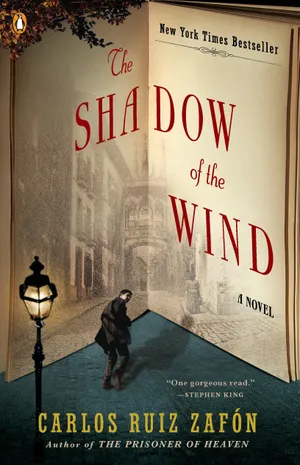
Our Review
Carlos Ruiz Zafón's The Shadow of the Wind begins with one of the most irresistible premises in modern fiction: a secret library called the Cemetery of Forgotten Books, hidden in the labyrinth of old Barcelona, where every visitor is allowed to adopt a single book and become its guardian. Ten-year-old Daniel Sempere, taken there by his bookseller father in 1945, chooses a novel called The Shadow of the Wind by an obscure author named Julián Carax. The book captivates him. He sets out to find Carax's other works — and discovers that someone has been systematically destroying every copy of every book Carax ever wrote.
What unfolds is a literary mystery woven through the dark streets of Franco-era Barcelona, a city of shadows, secrets, and architecture that seems to breathe. Daniel's investigation draws him into a story that mirrors his own life with uncanny precision — a tale of forbidden love, betrayal, madness, and vengeance that spans decades. There is a scarred man named Laín Coubert — the name of the devil in one of Carax's novels — who warns Daniel to stop looking. There is a police inspector whose cruelty is coldly methodical. There is a love story so tangled in violence that it becomes almost impossible to separate the beauty from the horror.
Zafón writes like a man possessed by the ghost of every great storyteller who ever lived. The Shadow of the Wind is a gothic novel, a noir thriller, a coming-of-age story, and a love letter to literature itself — and it is all of these things at once, without ever losing its headlong narrative momentum.
Why This Book Earned Its Place in the Top 100
The Shadow of the Wind earns its place because it is the rare novel that combines literary ambition with sheer, unashamed entertainment. Zafón is often compared to Dumas and Hugo, and the comparison is apt: like them, he understood that a novel could be both popular and profound, that page-turning suspense and genuine emotional depth are not enemies but allies.
The novel also earns its place as the definitive love letter to books and reading. The Cemetery of Forgotten Books is one of the great fictional inventions of the twenty-first century — a place where literature is not merely consumed but protected, cherished, and passed from guardian to guardian. For anyone who has ever felt that a book saved their life, Zafón built a cathedral.
Finally, the Barcelona of this novel is as much a character as any of the humans. Zafón's city is gothic, romantic, and terrifying in equal measure — a place where Gaudí's architecture casts shadows that seem to move, and where the wounds of the Civil War bleed beneath the surface of every cobblestone. No other novelist has captured Barcelona with this intensity, and the novel has become a literary pilgrimage site for the city's visitors.
Who Should Read This Book
- •Anyone who loves books about books — the Cemetery of Forgotten Books is the ultimate bibliophile's fantasy, and the novel's reverence for literature is contagious.
- •Mystery and thriller readers who want literary depth — this novel delivers genuine suspense alongside prose that rewards close attention.
- •Fans of gothic fiction — the atmosphere is thick enough to cut, and Zafón's Barcelona at night is as haunting as any setting in the genre.
- •Travelers to Barcelona — reading this novel before or during a visit to the city transforms the experience entirely.
Key Themes and Takeaways
- The power of literature
- Books in this novel are not just objects but living things — capable of saving lives, destroying them, and connecting strangers across time.
- Memory and identity
- Daniel's investigation into Carax's past is simultaneously an investigation into his own identity, and the parallel between their lives blurs the boundary between reader and author.
- Love and obsession
- The novel's love stories — Daniel's and Carax's — are passionate, destructive, and inseparable from the violence that surrounds them.
- Political oppression
- Franco's Spain provides the backdrop, and the casual cruelty of the regime seeps into every corner of the plot.
- Secrets and the past
- Every character harbors a secret, and the novel's architecture is built on the slow, inevitable revelation of truths that everyone has conspired to bury.
Cultural and Historical Impact
Published in 2001 in Spanish and translated into English in 2004, The Shadow of the Wind has sold over 15 million copies worldwide and been translated into more than 40 languages. It was a number-one bestseller in Spain, the UK, and numerous other countries. The novel launched Zafón's "Cemetery of Forgotten Books" quartet, which also includes The Angel's Game, The Prisoner of Heaven, and The Labyrinth of the Spirits. Zafón's death in 2020 left the series as a completed tetralogy. The novel has transformed Barcelona tourism, with guided walking tours following Daniel Sempere's footsteps through the Gothic Quarter. It is widely credited with reviving international interest in Spanish literary fiction.
Notable Quotes
“Every book, every volume you see here, has a soul. The soul of the person who wrote it and of those who read it and lived and dreamed with it.”
“Books are mirrors: you only see in them what you already have inside you.”
“Few things leave a deeper mark on a reader than the first book that finds its way into his heart.”
If You Loved The Shadow of the Wind, Read These Next
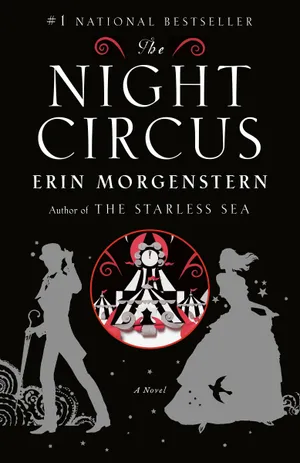
Ready to read The Shadow of the Wind?
Penguin Books · 487 pages
Buy The Shadow of the Wind on Amazon