Our Review
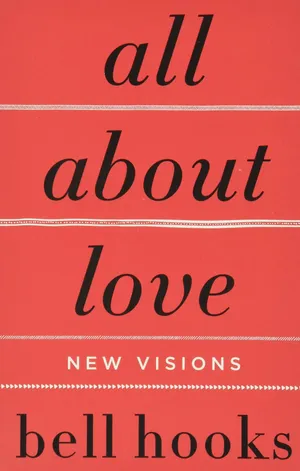
All About Love: New Visions, published in 2000, is bell hooks's attempt to rescue the word "love" from the sentimental mush that our culture has made of it. Her argument is straightforward and radical: we live in a society that talks constantly about love — in songs, in movies, in greeting cards — but has almost no understanding of what love actually is. And that ignorance is destroying us.
hooks begins by adopting psychiatrist M. Scott Peck's definition of love: "the will to extend one's self for the purpose of nurturing one's own or another's spiritual growth." Love, by this definition, is not a feeling. It is a practice. It is not something that happens to you. It is something you choose to do, repeatedly, even when it is difficult. This distinction is the foundation on which the entire book rests.
From there, hooks moves through a series of essays examining how a loveless culture reproduces itself. She writes about growing up in a household where affection and violence coexisted, and how that taught her — as it teaches millions — that love and abuse can occupy the same space. She examines how capitalism encourages us to substitute material consumption for genuine connection. She explores how patriarchy cripples men's capacity for emotional intimacy. And throughout, she insists that love is not a luxury or a weakness but the only force powerful enough to heal individuals and communities. The book is clear-eyed, unsentimental, and unexpectedly hopeful.
Why This Book Earned Its Place in the Top 100
All About Love earns its place because it addresses a problem that every other book on this list touches but none confront so directly: the absence of love as a guiding ethical practice in modern life. hooks argues that most of what we call love — possessiveness, infatuation, codependency — is not love at all, and that this confusion is the root cause of enormous personal and social suffering.
The book's power lies in hooks's refusal to be either cynical or naive. She does not pretend that love is easy or that good intentions are sufficient. She examines, with genuine intellectual rigor, the structural forces — sexism, racism, capitalism, patriarchy — that make love difficult. But she also insists, with equal conviction, that love is possible, that it can be learned, and that it is necessary. In an age of polarization, loneliness, and despair, this argument feels more essential than ever. All About Love has experienced a massive resurgence in popularity, particularly among younger readers, because it offers something rare: a serious, intelligent, practically useful vision of how to live a more loving life.
Who Should Read This Book
- •Anyone who has ever struggled in a relationship — hooks provides a framework for understanding love that is more honest and more useful than anything in popular self-help.
- •Readers disillusioned with romance culture — hooks dismantles the fairy-tale narrative and replaces it with something far more sustainable and real.
- •Men who want to develop emotional intelligence — hooks writes extensively about how patriarchy stunts men's emotional growth, and she does so with compassion rather than blame.
- •Social justice activists — hooks connects personal love ethic to larger political and social transformation in ways that are both practical and profound.
- •Young adults navigating their first serious relationships — the book provides vocabulary and frameworks for understanding love that most people never receive.
Key Themes and Takeaways
- Love as practice, not feeling
- Love is a verb — a sustained act of will directed toward the spiritual growth of oneself and others, not a passive emotion.
- The lovelessness of modern culture
- hooks argues that American culture is profoundly loveless, substituting sentimentality, consumption, and domination for genuine care.
- Honesty as the foundation of love
- Without truthfulness, love is impossible; the epidemic of lying in our culture is both a symptom and a cause of our inability to love.
- Patriarchy and emotional crippling
- Boys are taught to suppress vulnerability and emotional expressiveness, which makes them incapable of the intimacy love requires.
- Community and belonging
- Love is not limited to romantic relationships; it must extend to friendships, communities, and the broader social fabric.
- Self-love and healing
- You cannot give love if you have never received it; healing begins with learning to love yourself honestly and without narcissism.
Cultural and Historical Impact
All About Love was published in 2000 and initially found a dedicated but modest readership. After bell hooks's death in December 2021, the book surged to the top of bestseller lists, selling hundreds of thousands of additional copies. It became a viral phenomenon on social media, particularly on TikTok and Instagram, where passages were widely shared by a new generation of readers. The book has been translated into multiple languages. hooks's insistence that love is a political and ethical practice, not merely a personal emotion, has influenced contemporary discussions of mental health, relationship culture, and social justice. The book is now regularly assigned in university courses on gender studies, sociology, and philosophy. It has become one of the defining texts of 21st-century thinking about love, relationships, and emotional well-being.
Notable Quotes
“Rarely, if ever, are any of us healed in isolation. Healing is an act of communion.”
“The practice of love offers no place of safety. We risk loss, hurt, pain. We risk being acted upon by forces outside our control.”
“To begin by always thinking of love as an action rather than a feeling is one way in which anyone using the word in this manner automatically assumes accountability and responsibility.”
If You Loved All About Love: New Visions, Read These Next
Ready to read All About Love: New Visions?
William Morrow Paperbacks · 272 pages
Buy All About Love: New Visions on Amazon