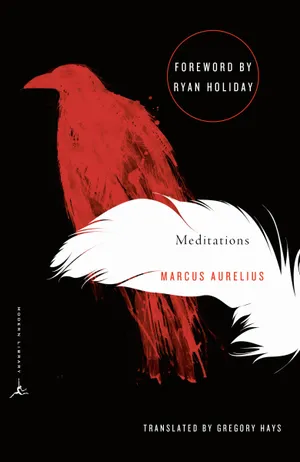
Our Review
Meditations was never meant to be read by anyone. Marcus Aurelius, the last of the Five Good Emperors of Rome, wrote these notes to himself — private reflections on duty, mortality, and self-discipline — while commanding military campaigns along the Danube frontier in the 170s CE. He titled the work "To Himself." That we have it at all is an accident of history, and one of the most fortunate accidents in the history of literature.
What makes Meditations extraordinary is its relentless honesty. This is the most powerful man in the known world reminding himself not to be arrogant, not to waste time, not to be distracted by praise or wounded by criticism. There is no posturing, no attempt to impress a reader who was never supposed to exist. The result is an intimacy that crosses two millennia as though they were nothing.
The philosophy is Stoicism at its most practical. Marcus does not construct elaborate metaphysical systems. He repeats, in slightly different formulations, a handful of core ideas: you cannot control events, only your response to them. Fame is meaningless. Death is natural. The present moment is all you truly possess. These ideas are simple. Living by them, as Marcus clearly knew, is extraordinarily hard. Meditations is the record of a man trying, every day, to close the gap between knowing what is right and actually doing it.
Why This Book Earned Its Place in the Top 100
Meditations has endured for nearly two thousand years because it solves a problem that never goes away: how to remain sane, decent, and purposeful in a world that constantly tempts you toward distraction, self-pity, and rage. Marcus Aurelius did not have the luxury of armchair philosophy. He wrote these reflections while fighting wars, managing plagues, dealing with betrayal, and shouldering the impossible weight of governing an empire. The fact that he kept returning to the same simple principles — presence, duty, acceptance, perspective — is precisely the point.
In the last decade, Meditations has experienced a massive resurgence. Silicon Valley executives, professional athletes, military leaders, and therapists have all embraced Stoicism, and this book is almost always the entry point. But its appeal long predates the modern self-help movement. Frederick the Great carried it on campaign. Bill Clinton reportedly re-read it every few years. The book persists because its counsel is timeless: do your work, don't complain, treat others fairly, and remember that your time is short.
Who Should Read This Book
- •Anyone going through a difficult period — Marcus wrote these words during plague, war, and personal loss, and they carry the weight of real suffering transformed into wisdom.
- •Leaders and managers — this is the private journal of one of history's most effective rulers, reflecting honestly on the temptations and responsibilities of power.
- •Readers interested in Stoicism or practical philosophy — Meditations is the most accessible and immediately useful Stoic text ever written.
- •People who find traditional self-help books shallow — Marcus offers no gimmicks, no seven-step programs, just rigorous self-examination by a man who actually lived what he preached.
- •Anyone who struggles with anxiety about things beyond their control — the core Stoic insight that you can only control your own responses has helped millions of readers find equanimity.
Key Themes and Takeaways
- Impermanence and mortality
- Everything you see, everyone you know, and you yourself will be gone soon — and that knowledge should liberate, not paralyze.
- The dichotomy of control
- Suffering comes from wanting to control what you cannot; peace comes from focusing entirely on what you can.
- Duty and service
- Marcus sees himself as a citizen of the universe with obligations that transcend personal comfort or preference.
- Self-discipline and the inner life
- The real battle is not external — it is the daily struggle to align your actions with your principles.
- The insignificance of fame
- Even Alexander the Great and his mule driver ended up in the same place; reputation is a distraction from genuine virtue.
Cultural and Historical Impact
Meditations has been continuously read for nearly 1,900 years. The first English translation appeared in 1634, and there have been dozens since. In the 21st century, the book has become a publishing phenomenon — modern translations by Gregory Hays (2002) and Robin Hard have sold millions of copies. The resurgence of popular Stoicism, led by writers like Ryan Holiday, has placed Meditations at the center of a global philosophical movement. The book has been cited by figures ranging from Bill Clinton to Admiral James Stockdale, who credited Stoic philosophy with his survival as a prisoner of war in Vietnam. Meditations has been translated into virtually every major language and remains a perennial bestseller in the philosophy category on Amazon. It is one of the most highlighted books on Kindle.
Notable Quotes
“You have power over your mind — not outside events. Realize this, and you will find strength.”
“The happiness of your life depends upon the quality of your thoughts.”
“Waste no more time arguing about what a good man should be. Be one.”
If You Loved Meditations, Read These Next
Ready to read Meditations?
Modern Library · 256 pages
Buy Meditations on Amazon