Our Review
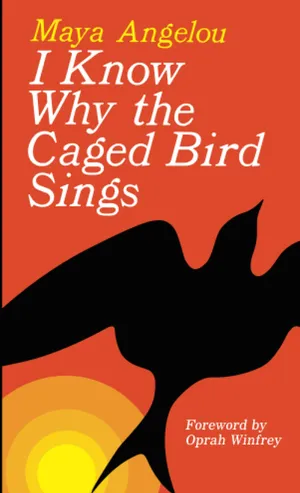
I Know Why the Caged Bird Sings, published in 1969, is the first and most celebrated volume of Maya Angelou's seven-part autobiography. It covers her childhood and adolescence in Stamps, Arkansas; St. Louis; and San Francisco during the 1930s and 1940s — years defined by the Depression, Jim Crow, and a traumatic sexual assault at age seven that left her mute for nearly five years.
The book's genius lies in its voice. Angelou writes about unspeakable things — racism, poverty, abuse — with a lyrical precision that transforms suffering into art without minimizing it. She does not ask for pity. She describes the world as she experienced it, and the clarity of that description is devastating. The scene in which a white dentist refuses to treat her because she is Black, and her grandmother stands powerless, is one of the most quietly enraging passages in American literature.
But the book is not a catalog of horrors. It is also joyful, funny, and deeply alive. Angelou's descriptions of her grandmother's general store, of the community life of Stamps, of the transformative power of literature — a teacher named Mrs. Flowers introduces her to Dickens and Shakespeare, which helps unlock her voice — are warm and vivid. The book is a testament to resilience, but more than that, it is a testament to the power of language itself to heal, to resist, and to insist on one's own humanity in a world determined to deny it.
Why This Book Earned Its Place in the Top 100
I Know Why the Caged Bird Sings is one of the most important American memoirs because it did something that had never been done at that scale: it placed the interior life of a Black girl at the center of American literature. Before Angelou, the experiences of Black women and girls — their fears, their joys, their sexual vulnerabilities, their intellectual awakening — were largely invisible in mainstream publishing. This book changed that permanently.
It also earns its place through sheer literary quality. Angelou was a poet, and her prose has a rhythmic power that makes it unforgettable. Her ability to render a child's perspective without condescension or sentimentality is remarkable. She captures the way children process trauma — through silence, through fantasy, through the gradual reconstruction of self — with an accuracy that psychologists have since confirmed. The book has been challenged and banned more than almost any other work in American schools, which is itself a testament to its power. Books that are dangerous to comfortable lies always are.
Who Should Read This Book
- •Anyone interested in the Black experience in America — Angelou's memoir is one of the most vivid and intimate portraits of growing up Black in the Jim Crow South.
- •Survivors of trauma — Angelou's honest account of assault, silence, and recovery has helped millions of readers feel less alone.
- •Readers who love beautiful prose — Angelou's writing has a poetic musicality that makes every sentence feel deliberate and alive.
- •Educators and parents — the book raises essential questions about how we protect children and how children protect themselves.
- •Anyone who has ever felt voiceless — the arc from silence to speech, from shame to self-expression, is one of the most powerful in all of literature.
Key Themes and Takeaways
- Racial oppression and resistance
- Angelou depicts Jim Crow not as distant history but as the daily texture of a Black child's life in the American South.
- The power of language and literature
- Books and poetry become Angelou's lifeline — the tools through which she reclaims her voice and her sense of self.
- Trauma, silence, and healing
- After her assault, young Maya goes mute for years; her gradual return to speech is the emotional spine of the book.
- Identity and self-worth
- Growing up Black, female, and poor in a society that devalues all three, Angelou must construct her identity against enormous external pressure.
- Community and family
- The Black community of Stamps — particularly Angelou's formidable grandmother — provides the foundation of love and structure that makes survival possible.
Cultural and Historical Impact
I Know Why the Caged Bird Sings was published in 1969 and became a massive bestseller, staying on the New York Times bestseller list for two years. It was nominated for a National Book Award. The book is one of the most frequently challenged and banned books in American schools — the American Library Association has documented hundreds of attempts to remove it — primarily due to its frank depictions of racism and sexual assault. Despite this, it remains one of the most commonly assigned texts in American literature and women's studies courses. Angelou went on to become one of the most celebrated figures in American culture, reading her poem "On the Pulse of Morning" at President Clinton's 1993 inauguration. The memoir has been translated into dozens of languages and has sold millions of copies worldwide. It opened the door for an entire generation of Black women memoirists.
Notable Quotes
“There is no greater agony than bearing an untold story inside you.”
“I've learned that people will forget what you said, people will forget what you did, but people will never forget how you made them feel.”
“We delight in the beauty of the butterfly, but rarely admit the changes it has gone through to achieve that beauty.”
If You Loved I Know Why the Caged Bird Sings, Read These Next
Ready to read I Know Why the Caged Bird Sings?
Ballantine Books · 304 pages
Buy I Know Why the Caged Bird Sings on Amazon