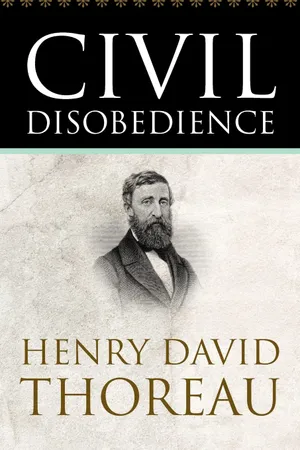
Our Review
In July 1846, Henry David Thoreau was arrested for refusing to pay his poll tax. He spent one night in the Concord jail — his aunt paid the tax the next morning, apparently to his annoyance — and from that single night of incarceration produced one of the most consequential political essays ever written. Originally titled "Resistance to Civil Government," it was published in 1849 and has been shaking governments ever since.
Thoreau's argument is breathtakingly direct: when a government commits injustice — in his case, the injustices were slavery and the Mexican-American War — the citizen has not merely a right but a duty to refuse compliance. Paying taxes that fund an unjust war makes you complicit in that war. Obeying laws that enforce slavery makes you an accomplice to slavery. The conscience of the individual, Thoreau insists, must take precedence over the law of the state.
The essay is short — most editions run under forty pages — but its compression is part of its power. Thoreau wastes no words. He moves from moral principle to practical application with the efficiency of a man who has actually put his body on the line for his beliefs. He is not theorizing about resistance from a safe distance. He is writing from the experience of having said no and accepted the consequences. That authenticity gives Civil Disobedience an authority that longer, more carefully argued works often lack.
Why This Book Earned Its Place in the Top 100
Civil Disobedience has probably influenced more real-world political change per page than any other text in the English language. Gandhi read it in South Africa in 1907 and later said it was the essay that crystallized his philosophy of nonviolent resistance, which he used to help free India from British colonial rule. Martin Luther King Jr. read it as a student at Morehouse College and described the experience as transformative — it provided the intellectual foundation for the strategy of nonviolent direct action that defined the American civil rights movement.
The essay's influence extends far beyond these two towering figures. It shaped the anti-apartheid movement in South Africa, the Danish resistance to Nazi occupation, and countless protest movements around the world. Its central claim — that unjust laws do not deserve obedience — is one of the most radical and important ideas in democratic political thought. In a world where citizens are constantly told to work within the system, Thoreau's insistence that sometimes the system itself is the problem remains as vital and as uncomfortable as ever.
Who Should Read This Book
- •Every citizen in a democracy — Thoreau forces you to confront the question of where your personal responsibility ends and complicity begins.
- •Students of political philosophy — this is one of the foundational texts of civil resistance theory and a direct predecessor to Gandhi and King.
- •Activists and organizers — the essay provides a clear moral framework for nonviolent resistance that has proven effective across cultures and centuries.
- •Anyone who has ever felt that following the rules is not the same as doing the right thing — Thoreau articulates that intuition with devastating clarity.
Key Themes and Takeaways
- Individual conscience versus state authority
- When the law conflicts with morality, the citizen must obey conscience, not the government.
- The duty to resist injustice
- Silence and compliance in the face of injustice are not neutrality — they are participation.
- The limits of majority rule
- A majority does not make something right; justice is not determined by counting votes.
- Taxation and complicity
- Paying taxes that fund unjust policies makes the taxpayer a partner in those policies.
- The power of individual action
- One honest man refusing to comply with injustice can be more powerful than an army — because he forces the system to reveal its true nature.
Cultural and Historical Impact
Civil Disobedience, first published in 1849, initially attracted little attention. Its influence grew exponentially in the 20th century. Mahatma Gandhi discovered it in 1907 and called it "a masterly treatise" that left "a deep impression" on him. He distributed copies widely during the Indian independence movement. Martin Luther King Jr. encountered it during his time at Morehouse College and later wrote that he was "fascinated by the idea of refusing to cooperate with an evil system." The essay influenced the Danish resistance during World War II, the anti-apartheid movement in South Africa, and the Tiananmen Square protests. It remains one of the most widely reprinted and translated essays in American history. The concept of "civil disobedience" that Thoreau named has become a permanent part of the global political vocabulary.
Notable Quotes
“That government is best which governs least.”
“Under a government which imprisons any unjustly, the true place for a just man is also a prison.”
“Unjust laws exist: shall we be content to obey them, or shall we endeavor to amend them, and obey them until we have succeeded, or shall we transgress them at once?”
If You Loved Civil Disobedience, Read These Next

Ready to read Civil Disobedience?
Wisehouse Classics · 48 pages
Buy Civil Disobedience on Amazon