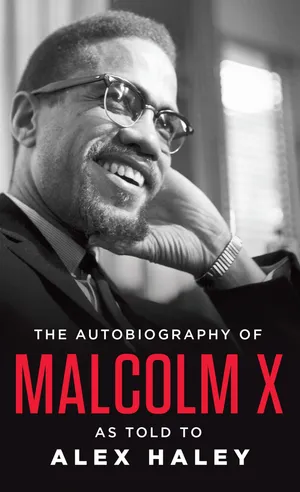
Our Review
The Autobiography of Malcolm X, told to journalist Alex Haley and published in 1965 — the same year Malcolm was assassinated — is one of the great American life stories. It traces an arc so dramatic that fiction would struggle to contain it: from a childhood shattered by white supremacist violence, through petty crime, prison, religious conversion, national prominence, ideological transformation, and martyrdom.
Malcolm Little grew up watching the Ku Klux Klan terrorize his family. His father was killed — almost certainly by white supremacists — when Malcolm was six. His mother was institutionalized. He drifted into hustling, drug dealing, and burglary, and was sentenced to prison at age twenty. There, he discovered the Nation of Islam and reinvented himself as Malcolm X, becoming the organization's most charismatic and controversial spokesperson.
But the book's most powerful section is its final act. After breaking with the Nation of Islam and making a pilgrimage to Mecca, Malcolm experienced what can only be called a second conversion. Encountering Muslims of every race praying together, he abandoned the racial separatism that had defined his public career and embraced a more universal vision of human brotherhood. He was murdered before he could fully develop this new philosophy. The book captures a mind in the act of changing itself, and that intellectual honesty — the willingness to publicly admit that you were wrong — makes it one of the most compelling memoirs ever written.
Why This Book Earned Its Place in the Top 100
The Autobiography of Malcolm X earns its place because no other American memoir combines such raw personal transformation with such enormous political significance. Malcolm's story is not just the story of one man — it is a prism through which you can see the entire struggle of Black Americans in the 20th century: the violence of Jim Crow, the appeal of separatism, the limitations of respectability politics, the power and danger of charismatic leadership, and the possibility of radical change.
The book also matters because it complicates easy narratives. Malcolm is not a saint. He does not sugarcoat his criminal past, his years of preaching racial hatred, or his capacity for cruelty. But he also refuses to let the reader reduce him to a villain. The result is a portrait of a human being in full complexity — brilliant, flawed, brave, angry, and ultimately transformed. In a culture that prefers its heroes simple, Malcolm's insistence on showing the whole truth about himself is both humbling and liberating.
Who Should Read This Book
- •Every American interested in understanding racial politics — Malcolm's perspective is the essential counterpoint to the narrative of nonviolent resistance, and you cannot understand one without the other.
- •Anyone going through a personal transformation — Malcolm reinvented himself multiple times, and his willingness to discard beliefs that no longer served truth is a model of intellectual courage.
- •Readers of biography and memoir — the collaboration between Malcolm and Alex Haley produced one of the most vivid and propulsive life stories in the English language.
- •Students of rhetoric and persuasion — Malcolm was one of the most electrifying public speakers in American history, and the autobiography captures his voice with remarkable fidelity.
Key Themes and Takeaways
- Racial injustice in America
- Malcolm's life is a case study in how systemic racism shapes individual destiny from childhood onward.
- Self-invention and transformation
- Malcolm Little becomes Detroit Red, then Malcolm X, then El-Hajj Malik El-Shabazz — each identity a response to new understanding.
- The power of education
- Malcolm's self-education in prison — reading the dictionary cover to cover, studying history — transformed him from a criminal into an intellectual.
- Religion and ideology
- The book traces Malcolm's journey through the Nation of Islam and his eventual embrace of orthodox Sunni Islam, showing how faith can both liberate and constrain.
- Intellectual honesty
- Malcolm's willingness to publicly admit that his earlier views were wrong is one of the rarest and most admirable qualities in public life.
Cultural and Historical Impact
Published weeks after Malcolm X's assassination in February 1965, The Autobiography of Malcolm X has sold millions of copies and been translated into more than two dozen languages. Time magazine named it one of the ten most important nonfiction books of the 20th century. It was a foundational text of the Black Power movement and influenced leaders including Huey Newton, Stokely Carmichael, and the founders of the Black Panther Party. Spike Lee's 1992 film Malcolm X, starring Denzel Washington, introduced Malcolm's story to a new generation. The book remains one of the most commonly assigned texts in American history and African American studies courses. In 2019, a lost chapter of the autobiography, discovered by a daughter of Alex Haley, was auctioned for $7,000. The book's influence extends beyond the United States — Nelson Mandela and other global leaders have cited it as an inspiration.
Notable Quotes
“Education is the passport to the future, for tomorrow belongs to those who prepare for it today.”
“I'm for truth, no matter who tells it. I'm for justice, no matter who it is for or against.”
“There is no better than adversity. Every defeat, every heartbreak, every loss, contains its own seed, its own lesson on how to improve your performance next time.”
If You Loved The Autobiography of Malcolm X, Read These Next
Ready to read The Autobiography of Malcolm X?
Ballantine Books · 500 pages
Buy The Autobiography of Malcolm X on Amazon