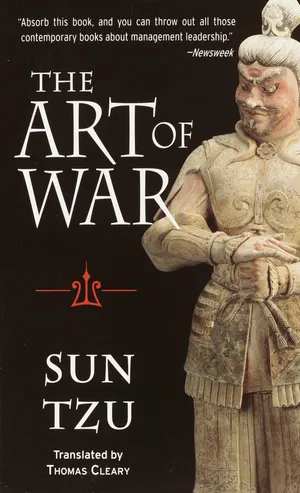
Our Review
The Art of War is the most influential book on strategy ever written. Composed in China around the 5th century BCE by the military general Sun Tzu, it consists of thirteen short chapters covering topics from terrain and espionage to the use of fire and the management of armies. The entire text can be read in an afternoon. Its influence has lasted twenty-five centuries.
What makes the book remarkable is not its military specifics — ancient Chinese chariot tactics are no longer particularly relevant — but its underlying philosophy. Sun Tzu's core insight is that the greatest victory is the one achieved without fighting. He prizes intelligence over brute force, flexibility over rigidity, and psychological advantage over physical confrontation. "All warfare is based on deception," he writes, and then proceeds to demonstrate that the same principle applies to negotiation, leadership, and virtually every competitive endeavor.
The brevity is part of the genius. Each passage is dense enough to support multiple interpretations, which is why The Art of War has been applied to everything from corporate strategy to sports coaching to personal development. The text works like a series of koans — you return to the same passages at different points in your life and find different meanings. It is less a manual than a framework for thinking about conflict, advantage, and the wise use of limited resources.
Why This Book Earned Its Place in the Top 100
The Art of War is one of the oldest texts on this list, and its unbroken relevance across two and a half millennia speaks for itself. No other book on strategy — military or otherwise — has achieved such universal and enduring influence. Napoleon reportedly studied it. During the Vietnam War, Ho Chi Minh's generals drew directly on its principles. In the 1980s, it became a staple of business school reading lists, and it remains one today.
The book earns its place not because it glorifies war but because it clarifies the nature of all competitive situations. Sun Tzu teaches that winning begins with understanding — understanding the terrain, the opponent, and yourself. His insistence that the best strategist wins without fighting, that the highest form of generalship is to undermine the enemy's plans rather than to attack their army, contains a moral dimension often overlooked by casual readers. The Art of War is ultimately a book about achieving your objectives with the least possible waste of life and resources. That makes it as relevant to a modern negotiation as to an ancient battlefield.
Who Should Read This Book
- •Business leaders and entrepreneurs — Sun Tzu's principles of strategic positioning, competitive intelligence, and resource management translate directly to the marketplace.
- •Anyone facing a competitive situation — whether it's a legal battle, a political campaign, or a chess tournament, the framework of strategic thinking here is universally applicable.
- •Students of history and military science — this is the foundational text of Eastern strategic thought and essential reading for understanding military history.
- •Readers who appreciate brevity and density — at under 100 pages, The Art of War delivers more insight per sentence than almost any other book in existence.
Key Themes and Takeaways
- Strategic deception
- All warfare — and by extension all competition — is based on misleading your opponent about your true intentions and capabilities.
- Winning without fighting
- The supreme art of war is to subdue the enemy without fighting; the best victories are those that cost nothing.
- Knowledge and intelligence
- Know your enemy and know yourself, and you will never be in peril; ignorance of either is the root of defeat.
- Adaptability
- Water shapes its course according to the ground; the skilled strategist shapes plans according to circumstances.
- Economy of force
- Resources are always limited, and the wise commander achieves objectives with minimum expenditure of men and material.
Cultural and Historical Impact
The Art of War has been translated into virtually every major language and has sold tens of millions of copies worldwide. In East Asia, it has been a foundational text for military and political leaders for over two millennia. In the West, its influence exploded in the 20th century: it became required reading at military academies including West Point and Sandhurst. The book became a Wall Street phenomenon in the 1980s, with executives treating it as a corporate strategy manual. It has been referenced in films from Wall Street to The Godfather. Professional sports coaches, including NFL and NBA figures, have cited it as a strategic influence. Tony Soprano was shown reading it on The Sopranos. It remains one of the bestselling strategy books on Amazon in any given year, consistently outselling books published thousands of years after it.
Notable Quotes
“All warfare is based on deception.”
“The supreme art of war is to subdue the enemy without fighting.”
“If you know the enemy and know yourself, you need not fear the result of a hundred battles.”
If You Loved The Art of War, Read These Next
Ready to read The Art of War?
Shambhala · 273 pages
Buy The Art of War on Amazon