Our Review
The Republic is a book about justice. That sounds straightforward enough, but Plato — writing around 375 BCE, in the voice of his teacher Socrates — uses that question as a gateway into virtually every major problem philosophy has ever addressed: What is the best form of government? What is the nature of reality? What does it mean to live a good life? Can education make people virtuous? Is the soul immortal?
The dialogue begins with a deceptively casual conversation about old age and money, then escalates through a series of increasingly radical arguments. Socrates and his interlocutors construct an ideal city-state from scratch, not because Plato expected such a city to exist, but because he believed you could only understand justice in an individual by first seeing it writ large in a society. The result is one of the most ambitious thought experiments ever conducted.
The Allegory of the Cave — in which prisoners chained in darkness mistake shadows for reality — remains one of the most powerful metaphors in human history. It captures something essential about the difficulty of seeing past our assumptions, our cultural conditioning, our comfortable illusions. Two and a half millennia later, philosophers, filmmakers, and political theorists are still unpacking its implications. The Republic is not easy reading, but it rewards effort in a way few books can match.
Why This Book Earned Its Place in the Top 100
The Republic is on this list for the simplest possible reason: virtually every major conversation in Western philosophy, political theory, and education traces back to it. Plato did not just contribute to these fields — in many cases, he invented them. Alfred North Whitehead famously said that all of Western philosophy is "a series of footnotes to Plato," and while that is an exaggeration, it is not a wild one.
The book remains relevant because its questions have never been answered to everyone's satisfaction. We still argue about whether philosopher-kings or democratic assemblies should govern. We still debate whether justice is intrinsic or merely a social contract. We still wrestle with the relationship between knowledge and virtue. The Republic doesn't give you comfortable answers — Plato's ideal state includes features that are genuinely disturbing — but it teaches you how to think about these questions with a rigor and depth that most modern discourse lacks. It is the foundation stone of intellectual life in the West.
Who Should Read This Book
- •Anyone who has never read a work of philosophy — The Republic is the most accessible and dramatic entry point into the tradition, structured as a living conversation rather than a dry treatise.
- •Political science students and citizens concerned about governance — Plato's analysis of how democracies decay into tyrannies reads like a contemporary op-ed.
- •Readers who loved The Matrix — the Allegory of the Cave is the direct philosophical ancestor of the film's central premise.
- •Teachers and educators — Plato's ideas about how education shapes the soul remain foundational to debates about curriculum and pedagogy.
- •Anyone who enjoys having their assumptions challenged — Socrates is the original intellectual gadfly, and his method of relentless questioning has lost none of its sting.
Key Themes and Takeaways
- The nature of justice
- Is justice merely the advantage of the stronger, or is it an intrinsic good that benefits the just person regardless of consequences?
- The ideal state
- Plato constructs a city governed by philosopher-kings, arguing that only those who understand truth should wield power.
- The Allegory of the Cave
- Reality as most people experience it is shadows on a wall; true knowledge requires painful liberation from comfortable illusions.
- Education and the soul
- The purpose of education is not to fill an empty vessel but to turn the soul toward the light of understanding.
- The tripartite soul
- Reason, spirit, and appetite each play a role in the human psyche, and justice consists in their proper harmony.
- The decline of political systems
- Plato maps the degeneration from aristocracy to timocracy, oligarchy, democracy, and finally tyranny with chilling precision.
Cultural and Historical Impact
The Republic has been in continuous circulation for approximately 2,400 years, making it one of the most enduring texts in human history. It has been translated into virtually every written language. The Allegory of the Cave has influenced works ranging from Augustine's Confessions to The Matrix trilogy. Plato's Academy, which he founded partly on ideas developed in The Republic, operated for nearly 900 years and is considered the first institution of higher learning in the Western world. The book's political philosophy shaped thinkers from Thomas More (Utopia) to Karl Popper (who attacked it in The Open Society and Its Enemies). In the United States, The Republic remains one of the most commonly assigned texts in university philosophy and political science courses. Its concept of the "noble lie" continues to generate heated debate in political theory.
Notable Quotes
“The measure of a man is what he does with power.”
“Until philosophers are kings, or the kings and princes of this world have the spirit and power of philosophy, and political greatness and wisdom meet in one, cities will never have rest from their evils.”
“We can easily forgive a child who is afraid of the dark; the real tragedy of life is when men are afraid of the light.”
If You Loved The Republic, Read These Next

Ready to read The Republic?
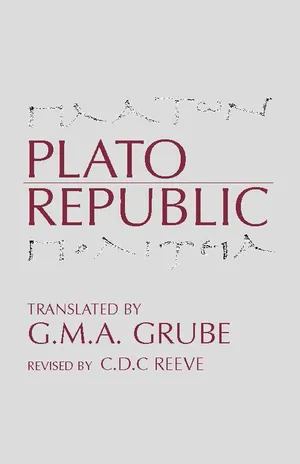
Hackett Publishing · 352 pages
Buy The Republic on Amazon