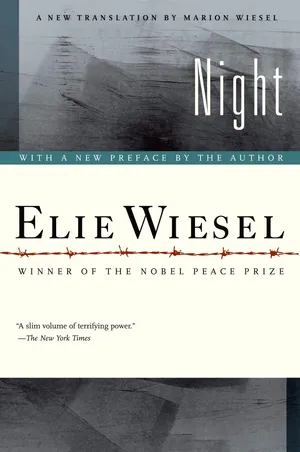
Our Review
Night is one of the shortest books on this list and one of the most unbearable. In barely over a hundred pages, Elie Wiesel recounts his experience as a fifteen-year-old Jewish boy deported with his family from their home in Sighet, Transylvania, to the Nazi death camps at Auschwitz and Buchenwald in 1944 and 1945.
The memoir begins in a world of faith. Young Eliezer is deeply religious, studying the Talmud and the Kabbalah, praying with fervor. He ignores warnings about what is coming — as does his entire community, unable to believe that such horror is possible. When the deportations begin, the speed of the descent is vertiginous. Within pages, Eliezer is standing at the gates of Auschwitz, watching babies thrown into a burning ditch.
What follows is a systematic destruction — of body, of spirit, of faith, of the relationship between father and son that is the memoir's emotional center. Eliezer watches his father weaken and eventually die, and he watches himself become someone capable of feeling relief at the burden being lifted. That admission — raw, unforgivable, necessary — is what separates Night from lesser testimony. Wiesel does not make himself a hero. He makes himself a witness to his own dehumanization, and in doing so, he forces the reader to confront what extremity does to the human soul.
The prose is spare to the point of silence. Wiesel cut and revised the original Yiddish manuscript from over 800 pages down to just over 100. What remains is concentrated to the density of lead.
Why This Book Earned Its Place in the Top 100
Night is on this list because some things must be remembered, and because Wiesel found a way to make remembering possible. The Holocaust produced a vast literature of testimony, but Night has become the primary text through which millions of readers — particularly young readers — first encounter the reality of the camps. That is not an accident. Wiesel's brevity and restraint make the horror accessible without making it bearable. He does not describe everything. He describes exactly enough.
The memoir also matters as a spiritual document. Wiesel was a man of deep faith, and Night is the record of that faith's destruction. The passage where young Eliezer watches three men hanged — including a child who takes half an hour to die — and hears a man behind him ask "Where is God?" is one of the most shattering moments in all of literature. Wiesel's answer — "He is hanging here on this gallows" — has been debated by theologians for decades.
Wiesel went on to spend his life as a voice for Holocaust remembrance and human rights, winning the Nobel Peace Prize in 1986. But Night is where it began — the testimony that made everything else possible. It is a book you read once and carry forever.
Who Should Read This Book
- •Every person — Night is not a book for specialists. It is a moral obligation. Wiesel wrote it so the world would not forget, and reading it honors that purpose.
- •Students encountering the Holocaust for the first time — this is the most commonly and rightly assigned introductory text.
- •People of faith wrestling with the problem of suffering — Wiesel's crisis of belief is one of the most honest and devastating ever recorded.
- •Readers of Man's Search for Meaning who want a complementary perspective — where Frankl found meaning in the camps, Wiesel found the death of God.
Key Themes and Takeaways
- The death of faith
- Night traces the systematic destruction of a devout boy's belief in a just God, culminating in a silence that Wiesel spent his life trying to understand.
- The father-son bond under extremity
- Eliezer's relationship with his father is the memoir's emotional spine, and its disintegration under the pressure of survival is its most devastating thread.
- Dehumanization
- Wiesel records the step-by-step process by which human beings were reduced to numbers, then to animals, then to something less.
- Silence and witness
- The book is haunted by silence — the silence of God, the silence of the world, and the silence Wiesel broke by writing.
- Memory as moral duty
- Wiesel believed that to forget the dead was to kill them a second time, and Night is his monument to that conviction.
Cultural and Historical Impact
Originally published in Yiddish in 1956 as Un di velt hot geshvign and in French in 1958 as La Nuit, Night has sold over 10 million copies and been translated into more than 30 languages. It is the most widely read Holocaust memoir in the world and is assigned in schools across the United States, Europe, and beyond. Wiesel received the Nobel Peace Prize in 1986, with the committee calling him "a messenger to mankind." Oprah Winfrey selected Night for her book club in 2006, introducing the memoir to millions of new readers and sending it back to the top of bestseller lists. The book, along with Wiesel's subsequent works and advocacy, was instrumental in establishing Holocaust education as a standard part of curricula worldwide. Wiesel's testimony before Congress and the United Nations shaped international discourse on genocide and human rights for decades.
Notable Quotes
“Never shall I forget that night, the first night in camp, which has turned my life into one long night, seven times cursed and seven times sealed.”
“For the dead and the living, we must bear witness.”
“The opposite of love is not hate, it's indifference.”
If You Loved Night, Read These Next
Ready to read Night?
Hill and Wang · 120 pages
Buy Night on Amazon