Our Review
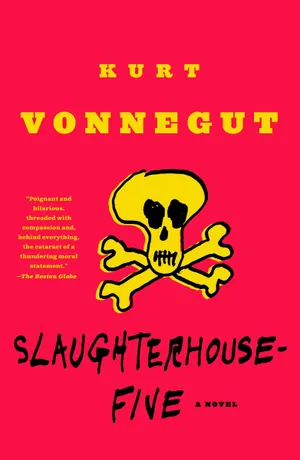
Kurt Vonnegut spent twenty-three years trying to write about the firebombing of Dresden. He was there — an American prisoner of war sheltered in an underground slaughterhouse while one of the most beautiful cities in Europe was incinerated above him. Every attempt at a conventional war novel failed. So in 1969, he wrote an unconventional one, and produced the defining anti-war novel of the twentieth century.
Billy Pilgrim is an optometrist from Ilium, New York, who has become "unstuck in time." He experiences his life — childhood, the war, his postwar career, his death — in random order, jumping between moments without warning or control. He is also, he claims, abducted by aliens from the planet Tralfamadore, who see all of time simultaneously and regard free will as a quaint Earthling delusion.
Is Billy insane? Has trauma shattered his mind into fragments? Or has he genuinely transcended linear time? Vonnegut refuses to answer, and that refusal is the point. The novel's famous refrain, "So it goes," follows every death — whether of a soldier, a champagne bottle, or the entire city of Dresden — with the same flat acceptance. It is at once the most heartbreaking and the funniest sentence in American literature.
Slaughterhouse-Five is short, strange, and shattering. It proves that the truest response to horror is not solemnity but something far more unsettling: laughter through tears.
Why This Book Earned Its Place in the Top 100
Slaughterhouse-Five belongs on this list because it solved a problem that no other war novel had managed to solve: how to convey the incomprehensibility of mass death without either glorifying it or reducing it to statistics. Vonnegut's answer was to break the form itself — to shatter narrative time the way trauma shatters the mind, and to let humor carry the weight that gravity could not hold.
The novel's influence on American literature is immense. Its blend of science fiction, autobiography, dark comedy, and sincere grief created a template that writers from Don DeLillo to George Saunders have been working with ever since. "So it goes" has entered the language as a shorthand for resigned acceptance of mortality.
But the deepest reason to read Slaughterhouse-Five is personal. This is a book about a man who cannot stop reliving the worst thing that ever happened to him. If you have ever been haunted by a memory you cannot process, Billy Pilgrim will feel less like a character and more like a mirror. Vonnegut turned his own inexpressible pain into something that speaks for millions.
Who Should Read This Book
- •Anyone interested in war literature — this is the anti-war novel against which all others are measured, and it accomplishes more in 275 pages than most manage in 800.
- •Readers who appreciate dark humor — Vonnegut's wit is razor-sharp and deeply compassionate, never cruel.
- •Fans of unconventional narrative structure — the time-jumping, alien-abduction framework is disorienting by design and deeply rewarding.
- •People who think they don't like science fiction — the Tralfamadorian elements are philosophical tools, not genre furniture, and the novel transcends every category.
- •Anyone who has experienced trauma — Billy Pilgrim's fragmented reality is one of literature's most honest portrayals of what it feels like to carry an unbearable past.
Key Themes and Takeaways
- The absurdity of war
- Vonnegut presents war not as heroic or even tragic, but as fundamentally senseless — an event that resists rational narrative.
- Free will versus determinism
- The Tralfamadorians' belief that all moments exist simultaneously raises the question of whether humans have any agency at all.
- Trauma and memory
- Billy's time-travel can be read as a precise metaphor for post-traumatic stress, where the past invades the present without warning.
- The limits of storytelling
- Vonnegut's first chapter confesses that he cannot write a proper war story, and the novel's structure embodies that impossibility.
- Death and acceptance
- 'So it goes' is both a coping mechanism and a philosophical stance — an attempt to absorb the unabsorbable.
Cultural and Historical Impact
Published in 1969 at the height of the Vietnam War, Slaughterhouse-Five became an immediate bestseller and cultural touchstone for the anti-war movement. It has sold millions of copies worldwide and has been translated into numerous languages. The novel was adapted into a 1972 film by George Roy Hill, which won the Jury Prize at Cannes. It has been one of the most frequently banned books in American schools and libraries, challenged for its language, sexual content, and anti-war stance. The phrase "So it goes" has become one of the most recognized literary refrains in the English language. In 2019, a graphic novel adaptation by Ryan North and Albert Monteys introduced the story to a new generation of readers.
Notable Quotes
“So it goes.”
“Everything was beautiful and nothing hurt.”
“And I asked myself about the present: how wide it was, how deep it was, how much was mine to keep.”
If You Loved Slaughterhouse-Five, Read These Next


Ready to read Slaughterhouse-Five?
Dell · 275 pages
Buy Slaughterhouse-Five on Amazon