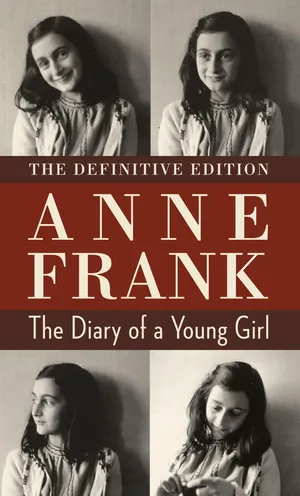
Our Review
Anne Frank's "The Diary of a Young Girl" is not a crafted literary work in the traditional sense — it is the real journal of a real thirteen-year-old girl hiding from the Nazis in a secret annex behind her father's office building in Amsterdam. And yet it is one of the most powerful and essential books of the twentieth century, not despite its ordinariness but because of it. Anne writes about her fears and her hopes, her conflicts with her mother, her crush on Peter van Pels, her ambitions to become a writer, her boredom, her frustrations, her moments of joy — the full interior life of an adolescent girl, rendered with startling honesty and literary talent.
What makes the diary devastating is the knowledge that hovers over every page: we know what Anne does not. We know that in August 1944, the annex will be raided. We know that Anne will be transported to Bergen-Belsen, where she will die of typhus at the age of fifteen. This foreknowledge transforms every entry — every petty argument, every hopeful passage, every dream of the future — into something almost unbearably poignant.
But Anne's diary is not simply a document of victimhood. It is the testament of a brilliant, complicated, fiercely alive young person who refused to be reduced to her circumstances. Her writing reveals a mind of remarkable maturity and self-awareness, and her determination to believe in human goodness despite everything makes her not just a symbol of the Holocaust but one of the most compelling voices in modern literature.
Why This Book Earned Its Place in the Top 100
Anne Frank's diary belongs on this list because it accomplishes something that no history textbook, no documentary, and no memorial can: it makes the Holocaust personal. Six million is a number too large for the human mind to comprehend. But one girl — funny, vain, ambitious, generous, petty, brilliant, ordinary — that, we can understand. And through understanding one life, we begin to grasp what was lost.
The diary also matters because it is an extraordinary work of literature in its own right. Anne was not merely recording events; she was consciously crafting a narrative, revising and editing her entries with the explicit intention of publishing them after the war. Her writing has a clarity, a wit, and a psychological insight that are remarkable for any age, let alone thirteen. She writes with a novelist's eye for character and a philosopher's instinct for big questions.
Its educational impact is unparalleled. The diary has been a primary tool for teaching young people about the Holocaust for over seven decades. It has introduced the concept of genocide to millions of readers who were children themselves, creating empathy by showing them a girl who could have been their classmate, their sister, their friend. Anne Frank wanted to be remembered; she is remembered by the entire world.
Who Should Read This Book
- •Every young reader — Anne was a teenager writing for posterity, and her voice speaks directly to young people in a way that no adult account of the Holocaust can match.
- •Anyone seeking to understand the Holocaust on a human level — statistics tell us the scale of the horror; Anne's diary makes us feel it.
- •Aspiring writers — Anne's dedication to her craft under impossible circumstances is both humbling and inspiring, and her prose is genuinely accomplished.
- •Readers interested in the psychology of confinement — the diary is a remarkable study of how human beings cope with extreme stress, isolation, and the constant threat of death.
Key Themes and Takeaways
- The persistence of hope
- Anne's continued belief in human goodness, even as the world outside is consumed by evil, is the diary's most famous and most challenging quality.
- Coming of age under impossible conditions
- The normal turbulence of adolescence — identity formation, romantic awakening, parental conflict — takes on unbearable poignancy in the context of the annex.
- The power of writing
- Anne's diary is itself a testament to literature's ability to preserve a human life against the forces that sought to destroy it.
- Confinement and the hunger for freedom
- The physical constraints of the annex become a metaphor for all the ways that fear and hatred imprison the human spirit.
- Ordinary life in extraordinary circumstances
- The diary's power lies in its insistence on recording everyday life — meals, arguments, laughter — even as catastrophe looms outside the walls.
Cultural and Historical Impact
"The Diary of a Young Girl" has been translated into more than 70 languages and has sold over 30 million copies worldwide, making it one of the most widely read books in history. The Anne Frank House in Amsterdam, where the diary was written, receives over one million visitors annually. The diary has been adapted into a Pulitzer Prize-winning play (1955) and multiple films. Anne Frank has become the most recognized victim of the Holocaust and a universal symbol of lost potential. UNESCO added the diary to its Memory of the World Register in 2009. The diary has been a cornerstone of Holocaust education in schools worldwide for over seventy years, and studies consistently show that reading it significantly increases young people's empathy and historical awareness. Despite its enormous fame, the diary continues to face periodic challenges and bans in schools, most recently over its frank discussion of sexuality and the human body.
Notable Quotes
“In spite of everything I still believe that people are really good at heart.”
“How wonderful it is that nobody need wait a single moment before starting to improve the world.”
“I can shake off everything as I write; my sorrows disappear, my courage is reborn.”
If You Loved The Diary of a Young Girl, Read These Next
Ready to read The Diary of a Young Girl?
Bantam · 283 pages
Buy The Diary of a Young Girl on Amazon