Our Review
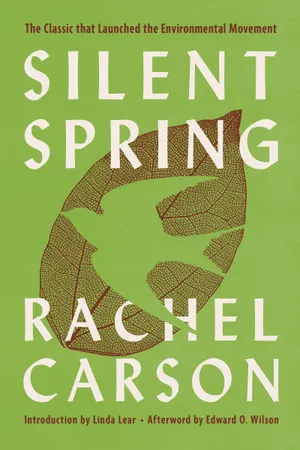
Silent Spring opens with a fable. A nameless American town, once vibrant with birdsong and wildflowers, falls eerily silent. The birds are gone. The fish are dead. The children are sick. No enemy has attacked. No natural disaster has struck. The cause is a white powder — pesticide — that humans spread deliberately. The fable is fiction. Everything else in the book is meticulously documented fact.
Published in 1962, Rachel Carson's masterwork is a devastating indictment of the chemical industry's indiscriminate use of synthetic pesticides, particularly DDT. Carson, a marine biologist and already a bestselling author of nature books, spent four years gathering evidence — from scientific journals, government reports, and firsthand accounts — showing that pesticides were poisoning not just their intended targets but entire ecosystems. They accumulated in the tissues of animals, traveled up food chains, contaminated soil and water, and were killing birds, fish, and beneficial insects on a massive scale.
What makes Silent Spring exceptional is not just its science but its writing. Carson had the rare ability to make complex ecological processes comprehensible and compelling. She understood that data alone would not change public opinion — people needed to feel the loss. Her descriptions of silent springs, of robins convulsing on suburban lawns, of children playing in clouds of DDT spray are unforgettable precisely because they are true. Carson turned ecological science into a moral argument, and that argument changed the world.
Why This Book Earned Its Place in the Top 100
Silent Spring is on this list because it is the single most important environmental book ever published. Before Carson, the word "environment" was not a political concept. There was no Environmental Protection Agency, no Clean Air Act, no Clean Water Act. DDT was sprayed freely on crops, lawns, and even directly on children at public beaches. Carson's book did not merely raise awareness — it created the intellectual and emotional foundation for the modern environmental movement.
The book also earns its place for its courage. The chemical industry launched an unprecedented campaign to discredit Carson, attacking her scientific credentials, her character, and even her gender. She was called hysterical, a Communist, and a nature fanatic. She was dying of breast cancer throughout the controversy and did not live to see the ban on DDT that her work made inevitable. But she never backed down, and the factual accuracy of her claims was ultimately confirmed by every independent investigation. Silent Spring is a model of what happens when rigorous science, beautiful writing, and moral conviction converge in a single work.
Who Should Read This Book
- •Everyone who breathes, drinks water, or eats food — Carson's subject is literally the health of the planet that sustains all human life.
- •Environmentalists and climate activists — this is the book that started the modern environmental movement, and its methods and arguments remain instructive.
- •Science writers and communicators — Carson's ability to translate complex ecology into compelling narrative is a masterclass in the genre.
- •Anyone skeptical of corporate claims about product safety — Carson's documentation of how the chemical industry suppressed evidence of harm reads as disturbingly contemporary.
Key Themes and Takeaways
- The interconnectedness of ecosystems
- Carson demonstrates that poisoning one part of an ecosystem inevitably affects every other part, including humans.
- Corporate power and public health
- The chemical industry prioritized profits over safety and actively suppressed evidence of environmental and human harm.
- The arrogance of control
- Humanity's attempt to dominate nature through chemicals reflects a fundamental misunderstanding of ecological complexity.
- Science and public responsibility
- Scientists have a duty to communicate dangers to the public, even when powerful interests oppose them.
- The precautionary principle
- Carson argues that the burden of proof should fall on those introducing chemicals, not on those harmed by them.
Cultural and Historical Impact
Silent Spring was published in September 1962, after being serialized in The New Yorker. It became an immediate bestseller, spending 31 weeks on the New York Times bestseller list. The book prompted President Kennedy to order his Science Advisory Committee to investigate pesticides; their 1963 report vindicated Carson's findings. In 1970, the Environmental Protection Agency was established. In 1972, DDT was banned for agricultural use in the United States. Carson has been credited by Al Gore, among many others, as the founder of the modern environmental movement. She was posthumously awarded the Presidential Medal of Freedom in 1980. The book has been translated into more than a dozen languages and remains in print over sixty years later. Time magazine named it one of the 100 most influential nonfiction books of the 20th century.
Notable Quotes
“In nature nothing exists alone.”
“The more clearly we can focus our attention on the wonders and realities of the universe about us, the less taste we shall have for destruction.”
“Those who contemplate the beauty of the earth find reserves of strength that will endure as long as life lasts.”
If You Loved Silent Spring, Read These Next
Ready to read Silent Spring?
Mariner Books · 400 pages
Buy Silent Spring on Amazon