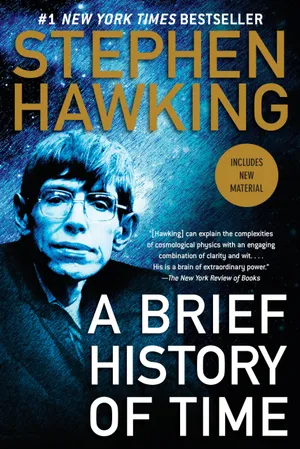
Our Review
Stephen Hawking set out to write a book about the universe for people who had never taken a physics class, and against all odds, he succeeded. A Brief History of Time covers the biggest questions human beings can ask — How did the universe begin? What is time? What are black holes? Is time travel possible? Does the universe have an edge? — and explains them with a clarity that is both remarkable and, occasionally, delightfully mischievous.
Hawking begins with the ancient debate between a finite and an infinite universe and moves through Newton's gravity, Einstein's relativity, quantum mechanics, and the search for a grand unified theory that would reconcile them all. Along the way, he explains his own groundbreaking work on black holes — specifically his discovery that black holes are not entirely black but emit radiation (now called Hawking radiation), a finding that upended theoretical physics when it was published in 1974.
The book is not easy. Hawking famously included only one equation (E=mc2, at his editor's insistence, who warned that every equation would halve the book's sales), but the conceptual challenges are real. What makes it work is Hawking's gift for analogy and his refusal to condescend. He assumes you are intelligent enough to follow the argument if he explains it well enough. And his dry British humor — the wit of a man who faced a devastating diagnosis at twenty-one and decided to be funny about the cosmos — makes even the most mind-bending passages feel like a conversation rather than a lecture.
Why This Book Earned Its Place in the Top 100
A Brief History of Time belongs on this list because it did something unprecedented: it made theoretical physics a mainstream cultural subject. Before Hawking's book, cosmology was the province of specialists. After it, millions of ordinary readers had a working understanding of the Big Bang, black holes, and the arrow of time. The book proved that the public hunger for fundamental knowledge about the universe was enormous — it just needed the right guide.
Hawking was that guide not only because of his intellectual brilliance but because of his extraordinary personal story. Diagnosed with motor neuron disease at twenty-one and given two years to live, he survived for another fifty-five years, making his most important discoveries while progressively losing the ability to move, speak, and write. The book does not dwell on this, but it is the subtext of every page: a mind that refused to be confined by its body, reaching toward the farthest edges of the universe.
The book also matters because of its honesty about what science does not yet know. Hawking does not pretend that physics has all the answers. He describes dead ends, failed theories, and unsolved mysteries with the same enthusiasm he brings to breakthroughs. His famous closing line — "then we would know the mind of God" — is not a statement of certainty but of aspiration. It is science at its most human: not a catalog of facts but a story of curiosity that will not stop.
Who Should Read This Book
- •Anyone curious about the fundamental nature of the universe who has no background in physics — this is the most celebrated popular science book ever written, and it earns that reputation.
- •Students considering a career in science — Hawking communicates the thrill of discovery and the beauty of theoretical reasoning in a way that no textbook can match.
- •Readers who want to understand the Big Bang, black holes, and time — Hawking explains these concepts more clearly than anyone before or since.
- •Philosophy enthusiasts — the book's questions about the origin and nature of the universe overlap with the deepest philosophical problems about existence and meaning.
- •Anyone who appreciates great writing about complex subjects — Hawking's prose is a model of clarity, economy, and understated wit.
Key Themes and Takeaways
- The origin and fate of the universe
- Hawking traces the evolution of our understanding of how the universe began, how it might end, and whether it had a beginning at all.
- The nature of time
- The book explores why time appears to move in one direction only and whether the laws of physics permit time travel.
- Black holes and Hawking radiation
- Hawking's own discovery that black holes emit radiation and eventually evaporate was a revolution in theoretical physics, and he explains it here for the first time to a general audience.
- The search for a unified theory
- The holy grail of physics — a single theory reconciling general relativity and quantum mechanics — is the book's driving quest and its unresolved destination.
- The limits of human knowledge
- Hawking is honest about what physics does not yet understand, presenting uncertainty not as failure but as the engine of scientific progress.
Cultural and Historical Impact
Published in 1988, A Brief History of Time spent 237 weeks on the Sunday Times bestseller list — a record — and has sold over 25 million copies worldwide in more than 40 languages. It made Stephen Hawking the most famous scientist in the world since Albert Einstein and turned theoretical physics into a mainstream cultural subject. The book inspired a 1991 Errol Morris documentary of the same name. Hawking became a global celebrity, appearing on The Simpsons, Star Trek: The Next Generation, and The Big Bang Theory. The book's influence extended far beyond science: it gave the general public a vocabulary for discussing cosmological questions and demonstrated that popular science writing could achieve the sales and cultural impact of major literary fiction. A Brief History of Time remains the bestselling popular science book ever published.
Notable Quotes
“Even if there is only one possible unified theory, it is just a set of rules and equations. What is it that breathes fire into the equations and makes a universe for them to describe?”
“We are just an advanced breed of monkeys on a minor planet of a very average star. But we can understand the Universe. That makes us something very special.”
“However difficult life may seem, there is always something you can do and succeed at. It matters that you don't just give up.”
If You Loved A Brief History of Time, Read These Next
Ready to read A Brief History of Time?
Bantam · 212 pages
Buy A Brief History of Time on Amazon