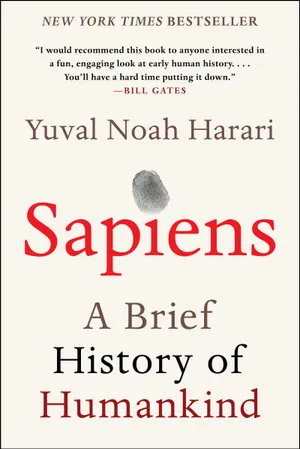
Our Review
Sapiens asks a question so large it should be unanswerable: how did an unremarkable ape on the African savanna come to dominate the entire planet? Yuval Noah Harari's answer unfolds across 70,000 years of human history, from the Cognitive Revolution that gave Homo sapiens the ability to gossip and tell stories, through the Agricultural Revolution that Harari controversially calls "history's biggest fraud," to the Scientific Revolution that launched us toward potential godhood — or extinction.
Harari's central argument is breathtaking in its simplicity: what makes humans unique is our ability to believe in shared fictions. Money, nations, human rights, corporations, religions — none of these things exist in objective reality. They exist because millions of people collectively agree to behave as if they are real. This capacity for collective fiction is what allowed a physically mediocre primate to coordinate in groups of millions and reshape the earth.
The book moves at exhilarating speed, covering the domestication of wheat, the invention of writing, the rise of empires, and the logic of capitalism in chapters that read more like a TED Talk than an academic text. Harari is provocative by design. He wants you to argue with him. He wants you to see the structures you live inside — money, law, religion — as inventions rather than inevitabilities. Whether you agree with every claim or not, you will never look at civilization the same way again.
Why This Book Earned Its Place in the Top 100
Sapiens earned its place because it is the rare nonfiction book that genuinely changes how readers think. It does not add new facts to your existing worldview — it rearranges the furniture of your mind. After reading Harari, concepts you took for granted — the nation-state, the corporation, even the idea of human rights — reveal themselves as collectively imagined fictions, no more "natural" than the myths of ancient Mesopotamia.
The book's intellectual ambition is staggering. Most historians specialize in a period, a region, a theme. Harari covers everything — biology, anthropology, economics, religion, technology — and synthesizes it into a single coherent narrative. That narrative is necessarily simplified, and specialists have challenged many of Harari's claims. But the point of Sapiens is not to be the last word on anything. It is to be the first word — the book that opens your eyes wide enough to ask better questions.
Sapiens also matters because it is accessible. Harari writes with the clarity of a great teacher, avoiding jargon without dumbing down ideas. This is a book that a curious teenager and a tenured professor can both read with pleasure and profit. That democratization of deep thinking is itself a contribution to the world.
Who Should Read This Book
- •Anyone who wants to understand the big picture of human history — Sapiens is the most readable single-volume overview available.
- •Readers who enjoy having their assumptions challenged — Harari is deliberately provocative, and his arguments about money, religion, and agriculture will make you think.
- •Business leaders and entrepreneurs — the sections on how shared fictions enable large-scale cooperation are directly applicable to understanding organizations and markets.
- •Science and history enthusiasts — Harari synthesizes biology, anthropology, and history in a way that makes connections you would not find in specialized texts.
- •Anyone who loved Guns, Germs, and Steel and wants a complementary perspective on why human civilizations developed the way they did.
Key Themes and Takeaways
- Shared fictions and collective imagination
- Harari argues that humanity's superpower is the ability to believe in things that do not physically exist — money, gods, nations — and to cooperate on the basis of those beliefs.
- The Agricultural Revolution as a trap
- Harari provocatively argues that farming made humanity's overall quality of life worse, not better, trading freedom and variety for backbreaking labor and nutritional poverty.
- The arrow of history toward unity
- Despite local differences, Harari shows that human history trends toward larger and larger units of cooperation — from bands to tribes to nations to a global order.
- The meaning of progress
- The book questions whether the massive increase in human power over nature has produced a corresponding increase in human happiness.
- The future of Homo sapiens
- Harari ends with a meditation on genetic engineering, artificial intelligence, and the possibility that we are on the verge of replacing ourselves with something we cannot yet imagine.
Cultural and Historical Impact
Published in Hebrew in 2011 and in English in 2014, Sapiens has sold over 25 million copies worldwide and been translated into more than 60 languages. It was recommended by Barack Obama, Bill Gates, and Mark Zuckerberg, propelling it to sustained bestseller status across multiple continents. The book made Harari one of the world's most prominent public intellectuals and led to two bestselling sequels: Homo Deus (2017) and 21 Lessons for the 21st Century (2018). A graphic novel adaptation was published beginning in 2020. Sapiens has become standard reading in Silicon Valley, where its framework of "shared fictions" has influenced how technology leaders think about institutions, currency, and social networks. It is one of the bestselling nonfiction books of the twenty-first century.
Notable Quotes
“You could never convince a monkey to give you a banana by promising him limitless bananas after death in monkey heaven.”
“How do you cause people to believe in an imagined order such as Christianity, democracy or capitalism? First, you never admit that the order is imagined.”
“We did not domesticate wheat. It domesticated us.”
If You Loved Sapiens: A Brief History of Humankind, Read These Next


Ready to read Sapiens: A Brief History of Humankind?
Harper Perennial · 464 pages
Buy Sapiens: A Brief History of Humankind on Amazon