Our Review
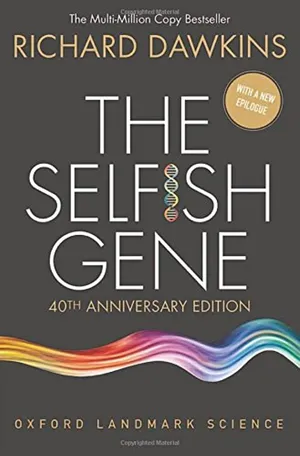
Richard Dawkins published The Selfish Gene in 1976 and permanently altered the way millions of people understand life on Earth. The central argument is deceptively simple: evolution does not operate for the good of the species, or even for the good of the individual organism. It operates for the good of the gene. We are, in Dawkins's memorable phrase, "survival machines" — robot vehicles blindly programmed to preserve the selfish molecules known as genes.
This is not a book about selfishness in any moral sense. Dawkins is careful to distinguish between the metaphorical "selfishness" of a gene — which simply means it acts in ways that promote its own replication — and the conscious selfishness of a human being. But the implications are staggering. Altruism, cooperation, parental love, even culture itself can be reframed as strategies genes use to propagate themselves.
The book also introduced the concept of the "meme" — a unit of cultural transmission that replicates and evolves much like a gene. Decades before the internet gave the word its current meaning, Dawkins had already sketched the theoretical framework. The Selfish Gene is that rare science book that doesn't just explain existing knowledge but generates entirely new ways of thinking. It is lucid, provocative, and occasionally infuriating — which is exactly what great science writing should be.
Why This Book Earned Its Place in the Top 100
The Selfish Gene earns its place because it did something almost no popular science book manages: it changed the conceptual vocabulary of an entire civilization. Before Dawkins, most people — including many biologists — thought loosely about evolution in terms of species survival or group benefit. After Dawkins, the gene-centered view of evolution became the default framework in mainstream biology.
Beyond its scientific contribution, the book demonstrated that rigorous evolutionary theory could be made genuinely accessible without being dumbed down. Dawkins writes with a clarity and rhetorical energy that makes complex ideas not just understandable but exciting. His concept of the meme alone would justify the book's place in intellectual history — it gave us a way to talk about how ideas replicate, mutate, and compete that has proven indispensable in the age of social media. Few books published in the last fifty years have so thoroughly reshaped how ordinary people understand the natural world.
Who Should Read This Book
- •Anyone curious about how evolution actually works — Dawkins strips away the misconceptions and reveals a mechanism that is simultaneously more elegant and more unsettling than most people imagine.
- •Readers who enjoyed Sapiens — if Harari gave you the big picture of human history, Dawkins gives you the deeper biological engine driving all of it.
- •Philosophy students grappling with free will and human nature — the gene-centered view raises profound questions about agency that philosophers are still wrestling with.
- •Anyone interested in cultural theory or internet culture — the concept of the meme originated here, and understanding its scientific roots transforms how you think about viral ideas.
- •Science skeptics who find biology dry — Dawkins is one of the finest prose stylists in science writing, and this book reads more like a thriller than a textbook.
Key Themes and Takeaways
- Gene-centered evolution
- The radical reframing of natural selection as a process that operates at the level of the gene, not the organism or species.
- Altruism and cooperation
- Dawkins explains how apparently selfless behavior can emerge from fundamentally selfish genetic strategies.
- The concept of the meme
- Cultural ideas replicate, mutate, and compete for survival in ways structurally analogous to genes.
- Replicators and vehicles
- Organisms are temporary vehicles; the true units of selection are the immortal replicators — genes — they carry.
- Evolutionary arms races
- Predators and prey, parasites and hosts, engage in escalating cycles of adaptation that drive biological complexity.
Cultural and Historical Impact
The Selfish Gene has sold over a million copies and been translated into more than 25 languages. It was voted the most influential science book of all time in a 2017 Royal Society poll. The word "meme," coined in its final chapter, became one of the most widely used terms of the 21st century, though its popular meaning has drifted far from Dawkins's original formulation. The book launched Dawkins into public intellectual stardom and directly inspired subsequent works like The Extended Phenotype and The Blind Watchmaker. It also provoked fierce debate — Stephen Jay Gould and other biologists accused Dawkins of genetic determinism, a charge Dawkins has spent decades rebutting. Regardless of where one falls in that debate, the book's influence on both science and popular culture is undeniable.
Notable Quotes
“We are survival machines — robot vehicles blindly programmed to preserve the selfish molecules known as genes.”
“Let us try to teach generosity and altruism, because we are born selfish.”
“We are built as gene machines and cultured as meme machines, but we have the power to turn against our creators.”
If You Loved The Selfish Gene, Read These Next


Ready to read The Selfish Gene?
Oxford University Press · 544 pages
Buy The Selfish Gene on Amazon