Our Review
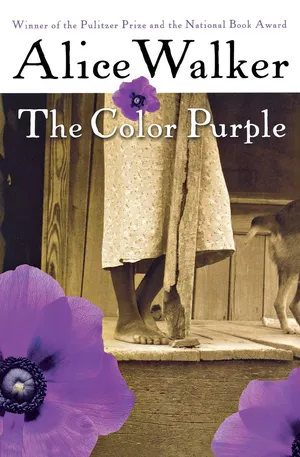
The Color Purple is told entirely through letters — first addressed to God, later to a sister — and that formal choice is the key to its power. When we meet Celie, she is fourteen, barely literate, and being raped by the man she believes is her father. She has no one to tell, so she tells God. The letters that follow chart decades of abuse, endurance, transformation, and ultimately liberation with a raw directness that no third-person narrator could achieve.
Celie is married off to a man she calls Mister, who beats her and treats her as property. Her sister Nettie, the one person who truly loves her, is driven away and their correspondence is secretly intercepted for years. The arrival of Shug Avery — a blues singer, a force of nature, and Mister's former lover — cracks open Celie's world. Shug teaches Celie to see beauty in herself, to claim pleasure, to recognize that God is not a white man in the sky but something alive in the color purple in a field.
Walker wrote this novel in a dialect that sings off the page. Celie's voice is one of the great achievements of American fiction — ungrammatical, unpolished, and unbearably eloquent. Through that voice, Walker tells a story about the systematic destruction of Black women's humanity and the stubborn, miraculous refusal to stay destroyed.
Why This Book Earned Its Place in the Top 100
The Color Purple won both the Pulitzer Prize and the National Book Award in 1983 — the first novel by a Black woman to win the Pulitzer — and it deserved both. Walker achieved something that literature rarely manages: she gave voice to the voiceless. Celie's story of abuse, silencing, and eventual liberation is both a specific indictment of the intersecting oppressions faced by Black women in rural America and a universal parable about the human capacity to survive, heal, and claim joy.
The novel was and remains controversial. It was accused of reinforcing negative stereotypes of Black men. It was challenged and banned in school libraries across the country. Walker did not soften the book in response. She had written the truth as she understood it — not the truth of all Black men, but the truth of one woman's experience — and she let the work stand.
What makes The Color Purple permanent is Celie's transformation. She goes from a girl who can barely raise her eyes to a woman who runs her own business, surrounds herself with love, and tells Mister to go to hell. That arc, told in Celie's own imperfect, luminous words, is one of the most powerful in American literature.
Who Should Read This Book
- •Anyone who values fiction that gives voice to the marginalized — Celie's letters are among the most important acts of literary testimony in the American canon.
- •Readers interested in the intersection of race, gender, and class — Walker illuminates how these forces compound to crush, and how resistance can emerge from the smallest acts of love.
- •Fans of epistolary novels — the letter format here is not a gimmick but the very engine of Celie's liberation.
- •Book club readers looking for a novel that provokes deep, difficult, necessary conversation.
- •Anyone who has ever felt invisible — Celie's journey from silence to self-expression is medicine for the soul.
Key Themes and Takeaways
- The liberation of the silenced voice
- Writing letters to God is Celie's first act of resistance, and her evolving voice is the novel's truest measure of her transformation.
- Intersecting oppressions
- Walker shows how racism, sexism, and poverty combine to trap Black women in cycles of abuse that are both systemic and intimate.
- Sexuality and self-discovery
- Celie's relationship with Shug Avery is a revelation of pleasure, selfhood, and a God who delights in creation rather than punishing it.
- Sisterhood and solidarity
- The bonds between women — Celie and Nettie, Celie and Shug, Celie and Sofia — are the forces that ultimately defeat the men who try to break them.
- Reimagining God
- Shug's theology — that God is not an old white man but a living presence in beauty, color, and pleasure — rewrites Celie's relationship with the divine.
Cultural and Historical Impact
Published in 1982, The Color Purple won the 1983 Pulitzer Prize for Fiction and the National Book Award, making Alice Walker the first Black woman to receive the Pulitzer for fiction. The novel has sold over 5 million copies. Steven Spielberg's 1985 film adaptation starred Whoopi Goldberg, Oprah Winfrey, and Danny Glover, earning 11 Academy Award nominations. A Broadway musical adaptation opened in 2005, was revived in 2015 starring Cynthia Erivo, and won the Tony Award for Best Revival of a Musical. A film adaptation of the musical was released in 2023. The novel remains one of the most frequently challenged books in American libraries. It is widely taught in high school and university curricula and is considered one of the essential texts of twentieth-century American and African American literature.
Notable Quotes
“I think it pisses God off if you walk by the color purple in a field somewhere and don't notice it.”
“I'm pore, I'm black, I may be ugly and can't cook, a voice say to everything listening. But I'm here.”
“Don't wait for a throne to start ruling. The universe is already yours.”
If You Loved The Color Purple, Read These Next
Ready to read The Color Purple?
Mariner Books · 300 pages
Buy The Color Purple on Amazon