Our Review
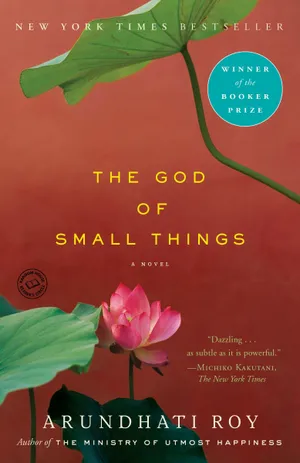
Arundhati Roy published The God of Small Things in 1997 and then did not write another novel for twenty years. That single book was enough. It won the Booker Prize, sold over six million copies, and announced a voice so distinctive that every sentence could only belong to her.
The novel is set in Ayemenem, a small town in Kerala, in southern India. It follows the twin siblings Rahel and Estha across two timelines: 1969, when they are seven years old and their world is about to be shattered, and 1993, when they reunite as damaged adults. At the center of the catastrophe is the forbidden love affair between their mother, Ammu, and Velutha, an Untouchable carpenter who is the most gifted and gentle man in the story. The "Love Laws" — Roy's term for the rules that dictate "who should be loved, and how. And how much" — will destroy them both.
Roy's prose is not quite like anything else in English. She writes with a child's eye and a poet's ear, fracturing words, inverting syntax, and building rhythms that feel more like incantation than narration. Time loops and coils. Phrases recur like musical motifs. The effect is hypnotic and, at times, unbearably sad.
This is a novel about the enormous consequences of small transgressions — about how the intersections of caste, class, gender, and colonial history can crush the people who dare to love outside the boundaries they were assigned.
Why This Book Earned Its Place in the Top 100
The God of Small Things earns its place because it achieves something that very few novels manage: it makes you feel the weight of an entire social system pressing down on individual lives. Roy does not write about caste discrimination in the abstract. She writes about Velutha's hands, about Ammu's rage, about the specific texture of a forbidden touch — and through those details, the enormity of the injustice becomes not just comprehensible but physically felt.
The novel also earns its place through the sheer originality of its language. Roy invented a way of writing English that carries the rhythms of Malayalam, the logic of a child's perception, and the emotional precision of poetry. No one wrote like this before her, and the many who have tried to imitate her have only confirmed how singular her achievement is.
Finally, the novel matters because it refuses to separate the personal from the political. The "Love Laws" are not just about Ammu and Velutha. They are about every society's insistence on controlling who may love whom, and the violence that follows when those boundaries are crossed. In this sense, The God of Small Things is not only an Indian novel. It is a human one.
Who Should Read This Book
- •Lovers of extraordinary prose — Roy's language alone justifies the read, and there are sentences in this book that will stop you mid-breath.
- •Anyone interested in caste and social hierarchy — this novel makes the invisible architecture of caste viscerally real in a way that no nonfiction account quite matches.
- •Readers who appreciated Beloved by Toni Morrison — both novels explore how historical injustice haunts individual bodies and families across generations.
- •Anyone who believes that love should be enough — this novel will break your heart and sharpen your understanding of why, for many people, it has never been allowed to be.
Key Themes and Takeaways
- The Love Laws
- Society's rules about who may love whom — across caste, class, and gender — are the novel's central preoccupation and its engine of tragedy.
- Caste and Untouchability
- Velutha's fate is determined not by his character but by an accident of birth, and Roy makes the reader feel the full weight of that injustice.
- Childhood and trauma
- The twins' perspective gives the novel its distinctive voice and its devastating power — they see everything and understand almost nothing.
- History and colonialism
- Kerala's communist politics, its Syrian Christian community, and its colonial legacy are woven into every relationship and every act of violence.
- The small versus the large
- Roy argues that it is the small things — a gesture, a touch, a whispered word — that contain the largest truths and carry the heaviest consequences.
Cultural and Historical Impact
Published in 1997, The God of Small Things won the Booker Prize that year, making Roy the first Indian woman and the first non-expatriate Indian to receive the award. The novel has sold over six million copies worldwide and been translated into more than 40 languages. It was a publishing sensation, receiving one of the largest advances ever paid for a debut novel at the time. The book reignited international interest in Indian fiction and opened doors for a new generation of Indian writers in the global market. Roy subsequently became one of the world's most prominent political essayists and activists, though she did not publish a second novel — The Ministry of Utmost Happiness — until 2017.
Notable Quotes
“That's what careless words do. They make people love you a little less.”
“She wore flowers in her hair and carried magic secrets in her eyes.”
“Perhaps it's true that things can change in a day. That a few dozen hours can affect the outcome of whole lifetimes.”
If You Loved The God of Small Things, Read These Next




Ready to read The God of Small Things?
Random House Trade Paperbacks · 340 pages
Buy The God of Small Things on Amazon