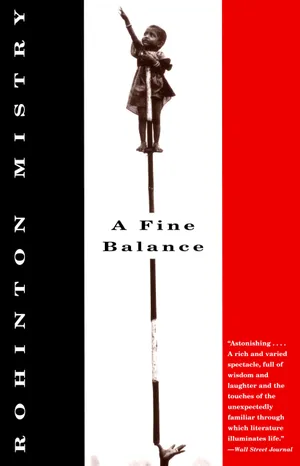
Our Review
Rohinton Mistry's A Fine Balance is the kind of novel that makes you grateful for your life while simultaneously demolishing your capacity to take anything for granted. Set in India during the Emergency declared by Indira Gandhi in 1975, it follows four characters whose lives converge in a small apartment in an unnamed city: Dina Dalal, a proud, widowed Parsi woman trying to maintain her independence; Ishvar and Omprakash Darji, an uncle and nephew from the Chamaar (Untouchable) caste who have fought their way into the tailoring trade; and Maneck Kohlah, a young student from a hill town whose family has been broken by modernization.
These four form an unlikely household. Dina hires the tailors for piecework. Maneck rents her spare room. Slowly, cautiously, they build something resembling a family — sharing meals, arguments, and the tentative trust of people who have learned to expect betrayal.
Then the Emergency tightens its grip. Slum demolitions, forced sterilizations, arbitrary arrests, and the casual brutality of petty officials descend upon the characters with the slow, grinding inevitability of a catastrophe that everyone can see coming and no one can prevent.
Mistry writes with a Dickensian amplitude and a Tolstoyan compassion. His characters are so fully alive that their suffering is almost unbearable. The novel's title refers to the delicate equilibrium between hope and despair, and Mistry maintains that balance with extraordinary skill — right until the moment he doesn't. The ending of A Fine Balance is among the most devastating in modern fiction.
Why This Book Earned Its Place in the Top 100
A Fine Balance earns its place because it is the most comprehensive fictional account of what the Emergency did to ordinary Indian lives. Mistry does not deal in abstractions or political theory. He writes about specific bodies, specific hands, specific stomachs — and through that specificity, he makes a national catastrophe personally unbearable for the reader.
The novel also earns its place through the sheer richness of its character work. Ishvar and Om are among the most fully realized characters in contemporary fiction. Their backstory — spanning generations of caste violence, resistance, and tentative progress — is a novel within the novel, and it is magnificent. Dina's fierce independence, Maneck's gentle bewilderment, and the beggar Shankar's improbable dignity round out a cast that makes you ache for a world in which good people could simply be allowed to live.
This is not an easy book. It will make you angry, it will make you cry, and its ending will haunt you. But it is essential because it insists that the lives of the powerless — the people history grinds up and forgets — deserve to be told with the same care and grandeur that literature usually reserves for kings and generals.
Who Should Read This Book
- •Readers who want to understand modern India beyond the tech-boom narrative — this novel reveals the human cost of political authoritarianism with devastating clarity.
- •Fans of Dickens and Tolstoy — Mistry belongs in their company, and this is his masterpiece.
- •Anyone who appreciated The Kite Runner — A Fine Balance operates at the same intersection of personal story and national tragedy, but with an even wider scope.
- •Readers with strong emotional stamina — this book will test you, but the experience of reading it is unforgettable and profoundly humanizing.
- •Book clubs — the novel raises essential questions about caste, dignity, resilience, and the responsibility of the state to its citizens.
Key Themes and Takeaways
- Caste and systemic oppression
- Ishvar and Om's story traces generations of caste violence, showing how deeply embedded inequality shapes every aspect of life.
- Political authoritarianism
- The Emergency is portrayed not through grand political drama but through its effects on bodies — slum demolitions, sterilizations, arbitrary detention.
- The fragility of dignity
- Every character fights to maintain a sense of self-worth, and the novel shows how easily the state can strip that away.
- Found family
- The four main characters build something beautiful from loneliness and necessity, and its destruction is the novel's deepest wound.
- Hope and resilience
- Even at its most devastating, the novel insists that human beings will find reasons to laugh, to share, and to persist.
Cultural and Historical Impact
Published in 1995, A Fine Balance was shortlisted for the Booker Prize and won the Giller Prize, Canada's most prestigious literary award. It was selected for Oprah's Book Club in 2001, which brought it to millions of new readers and made it a bestseller in North America. The novel has been translated into numerous languages and is widely regarded as one of the greatest novels about India. Mistry's unflinching portrayal of the Emergency has been cited by historians as one of the most accessible accounts of the period. The novel is frequently compared to the works of Dickens for its social scope and emotional power, and it remains Mistry's most celebrated achievement.
Notable Quotes
“You have to maintain a fine balance between hope and despair. In the end, it's all a question of balance.”
“The secret of survival is to embrace change, and to adapt.”
“Where humans were concerned, the only emotion that made sense was wonder, at their ability to endure.”
If You Loved A Fine Balance, Read These Next

Ready to read A Fine Balance?
Vintage · 603 pages
Buy A Fine Balance on Amazon