Our Review
The Little Prince is one of those rare books that operates on entirely different levels depending on when you read it. A child encounters a charming story about a tiny prince who travels from asteroid to asteroid meeting strange grown-ups. An adult encounters a devastating meditation on loss, love, loneliness, and the way maturity slowly blinds us to what matters.
A pilot crashes in the Sahara Desert and meets a small boy who claims to come from a tiny asteroid where he tends a single, vain rose and cleans out the baobab seedlings before they can overtake his world. The prince has left his rose after a quarrel and visited six other asteroids, each inhabited by an adult consumed by a single obsession — a king who rules nothing, a vain man who craves applause from no one, a drunkard who drinks to forget that he drinks. On Earth, the prince befriends a fox who teaches him the book's most famous lesson: that to tame something is to establish ties, and that what makes his rose special is the time he has invested in her.
Saint-Exupery wrote this during his exile in New York, homesick and heartsick, and the ache of it saturates every watercolor illustration and every deceptively simple sentence. He disappeared over the Mediterranean a year after publication. The book reads like a man saying goodbye to everything he loves.
Why This Book Earned Its Place in the Top 100
The Little Prince is the most translated non-religious book in human history, and that alone would earn it a place on any list. But numbers do not explain why people weep over a story about a boy and a flower. The reason is that Saint-Exupery achieved something nearly impossible: he wrote a book that is genuinely simple and genuinely profound at the same time.
The lessons of The Little Prince — that what is essential is invisible to the eye, that you become responsible for what you tame, that grown-ups have forgotten how to see — are not platitudes. They are hard-won truths delivered with the precision of a poet who happened to also be a combat pilot. Saint-Exupery knew loneliness, knew danger, knew the specific ache of loving something fragile in a brutal world. His fable is not naive. It is wise.
Very few books cross every boundary of age, culture, and language. The Little Prince has been read by children in over 300 languages and by adults in every country on earth. It endures because it tells the truth about what we lose when we grow up and what we must fight to remember.
Who Should Read This Book
- •Every adult who read it as a child — you will discover an entirely different book the second time through, and it will break your heart in new places.
- •Parents who want to share something meaningful with their children — this is one of the few books that genuinely speaks to both.
- •Anyone feeling lost in the machinery of adult life — the prince's questions about what matters are exactly the right medicine.
- •Readers who love philosophical fables — this sits alongside Siddhartha and The Alchemist as a story that uses simplicity to reach depth.
Key Themes and Takeaways
- The invisible essential
- The fox's teaching that what is essential is invisible to the eye is the book's moral center and its most enduring gift.
- The corruption of adulthood
- Each asteroid's inhabitant represents a different way that grown-ups lose sight of what matters — vanity, greed, power, routine.
- Love, responsibility, and taming
- To love something is to become responsible for it, and that responsibility is what gives the relationship its value.
- Loneliness and connection
- The prince's journey is driven by loneliness, and his encounters reveal that connection requires vulnerability, not proximity.
- Loss and farewell
- The ending is saturated with the knowledge that love and loss are inseparable — a theme Saint-Exupery knew in his bones.
Cultural and Historical Impact
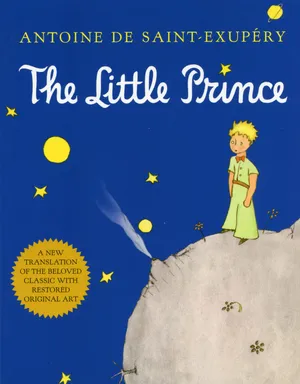
Published in 1943 in New York (Saint-Exupery's French publisher was occupied by the Nazis), The Little Prince has sold over 200 million copies worldwide and been translated into more than 300 languages and dialects — making it the most translated book ever published outside of religious texts. It has been adapted into a musical, an opera, a ballet, a 1974 film starring Gene Wilder and Bob Fosse, and a critically acclaimed 2015 animated feature. The phrase "What is essential is invisible to the eye" has entered common parlance worldwide. Saint-Exupery's watercolor illustrations have become iconic; the little prince standing on his asteroid is one of the most recognized images in world literature. A French 50-franc note featured his portrait alongside the prince.
Notable Quotes
“And now here is my secret, a very simple secret: It is only with the heart that one can see rightly; what is essential is invisible to the eye.”
“You become responsible, forever, for what you have tamed.”
“All grown-ups were once children... but only few of them remember it.”
If You Loved The Little Prince, Read These Next

Ready to read The Little Prince?
Mariner Books · 96 pages
Buy The Little Prince on Amazon