Our Review
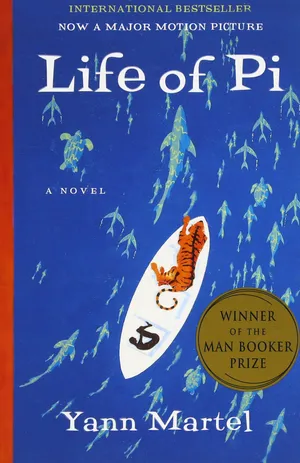
Life of Pi begins as a gentle, digressive novel about a boy growing up in Pondicherry, India, whose father runs a zoo, and who simultaneously practices Hinduism, Christianity, and Islam — not out of confusion, but out of an excess of love for God. Then the ship carrying his family and their zoo animals to Canada sinks in the Pacific, and the novel becomes something else entirely.
Pi Patel finds himself on a lifeboat with a wounded zebra, an orangutan, a hyena, and a 450-pound Bengal tiger named Richard Parker. The hyena kills the zebra and the orangutan. Pi expects the tiger to kill him next. Instead, an extraordinary coexistence begins — 227 days adrift on the Pacific Ocean, during which Pi must keep both himself and the tiger alive using nothing but ingenuity, faith, and an old survival manual.
Martel writes the ocean passages with hallucinatory beauty. Bioluminescent fish, endless calms, terrifying storms, a carnivorous island — the journey moves between the realistic and the fantastical without ever announcing which register it is operating in. This ambiguity is not incidental; it is the novel's central strategy.
Because at the end, Pi tells a second version of the story. This one has no animals. This one is unimaginably horrible. And he asks: "Which is the better story?" The question is not rhetorical. It is the novel's thesis about faith, narrative, and the stories we choose to believe in order to survive.
Why This Book Earned Its Place in the Top 100
Life of Pi earns its place because it is simultaneously a thrilling survival adventure and a profound philosophical inquiry into the nature of belief — and it manages this dual identity without either side undermining the other. The novel asks the most dangerous question a story can ask: Does it matter if a story is true, if it is meaningful?
Martel's answer — delivered through Pi's devastating final question — reframes the entire reading experience. Suddenly, you are not just evaluating a plot. You are confronting your own relationship to narrative, to faith, to the stories you have chosen to organize your life around. The novel becomes a mirror, and what it reflects is different for every reader.
The survival narrative alone would be enough to justify the book's place on this list. The 227 days at sea are rendered with such visceral precision that you feel the thirst, the sunburn, the terror of sharing a confined space with a predator. But it is the philosophical architecture beneath the adventure that elevates Life of Pi from a very good survival story to a genuinely important novel.
Few books work on this many levels simultaneously, and fewer still manage to be this entertaining while doing so.
Who Should Read This Book
- •Anyone interested in the intersection of faith and reason — Pi's simultaneous embrace of multiple religions is one of the most original treatments of belief in modern fiction.
- •Adventure readers — the survival narrative is genuinely gripping, meticulously researched, and as tense as any thriller.
- •Philosophical readers — the novel's final twist reframes everything that came before and will haunt your thinking about truth and storytelling.
- •Animal lovers — the relationship between Pi and Richard Parker is one of the strangest and most moving human-animal bonds in literature.
- •Book clubs — the ending generates fierce debate, and the conversation about which story is 'better' can last for hours.
Key Themes and Takeaways
- Faith and doubt
- Pi's multi-faith practice and his survival at sea both test the boundaries between belief and evidence, trust and delusion.
- Storytelling and truth
- The novel's dual endings ask whether a beautiful fiction is preferable to an unbearable truth — and whether the answer reveals something about faith itself.
- Survival and will
- Pi's physical and psychological endurance at sea is a testament to human adaptability and the will to live.
- The human-animal boundary
- Richard Parker forces Pi to confront the animal within himself, blurring the line between civilization and instinct.
- The nature of God
- Pi's refusal to choose a single religion suggests that the divine is too vast for any one tradition to contain.
Cultural and Historical Impact
Published in 2001, Life of Pi won the Man Booker Prize in 2002 and became a global bestseller, selling over 10 million copies in more than 40 languages. The 2012 film adaptation by Ang Lee won four Academy Awards, including Best Director, and grossed over $600 million worldwide, becoming one of the most successful literary adaptations in cinema history. The novel revitalized interest in philosophical fiction and demonstrated that a book could be simultaneously a page-turning adventure and a serious meditation on faith. It has become a staple of high school and university curricula worldwide and is frequently cited in discussions about the relationship between narrative and belief.
Notable Quotes
“The reason death sticks so closely to life isn't biological necessity — it's envy. Life is so beautiful that death has fallen in love with it.”
“If we, citizens, do not support our artists, then we sacrifice our imagination on the altar of crude reality and we end up believing in nothing and having worthless dreams.”
“I suppose in the end, the whole of life becomes an act of letting go, but what always hurts the most is not taking a moment to say goodbye.”
If You Loved Life of Pi, Read These Next
Ready to read Life of Pi?
Mariner Books · 326 pages
Buy Life of Pi on Amazon