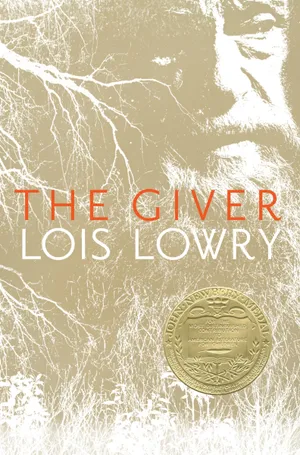
Our Review
Jonas lives in a world that has eliminated pain, conflict, inequality, and choice. Everything is controlled: the weather, emotions, careers, family units, even the language people use. At the Ceremony of Twelve, when children are assigned their lifelong roles, Jonas receives the most honored and most secret assignment in the community: he is to become the new Receiver of Memory, trained by an old man who holds the only remaining memories of what the world was like before Sameness.
Through the Giver's transmissions, Jonas experiences snow for the first time. Sunshine. Color. Music. Love. He also experiences war, starvation, and suffering — the things his community erased along with everything else. And as he absorbs the full spectrum of human experience, Jonas begins to understand what his society has traded away in exchange for its painless, colorless safety.
Lois Lowry wrote The Giver with the elegant simplicity of a fable, and that simplicity is deceptive. The prose is clean and spare — appropriate for a world that has pruned away excess — but the ideas it carries are enormous. What is the relationship between pain and joy? Can you have love without loss? Is safety worth the price of freedom? These are questions philosophers have debated for millennia, and Lowry delivers them to young readers with the force of a first encounter.
The ending — deliberately ambiguous, open to interpretation — is one of the most discussed in children's literature. Lowry trusts her readers to decide for themselves what it means.
Why This Book Earned Its Place in the Top 100
The Giver earns its place as the novel that taught an entire generation to think critically about utopia. Published in 1993, it arrived before the YA dystopian boom and helped create it — without The Giver, there is likely no Hunger Games, no Divergent, no Maze Runner. But unlike many of its successors, The Giver achieves its power through restraint rather than spectacle. There are no gladiatorial arenas or factional wars. The horror is quiet: a community that has chosen comfort over humanity and doesn't know what it's lost.
The novel's genius is in making the reader undergo Jonas's awakening alongside him. When he first sees color, you see it too. When he first feels love, the absence of it in his previous life becomes retroactively devastating. Lowry doesn't lecture about freedom or individuality — she makes you feel their absence, and that experiential approach is far more powerful than any argument.
The Giver is also remarkable for the respect it shows young readers. The ambiguous ending, the complex ethical questions, the refusal to provide easy answers — Lowry treated her audience as thinkers, and millions of readers rose to the occasion. It remains one of the most banned and most beloved books in American schools, which tells you everything about its power.
Who Should Read This Book
- •Young readers ready for their first encounter with big ideas — The Giver is the perfect introduction to questions about freedom, conformity, and what makes a life worth living.
- •Adults who read it as children and haven't revisited it — the novel gains new layers when re-read with adult experience, particularly the parenting and end-of-life themes.
- •Fans of dystopian fiction who want to understand the genre's roots — this is the seed from which the modern YA dystopian tradition grew.
- •Teachers and parents looking for a book that generates real discussion — the ethical questions here are genuinely open-ended and endlessly debatable.
- •Anyone who has ever traded authenticity for comfort — Jonas's awakening will resonate with uncomfortable recognition.
Key Themes and Takeaways
- Freedom versus security
- The community chose to eliminate pain, but eliminated meaning along with it, and the novel asks whether that trade is ever justified.
- The importance of memory
- Without memory of both suffering and joy, the community has no wisdom, no art, and no genuine emotional life.
- Conformity and individuality
- Sameness is not just policy but identity — the erasure of difference is the erasure of self.
- The cost of painlessness
- By eliminating suffering, the community has also eliminated love, beauty, color, and everything that makes life worth enduring.
- Coming of age and moral awakening
- Jonas's training is a compressed version of growing up — the moment when a child realizes the adult world is not what it claimed to be.
Cultural and Historical Impact
Published in 1993, The Giver won the Newbery Medal and has sold over 12 million copies worldwide. It is one of the most frequently taught novels in American middle schools and, paradoxically, one of the most frequently banned — challenged for its depictions of euthanasia, infanticide, and sexuality. A 2014 film adaptation starred Brenton Thwaites, Jeff Bridges, and Meryl Streep. Lowry wrote three companion novels — Gathering Blue, Messenger, and Son — expanding the world. The novel is widely credited as the foundational text of modern YA dystopian fiction, directly influencing Suzanne Collins, Veronica Roth, and James Dashner, among others. Its influence extends beyond literature into education, where it remains a staple for teaching critical thinking about society, ethics, and the role of government.
Notable Quotes
“The worst part of holding the memories is not the pain. It's the loneliness of it. Memories need to be shared.”
“We gained control of many things. But we had to let go of others.”
“If you were to be lost in the river, Jonas, your memories would not be lost with you. Memories are forever.”
If You Loved The Giver, Read These Next
Ready to read The Giver?
HMH Books for Young Readers · 240 pages
Buy The Giver on Amazon