Our Review
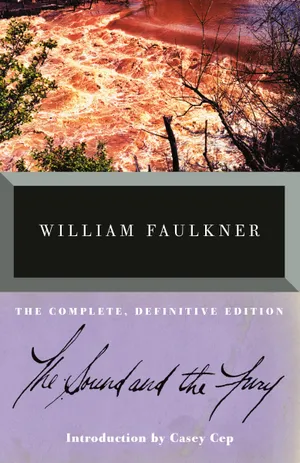
William Faulkner's The Sound and the Fury is widely considered the Mount Everest of American fiction — magnificent, punishing, and worth every step. Published in 1929, it tells the story of the Compson family's disintegration in the fictional Yoknapatawpha County, Mississippi. But "tells" is a misleading verb. This novel doesn't tell; it immerses, confuses, and finally illuminates.
The book is divided into four sections, each narrated from a different perspective. The first — and most notoriously difficult — belongs to Benjy Compson, a man with a severe intellectual disability whose mind moves between past and present without warning or punctuation to guide you. The second section follows his brother Quentin, a Harvard student drowning in obsessive thought on the day he will take his own life. The third belongs to the venomous, petty Jason. The fourth pulls back to a third-person view centered on Dilsey, the family's Black servant, who is the novel's moral anchor.
Faulkner once said he wrote the novel four times because he could never get it right. That restless ambition shows. The Sound and the Fury is not easy, but it rewards patience with moments of devastating beauty. The Compson family's collapse mirrors the decline of the old South itself, and Faulkner renders both with unflinching honesty and extraordinary technical daring.
Why This Book Earned Its Place in the Top 100
The Sound and the Fury earns its place because it permanently expanded what the novel could do. Before Faulkner, stream of consciousness was a European experiment. After The Sound and the Fury, it became a central tool of American literature. The novel proved that difficulty and beauty are not opposites — that a book could demand everything from its reader and give back more than it took.
Faulkner's influence on subsequent writers is almost immeasurable. Toni Morrison, Cormac McCarthy, Gabriel García Márquez, and dozens of others have cited this novel specifically as a turning point in their understanding of what fiction could achieve. The Benjy section alone — narrated by a mind that experiences time as a flat circle — anticipates techniques that writers would spend the next century trying to replicate.
But influence aside, the novel endures because the Compsons feel real in a way that literary families rarely do. Their failures are not abstract or symbolic. They are painfully, recognizably human — born from pride, grief, cruelty, and the terrible gravity of the past.
Who Should Read This Book
- •Serious readers ready for a challenge — if you've been meaning to tackle Faulkner, this is the place to start, and the difficulty is genuinely part of the reward.
- •Fans of Toni Morrison or Cormac McCarthy — both writers descend directly from Faulkner's innovations, and reading the source will deepen your appreciation of their work.
- •Anyone interested in the American South — Faulkner's Yoknapatawpha County is the most fully realized fictional landscape in American literature.
- •Students of modernist literature — this novel stands alongside Ulysses and Mrs Dalloway as a landmark of the movement.
- •Readers who want to understand how racism and class corrode families across generations — the Compsons are a case study written with surgical precision.
Key Themes and Takeaways
- Time and memory
- Each narrator experiences time differently, and the novel's fractured chronology enacts the way the past refuses to stay past.
- The decline of the Southern aristocracy
- The Compson family's ruin mirrors the collapse of the antebellum social order and the myths it told about itself.
- Race and servitude
- Dilsey's section provides the novel's moral center, and her dignity stands in sharp contrast to the Compsons' self-destruction.
- Obsession and honor
- Quentin's fixation on his sister Caddy's virginity reveals how Southern codes of honor become instruments of psychological annihilation.
- Loss of innocence
- Benjy's pure, timeless perspective shows a world that has lost something it can never name or recover.
Cultural and Historical Impact
Published in 1929, The Sound and the Fury was not a commercial success initially but became the cornerstone of Faulkner's reputation. It directly contributed to his 1949 Nobel Prize in Literature. The novel has been translated into dozens of languages and is a staple of university literature curricula worldwide. It was adapted into films in 1959 (starring Yul Brynner) and 2014 (starring James Franco). Faulkner's creation of Yoknapatawpha County — which spans this and fourteen other novels — is considered one of the most ambitious achievements in literary world-building. The Modern Library ranked The Sound and the Fury sixth on its list of the 100 best English-language novels of the twentieth century.
Notable Quotes
“I give you the mausoleum of all hope and desire... I give it to you not that you may remember time, but that you might forget it now and then for a moment and not spend all of your breath trying to conquer it.”
“Clocks slay time... time is dead as long as it is being clicked off by little wheels; only when the clock stops does time come to life.”
“Because no battle is ever won he said. They are not even fought. The field only reveals to man his own folly and despair, and victory is an illusion of philosophers and fools.”
If You Loved The Sound and the Fury, Read These Next
Ready to read The Sound and the Fury?
Vintage · 326 pages
Buy The Sound and the Fury on Amazon