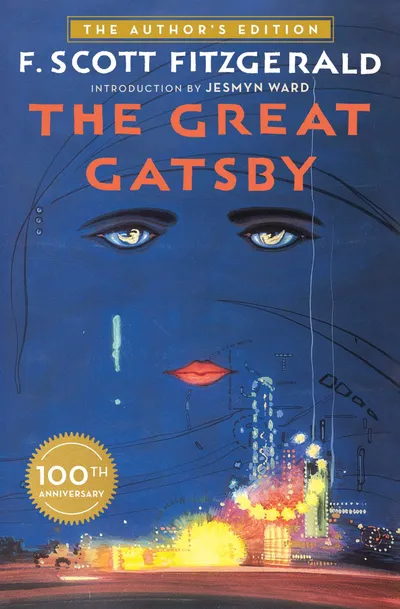
Our Review
F. Scott Fitzgerald's "The Great Gatsby" is a deceptively slim novel that contains within its pages one of the most devastating critiques of the American Dream ever written. Narrated by Nick Carraway, a young bond salesman newly arrived in New York, the story revolves around his mysterious neighbor Jay Gatsby — a self-made millionaire who throws lavish parties at his West Egg mansion, all in a desperate bid to recapture the love of Daisy Buchanan, a beautiful socialite married to the brutish old-money Tom.
On the surface, this is a story about love and obsession. But Fitzgerald is after something much larger: the hollow core of American aspiration itself. Gatsby's reinvention of himself from poor James Gatz into the glittering Jay Gatsby is the American Dream in action — and Fitzgerald shows us, with surgical precision, how that dream devours the dreamer. The parties are magnificent and empty. The wealth is vast and meaningless. The love at the center of it all is less a real relationship than a projection of longing onto an impossible ideal.
What elevates the novel beyond social criticism is Fitzgerald's prose, which is simply some of the most beautiful in the English language. Every sentence shimmers with a lyrical intensity that mirrors Gatsby's own romantic yearning, making the reader feel the seductive pull of the dream even as the novel reveals its fatal hollowness.
Why This Book Earned Its Place in the Top 100
"The Great Gatsby" belongs on any essential reading list because it captures something fundamental about American identity — the belief that we can reinvent ourselves, that the future will be better than the past, that enough money and enough wanting can overcome any obstacle — and then shows us, with heartbreaking clarity, why that belief is both beautiful and destructive.
Fitzgerald accomplished something extraordinary: he wrote a novel about the 1920s that somehow becomes more relevant with each passing decade. In an era of widening inequality, social media performance, and the relentless commodification of aspiration, Gatsby's green light — that symbol of unreachable longing — burns brighter than ever. The novel diagnoses a specifically American pathology: the confusion of wealth with virtue, of acquisition with achievement, of wanting with deserving.
Beyond its thematic richness, the novel is a technical marvel. At barely 50,000 words, it is a model of literary compression — every scene, every symbol, every line of dialogue earns its place. Nick Carraway's narration is a masterpiece of unreliable perspective, and the novel's structure — building toward that inevitable, devastating conclusion — is as tight as a Greek tragedy. It is quite simply one of the most perfect novels ever written.
Who Should Read This Book
- •Anyone fascinated by the American Dream and its contradictions — Fitzgerald wrote the definitive fictional autopsy of American aspiration.
- •Lovers of exquisite prose — Fitzgerald's writing is among the most lyrical and quotable in the English language, rewarding slow, savoring reading.
- •Readers interested in the Roaring Twenties — the novel is both a vivid portrait of Jazz Age excess and a prophetic warning of the crash to come.
- •Students and scholars of American literature — this is arguably the Great American Novel, and its layered symbolism rewards endless analysis.
- •People who enjoy short, powerful novels — at under 200 pages, Gatsby proves that literary greatness has nothing to do with length.
Key Themes and Takeaways
- The corruption of the American Dream
- Gatsby's rise and fall embodies the way American idealism curdles into materialism, turning a noble aspiration into an engine of self-destruction.
- Class and old money versus new money
- The geography of East Egg and West Egg maps a class divide that no amount of wealth can bridge, exposing the lie of American meritocracy.
- The impossibility of recapturing the past
- Gatsby's entire project — to repeat his romance with Daisy — is doomed because time only moves in one direction, no matter how desperately we wish otherwise.
- Illusion versus reality
- Nearly everything in the novel is performative — the parties, the relationships, even Gatsby's identity — raising questions about what, if anything, is authentic.
- Moral decay beneath surface glamour
- Fitzgerald shows a world of dazzling surfaces concealing rotten interiors, from Tom's casual cruelty to Daisy's carelessness to the valley of ashes between the Eggs.
Cultural and Historical Impact
"The Great Gatsby" was only a modest success when published in 1925, and Fitzgerald died in 1940 believing himself a failure. The novel's resurrection began when 150,000 copies were distributed to American soldiers during World War II, and by the 1950s it had entered the canon. Today it sells over 500,000 copies annually and is one of the most widely assigned novels in American high schools and universities. It has been adapted into five feature films, including Baz Luhrmann's 2013 version starring Leonardo DiCaprio, which grossed over $350 million worldwide. The green light at the end of Daisy's dock has become one of literature's most iconic symbols. When the novel entered the public domain in 2021, it spawned a wave of retellings and adaptations, confirming its status as perhaps the defining American novel of the twentieth century.
Notable Quotes
“So we beat on, boats against the current, borne back ceaselessly into the past.”
“I hope she'll be a fool — that's the best thing a girl can be in this world, a beautiful little fool.”
“Gatsby believed in the green light, the orgastic future that year by year recedes before us.”
If You Loved The Great Gatsby, Read These Next
Ready to read The Great Gatsby?
Scribner · 180 pages
Buy The Great Gatsby on Amazon