Our Review
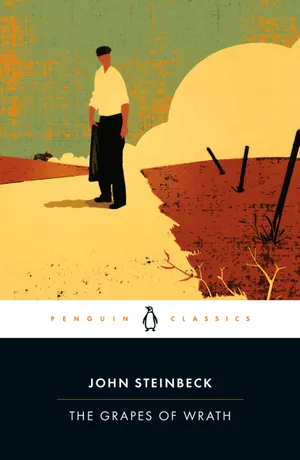
John Steinbeck's "The Grapes of Wrath" is an American epic in the truest sense — a novel that takes the suffering of a single family and transforms it into a story about the soul of a nation. The Joads are tenant farmers in Oklahoma, driven from their land by the Dust Bowl and the mechanization of agriculture, who load their belongings onto a decrepit truck and head west to California, lured by handbills promising work and a new beginning. What they find instead is exploitation, starvation, and the brutal indifference of an economic system that treats human beings as disposable labor.
Steinbeck alternates the Joad family's story with broader, more lyrical chapters that document the collective experience of the Dust Bowl migration — the highways choked with jalopies, the Hoovervilles, the desperate mathematics of supply and demand when a million hungry workers compete for a handful of jobs. These intercalary chapters give the novel its sweep and its anger, transforming a family saga into something closer to a national reckoning.
The novel's greatest creation is Ma Joad, the family's unbreakable center of gravity, who holds her people together through sheer force of will even as everything falls apart. But every Joad is vividly drawn — from Tom, the ex-convict finding his political conscience, to Rose of Sharon, whose final act of grace is one of the most startling and beautiful endings in American fiction. Steinbeck writes with a directness and compassion that makes the Joads' suffering not just visible but felt in the reader's own body.
Why This Book Earned Its Place in the Top 100
"The Grapes of Wrath" earns its place on this list because it is the great American novel of economic injustice — a book that took the suffering of the powerless and forced a nation to see it. Published in 1939, at the tail end of the Great Depression, it had an immediate and measurable impact on public policy: its vivid depictions of migrant labor conditions helped generate support for New Deal reforms and led to congressional investigations of California labor camps.
But the novel transcends its historical moment. Whenever workers are exploited, whenever the powerful use economic systems to crush the vulnerable, whenever refugees are dehumanized and turned away — the Joads' story repeats. Steinbeck's anger at injustice is not partisan; it is moral and, at its deepest level, spiritual. The novel argues that human beings are connected to each other in ways that economic thinking cannot measure, and that a system that allows some to starve while others profit is not merely inefficient but evil.
Steinbeck's prose is muscular, lyrical, and accessible — he writes with the directness of a journalist and the emotional power of a poet. The novel won the Pulitzer Prize in 1940 and was central to Steinbeck's Nobel Prize in Literature in 1962. It remains, nearly a century later, a book that can make you angry enough to want to change the world.
Who Should Read This Book
- •Anyone interested in American history and the Great Depression — Steinbeck's research was meticulous, and the novel serves as a vivid, emotionally truthful account of one of America's darkest chapters.
- •Readers who care about economic justice and workers' rights — the novel's depiction of labor exploitation remains painfully relevant in an era of growing inequality.
- •People who love family sagas — the Joads are one of American fiction's great families, and their journey is both heartbreaking and deeply human.
- •Fans of socially engaged fiction — Steinbeck demonstrates that a novel can be politically passionate without sacrificing artistic quality.
- •Those who appreciate powerful, accessible prose — Steinbeck writes with a clarity and emotional directness that makes this long novel a compelling page-turner.
Key Themes and Takeaways
- Economic injustice and exploitation
- The novel systematically exposes how the economic system grinds the poor into dust while enriching those who control land, capital, and labor.
- The dignity of labor
- Steinbeck insists that work is not merely economic but spiritual — that people need meaningful work to maintain their humanity and their dignity.
- Family and community as survival
- The Joads endure because they hold together, and the novel argues that solidarity — from family bonds to collective action — is the only answer to systemic oppression.
- The failure of the American Dream
- California, the promised land, turns out to be another trap, and the novel suggests that the American Dream has always been built on exploitation.
- Connection to the land
- Being uprooted from their land is presented as a kind of spiritual death for the Joads, reflecting Steinbeck's belief in the sacred connection between people and the earth.
- The emergence of political consciousness
- Tom Joad's transformation from a self-interested ex-convict to a committed advocate for collective justice mirrors the awakening Steinbeck hopes to spark in the reader.
Cultural and Historical Impact
"The Grapes of Wrath" won the Pulitzer Prize for Fiction in 1940 and was a key factor in Steinbeck's receiving the Nobel Prize in Literature in 1962. The novel was an immediate bestseller, selling nearly half a million copies in its first year. John Ford's 1940 film adaptation, starring Henry Fonda as Tom Joad, won two Academy Awards and is considered one of the greatest American films ever made. The novel was banned and publicly burned in several California counties upon its publication, with agricultural interests calling it communist propaganda. Tom Joad's famous speech — "I'll be there" — has been quoted by politicians, activists, and musicians, most notably Bruce Springsteen, whose 1995 album "The Ghost of Tom Joad" was a direct tribute. The novel remains a standard text in American high schools and universities and continues to be invoked whenever discussions of poverty, migration, and workers' rights arise in American public life.
Notable Quotes
“Wherever they's a fight so hungry people can eat, I'll be there. Wherever they's a cop beatin' up a guy, I'll be there.”
“And the great owners, who must lose their land in an upheaval, the great owners with access to history, with eyes to read history and to know the great fact: when property accumulates in too few hands it is taken away.”
“There ain't no sin and there ain't no virtue. There's just stuff people do.”
If You Loved The Grapes of Wrath, Read These Next

Ready to read The Grapes of Wrath?
Penguin Classics · 464 pages
Buy The Grapes of Wrath on Amazon