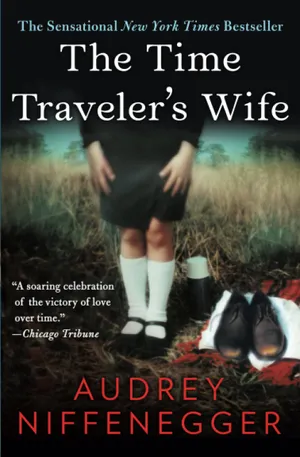
Our Review
The Time Traveler's Wife is a love story built on an impossible foundation: Henry DeTamble has a genetic disorder that causes him to spontaneously travel through time. He cannot control when he goes or where he arrives. He always arrives naked. And the woman he loves, Clare Abshire, must build a life with a man who keeps disappearing.
Published in 2003, Audrey Niffenegger's debut novel could easily have been a gimmick — science fiction played for romantic novelty. Instead, it is one of the most emotionally sophisticated love stories published in the last quarter century. The time travel is not metaphorical. It is literal, and Niffenegger works out its consequences with rigorous internal logic. Henry meets Clare for the first time when he is twenty-eight and she is twenty. But Clare has known Henry since she was six, because an older version of him has been visiting her throughout her childhood. The result is a relationship in which both partners are constantly at different stages of knowledge, experience, and emotional development.
What makes the novel devastating is that the time travel is ultimately a metaphor for what every relationship already is: two people experiencing time differently, aging at different rates emotionally if not physically, losing each other in ways both sudden and gradual. Every couple knows the feeling of being in different places at the same time. Niffenegger simply makes that feeling literal, and the effect is both fantastical and deeply, achingly real.
Why This Book Earned Its Place in the Top 100
The Time Traveler's Wife earns its place because it accomplishes something that literary fiction rarely attempts and genre fiction rarely achieves: it uses a speculative premise to illuminate something genuinely true about human love. The time travel is not an escape from reality but a lens that makes reality sharper. The terror of losing someone you love, the frustration of being unable to be present when you are needed, the way memory and anticipation shape a relationship as much as the present moment — these are universal experiences, and Niffenegger renders them with startling emotional precision.
The novel also succeeds as pure narrative. The chronological puzzle — Henry and Clare's story is told out of order, from both perspectives, with multiple versions of Henry appearing at different ages — is intricate but never confusing. Niffenegger manages the considerable feat of maintaining suspense in a story where the ending is, in certain respects, already known. The book is a genuine page-turner that also rewards careful re-reading, because knowing the ending changes the meaning of everything that comes before. It is one of those rare novels that bridges the gap between popular and literary fiction so completely that the distinction ceases to matter.
Who Should Read This Book
- •Anyone who has ever loved someone and feared losing them — the novel captures the terror and beauty of love's impermanence with extraordinary power.
- •Readers who enjoy genre-blending fiction — this book seamlessly combines science fiction, literary fiction, and romance in a way that satisfies all three audiences.
- •People who think love stories are predictable — the time travel mechanics create genuinely surprising narrative structures while deepening the emotional stakes.
- •Fans of clever, well-plotted novels — the chronological puzzle is intricate and satisfying, rewarding readers who pay close attention.
Key Themes and Takeaways
- Love and loss
- The novel's central insight is that love always involves loss — of time, of control, of the person you love — and that this loss is inseparable from love's value.
- The experience of time
- Henry and Clare experience their relationship at different speeds and in different orders, making literal what is metaphorically true of every relationship.
- Waiting and absence
- Clare spends much of her life waiting for Henry — a condition that speaks to the loneliness built into even the deepest partnerships.
- Free will and determinism
- If Henry has already visited the future, are his choices real? The novel raises profound questions about whether knowing your fate changes your ability to live.
- The body and its limitations
- Henry's time travel is presented as a medical condition — his body betrays him, leaving him vulnerable, exposed, and unable to control his own life.
Cultural and Historical Impact
The Time Traveler's Wife was published in 2003 and became a massive international bestseller, spending over a year on the New York Times bestseller list and selling over seven million copies worldwide. It was adapted into a feature film in 2009 starring Eric Bana and Rachel McAdams, and an HBO television series in 2022. The novel was a Richard & Judy Book Club selection in the UK, which helped drive sales of over two million copies in Britain alone. It has been translated into more than 30 languages. The book is widely credited with popularizing the genre of "speculative literary fiction" — novels that use fantastical premises to explore realistic emotional territory. It remains one of the most beloved and widely discussed debut novels of the 21st century.
Notable Quotes
“It's hard being left behind. It's hard to be the one who stays.”
“Don't you think it's better to be extremely happy for a short while, even if you lose it, than to be just okay for your whole life?”
“Long ago, men went to sea, and women waited for them, standing on the edge of the water, scanning the horizon for the tiny dot that would grow into a ship bringing their hearts home.”
If You Loved The Time Traveler's Wife, Read These Next

Ready to read The Time Traveler's Wife?
Scribner · 546 pages
Buy The Time Traveler's Wife on Amazon