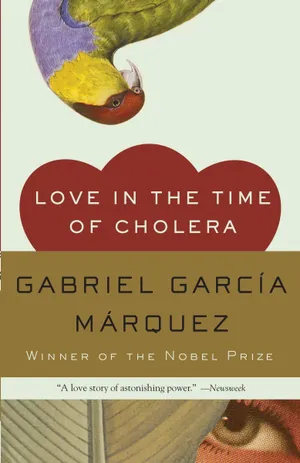
Our Review
Gabriel García Márquez called Love in the Time of Cholera his greatest book. Many of his readers agree, and the reason is simple: while One Hundred Years of Solitude is a novel about everything, Love in the Time of Cholera is a novel about one thing — love in all its absurd, obsessive, devastating, and ultimately redemptive forms.
Florentino Ariza falls in love with Fermina Daza when they are teenagers in a Caribbean port city at the turn of the twentieth century. Their courtship is conducted through feverish letters and stolen glances. When Fermina's father sends her away, and she returns to reject Florentino — suddenly seeing him as "nothing more than a shadow" — he makes a decision that will define his entire existence: he will wait for her. For over fifty years.
In the meantime, Fermina marries Dr. Juvenal Urbino, a distinguished physician, and builds a life of respectability and quiet compromise. Florentino, meanwhile, conducts 622 love affairs while never relinquishing his devotion to Fermina. The number is not metaphorical — he keeps a ledger.
When Dr. Urbino dies (in a scene involving a parrot that is both comic and heartbreaking), Florentino reappears at the funeral and declares his love. He is seventy-six years old. Fermina is seventy-two. What follows is one of the most beautiful and unexpected love stories ever written — proof that García Márquez understood something about the human heart that most novelists never approach.
Why This Book Earned Its Place in the Top 100
Love in the Time of Cholera earns its place because it does what almost no other novel has managed: it takes love seriously as a subject for adult fiction without descending into sentimentality or cynicism. García Márquez writes about love the way a naturalist writes about weather — as a force that operates according to its own laws, indifferent to human dignity, capable of inspiring both the sublime and the ridiculous.
Florentino Ariza is not a romantic hero in any conventional sense. He is obsessive, self-deluding, and morally compromised. His 622 affairs include at least one that is deeply troubling by any standard. Yet García Márquez never reduces him to a cautionary tale. Instead, he presents Florentino's lifelong devotion as simultaneously pathological and magnificent — because that is what love actually is, if we are honest about it.
The novel also earns its place through sheer beauty of prose. Even in translation, García Márquez's sentences have a music and a fullness that few writers in any language can match. Every page contains at least one line that makes you stop, reread, and breathe. This is a novel that proves literature can do things that no other art form can.
Who Should Read This Book
- •Anyone who has ever loved someone for years without resolution — Florentino's patience is both inspiring and cautionary, and the novel holds both readings simultaneously.
- •Readers who loved One Hundred Years of Solitude — this is García Márquez at his most intimate, trading sweeping history for the fine grain of a single lifelong obsession.
- •Fans of literary romance who want something beyond the genre's conventions — this novel redefines what a love story can be.
- •Older readers — this is one of the rare novels that takes love in old age seriously, treating it with the same intensity usually reserved for the young.
Key Themes and Takeaways
- The persistence of love
- Florentino's fifty-year vigil raises the question of whether unwavering devotion is romantic, pathological, or both.
- Aging and desire
- The novel insists that passion does not expire with youth, portraying elderly love with unflinching honesty and tenderness.
- Love versus marriage
- Fermina's comfortable but imperfect marriage to Dr. Urbino is contrasted with Florentino's chaotic, unfulfilled passion.
- Cholera as metaphor
- The symptoms of love and cholera mirror each other throughout the novel, suggesting that love is a kind of beautiful sickness.
- Memory and idealization
- Florentino loves a Fermina who may never have existed — and the novel asks whether that matters.
Cultural and Historical Impact
Published in 1985, Love in the Time of Cholera was written three years after García Márquez received the Nobel Prize in Literature. It was an immediate international bestseller, translated into dozens of languages and selling millions of copies worldwide. The novel was adapted into a 2007 film starring Javier Bardem. García Márquez based elements of the story on his own parents' courtship, which lends the narrative an autobiographical tenderness. The novel is widely considered the greatest love story of the twentieth century and is frequently cited by other writers — including Junot Díaz and Jeffrey Eugenides — as a defining influence.
Notable Quotes
“He allowed himself to be swayed by his conviction that human beings are not born once and for all on the day their mothers give birth to them, but that life obliges them over and over again to give birth to themselves.”
“The only regret I will have in dying is if it is not for love.”
“He was still too young to know that the heart's memory eliminates the bad and magnifies the good, and that thanks to this artifice we manage to endure the burden of the past.”
If You Loved Love in the Time of Cholera, Read These Next
Ready to read Love in the Time of Cholera?
Vintage International · 368 pages
Buy Love in the Time of Cholera on Amazon