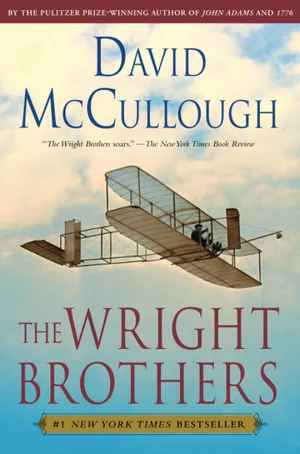
Our Review
David McCullough's biography of Wilbur and Orville Wright is a study in what happens when extraordinary determination meets ordinary circumstances. The Wright brothers were not wealthy. They were not formally educated beyond high school. They had no government funding, no corporate backing, no laboratory. They had a bicycle shop in Dayton, Ohio, an obsessive work ethic, and the radical conviction that human flight was an engineering problem, not a dream.
McCullough tells their story with the same meticulous narrative craftsmanship he brought to John Adams and Truman. He draws heavily on the brothers' own letters and diaries, which reveal two personalities that were far more interesting than the generic "genius inventor" archetype suggests. Wilbur was the visionary — intense, eloquent, capable of sustained intellectual focus that bordered on the monastic. Orville was the tinkerer, the hands-on builder who could solve mechanical problems by feel.
The book covers their years of wind tunnel experiments, their trips to the desolate dunes of Kitty Hawk, the twelve-second flight on December 17, 1903, that changed everything, and the surprisingly difficult years that followed as they fought for recognition, battled patent thieves, and struggled to convince a skeptical world that they had actually done what they claimed. McCullough makes you feel the sand, the wind, and the magnificent stubbornness of two men who refused to accept that a problem could not be solved.
Why This Book Earned Its Place in the Top 100
The Wright Brothers earns its place because it tells the origin story of the modern world. Human flight did not just give us airplanes — it shrank the planet, transformed warfare, enabled global commerce, and fundamentally altered humanity's relationship with distance and time. And it happened because two bicycle mechanics from Ohio decided to figure it out.
McCullough's genius as a biographer is his ability to make the reader understand not just what happened but how it felt. The sections at Kitty Hawk — the brutal weather, the isolation, the mosquitoes, the repeated crashes — convey the physical reality of invention in a way that makes the achievement feel both more miraculous and more human. These were not abstract thinkers. They were men who got their hands dirty, who crashed and rebuilt, who tested and failed and tested again.
The book also matters as a corrective to the myth of the lone genius. The Wright brothers succeeded because of their partnership — two minds that complemented each other perfectly — and because of their family, particularly their father and their sister Katharine, whose support and sacrifice made the work possible. McCullough shows that great achievements are never the product of one person alone. They are the product of relationships, values, and unglamorous persistence.
Who Should Read This Book
- •Anyone who loves stories of invention and ingenuity — this is one of the great accounts of human problem-solving under impossible conditions.
- •Readers who enjoy David McCullough's narrative history style — this is classic McCullough: deeply researched, beautifully written, and utterly engrossing.
- •Engineers and entrepreneurs — the Wright brothers' iterative approach to design, their willingness to fail, and their insistence on testing everything offer timeless lessons.
- •History enthusiasts — McCullough brings early twentieth-century America to life with vivid period detail.
- •Anyone looking for an inspiring read that is also intellectually rigorous — this is biography at its best.
Key Themes and Takeaways
- Persistence and methodical innovation
- The Wrights solved the problem of flight not through flashes of genius but through years of systematic experimentation, testing, and incremental improvement.
- The power of partnership
- Wilbur and Orville's complementary skills — one a theorist, the other a builder — demonstrate that the greatest achievements often require collaboration rather than solo brilliance.
- Modesty and integrity
- The brothers were famously unpretentious, indifferent to fame, and committed to honest dealing — values that McCullough presents as inseparable from their success.
- American self-reliance
- Without formal education, institutional support, or significant funding, the Wrights embody a particularly American tradition of self-taught, self-financed achievement.
- The struggle for recognition
- The years-long fight to prove their claims and protect their patents reveals how innovation is never just about the invention — it is about convincing the world to believe.
Cultural and Historical Impact
Published in 2015, The Wright Brothers debuted at number one on the New York Times bestseller list, where it remained for weeks. The book sold over a million copies and was widely praised for bringing new attention to a story many Americans thought they already knew. McCullough, a two-time Pulitzer Prize winner and two-time National Book Award winner, was considered the preeminent narrative historian of his generation, and this book cemented that reputation. It drew on previously underutilized primary sources, including the Wright family's personal correspondence, housed at the Library of Congress. The book was optioned for film adaptation and renewed public interest in the Wright Brothers National Memorial at Kitty Hawk, North Carolina. It also inspired renewed debate about the contributions of other aviation pioneers, particularly Glenn Curtiss.
Notable Quotes
“The best dividends on the labor invested have invariably come from seeking more knowledge rather than more power.”
“It is possible to fly without motors, but not without knowledge and skill.”
“Isn't it astonishing that all these secrets have been preserved for so many years just so we could discover them!”
If You Loved The Wright Brothers, Read These Next

Ready to read The Wright Brothers?
Simon & Schuster · 336 pages
Buy The Wright Brothers on Amazon