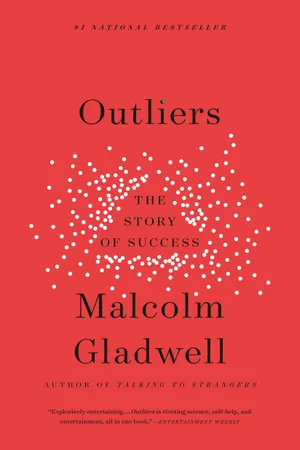
Our Review
Malcolm Gladwell's Outliers asks a question that most success stories ignore: why do some people achieve extraordinary things while equally talented people do not? His answer is not what the self-help industry wants to hear. Gladwell argues that individual talent and effort, while necessary, are far less important than circumstances — culture, timing, family, and accumulated advantage — in determining who rises to the top.
The book opens with Canadian hockey. The vast majority of elite junior hockey players are born in January, February, and March. Why? Because the youth league cutoff date is January 1, meaning kids born in early months are physically larger at tryout age, get selected for better teams, receive more coaching, and accumulate thousands of hours of additional practice by their teens. Talent is roughly equal. Opportunity is not.
From there, Gladwell introduces the 10,000-hour rule (roughly ten years of deliberate practice to achieve mastery), examines why The Beatles became The Beatles (Hamburg), why Bill Gates became Bill Gates (access to a mainframe computer in 1968 at age thirteen), and why cultural legacies — the honor culture of Appalachia, the rice-paddy precision of Chinese mathematics — shape outcomes in ways we rarely acknowledge. Each chapter is a beautifully constructed argument, supported by research but driven by story.
Gladwell does not deny individual agency. He reframes it. Success, he argues, is not just about pulling yourself up by your bootstraps. It is about whether you were given boots in the first place.
Why This Book Earned Its Place in the Top 100
Outliers earns its spot because it fundamentally changed how millions of people think about success. Before this book, the dominant American narrative was meritocratic: work hard, be talented, and you will rise. Gladwell did not destroy that narrative — he complicated it in ways that make it far more honest and far more useful.
The 10,000-hour concept alone entered popular culture so thoroughly that it is now referenced in business, education, sports, and parenting conversations worldwide. Whether you agree with Gladwell's specific number or not, the underlying insight — that mastery requires sustained, deliberate practice over years, not innate gifts — has reshaped how people think about expertise.
More importantly, Outliers asked readers to consider the systems behind success. Why do some schools produce more achievers? Why do certain cultures excel at certain tasks? Why does birth date matter? These are structural questions, and Gladwell made them accessible and compelling to a mainstream audience that might otherwise never engage with sociology or social psychology.
The book has been criticized for oversimplification, and some of those criticisms are fair. But Gladwell's gift is not academic rigor — it is the ability to make you see patterns you were blind to five minutes ago. Outliers makes you reconsider every success story you have ever heard, including your own. That is a significant intellectual achievement.
Who Should Read This Book
- •Anyone who believes success is purely a matter of talent and hard work — Gladwell will complicate that belief in the most productive way possible.
- •Parents and educators — the insights about early advantages, practice windows, and cultural factors in learning are directly applicable to raising and teaching children.
- •Business leaders and managers — understanding how systemic advantages create outliers changes how you think about hiring, mentoring, and organizational culture.
- •Fans of Freakonomics or Thinking, Fast and Slow who enjoy counterintuitive nonfiction that challenges conventional wisdom.
- •Anyone interested in social psychology and sociology presented through vivid, story-driven writing.
Key Themes and Takeaways
- The myth of the self-made person
- Gladwell systematically demonstrates that every 'self-made' success story is actually a story of accumulated advantages, opportunities, and cultural inheritance.
- The 10,000-hour rule
- Mastery in any field requires approximately 10,000 hours of deliberate practice — a threshold that depends as much on access and opportunity as on will.
- Cultural legacy
- Gladwell argues that the values, habits, and ways of thinking inherited from our cultures shape our outcomes in ways we rarely recognize or acknowledge.
- Timing and historical accident
- Being born in the right year, in the right place, with access to the right technology at the right moment can matter more than raw ability.
- Systemic advantage and disadvantage
- Small initial advantages compound over time into massive disparities, a process Gladwell calls 'accumulative advantage.'
Cultural and Historical Impact
Published in 2008, Outliers debuted at number one on the New York Times bestseller list and spent over three years on the list, selling more than 5 million copies worldwide. The "10,000-hour rule" became one of the most widely cited concepts in popular psychology, referenced in business books, sports training programs, and educational policy discussions. The book cemented Gladwell's status as the most influential popular nonfiction writer of his generation. It has been translated into over 40 languages and is widely assigned in business schools, education programs, and leadership courses. While the 10,000-hour concept has been debated and refined by subsequent researchers — including Anders Ericsson, whose work Gladwell drew upon — the core insight about systemic advantage has become a standard framework for discussing inequality and meritocracy in American public discourse.
Notable Quotes
“It's not how much money we make that ultimately makes us happy between nine and five. It's whether or not our work fulfills us.”
“Practice isn't the thing you do once you're good. It's the thing you do that makes you good.”
“Who we are cannot be separated from where we're from.”
If You Loved Outliers, Read These Next



Ready to read Outliers?
Little, Brown and Company · 309 pages
Buy Outliers on Amazon