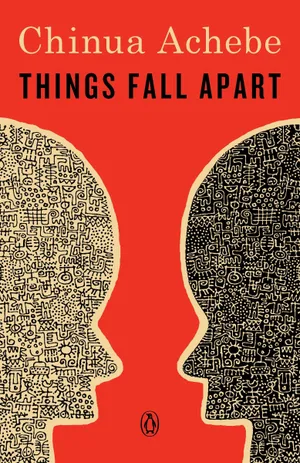
Our Review
Chinua Achebe wrote Things Fall Apart in 1958, partly in response to what he considered the racist depiction of Africa in novels like Joseph Conrad's Heart of Darkness. He wanted to tell an African story from the inside — not as exotic backdrop for European self-examination, but as a civilization with its own complexity, beauty, contradictions, and dignity. He succeeded so completely that the novel has become the most widely read work of African literature in history.
Okonkwo is a self-made man in the Igbo village of Umuofia, in what is now southeastern Nigeria. He has risen from nothing through sheer force of will, terrified of resembling his gentle, indebted father. He is a wrestler, a warrior, a farmer of yams. He is also rigid, violent, and incapable of showing tenderness without perceiving it as weakness. He is, in other words, a profoundly human creation — admirable and infuriating in equal measure.
The novel's first two-thirds paint a rich, detailed portrait of pre-colonial Igbo life: its rituals, its justice system, its humor, its spiritual beliefs, its internal debates. Then the missionaries arrive, and the world Achebe has so carefully built begins to crack. The genius of the novel is that the fall is not simple. Christianity offers genuine appeal to the marginalized members of Igbo society. Colonialism does not merely destroy — it exploits real fissures. Things fall apart not only because of external force, but because no civilization is monolithic.
Why This Book Earned Its Place in the Top 100
Things Fall Apart earns its place because it changed who gets to tell the story. Before Achebe, the dominant literary narrative of Africa was written by Europeans — Conrad, Cary, Haggard — and Africa existed in those works primarily as a symbol of darkness, mystery, or primitivism. Achebe demolished that tradition by writing a novel that portrays African society with the same fullness and nuance that European novelists reserved for their own cultures.
The novel's influence has been seismic. It opened the door for an entire generation of African and postcolonial writers. Chimamanda Ngozi Adichie, Ngũgĩ wa Thiong'o, and many others have cited Achebe as the writer who showed them that their stories deserved to be told on the world stage.
Beyond its cultural significance, Things Fall Apart is simply a beautifully crafted novel. Achebe's prose is spare, precise, and saturated with the rhythms of Igbo oral tradition. The proverbs that punctuate the dialogue are not decoration — they are the philosophy of an entire people, distilled into single sentences. Okonkwo's tragedy is rendered with the economy and inevitability of Greek drama.
Who Should Read This Book
- •Everyone — this is one of those genuinely essential books, as important to understanding the modern world as any Western classic.
- •Readers interested in colonialism and its aftermath — Achebe shows both the violence of colonialism and the internal fractures it exploited, avoiding simplistic narratives.
- •Fans of Greek tragedy — Okonkwo's fall has the same inexorable momentum as Oedipus, driven by the very qualities that made him great.
- •Anyone who read Heart of Darkness in school — Things Fall Apart is the necessary counterpoint, and reading them together transforms both.
- •Lovers of concise, powerful prose — at under 200 pages, this novel wastes nothing and says everything.
Key Themes and Takeaways
- Colonialism and cultural destruction
- The arrival of European missionaries and administrators dismantles a civilization that has sustained itself for centuries.
- Masculinity and its costs
- Okonkwo's terror of appearing weak drives every decision he makes, and ultimately ensures his destruction.
- Tradition versus change
- The novel refuses to idealize Igbo society while making clear that its destruction is a profound loss.
- The complexity of culture
- Achebe portrays Igbo life with its full range of beauty, cruelty, wisdom, and contradiction — exactly as a European novelist would portray England or France.
- Fate and personal agency
- Okonkwo's chi — his personal god — is invoked throughout, raising the question of how much of his fate he has authored.
Cultural and Historical Impact
Published in 1958, Things Fall Apart has sold over 20 million copies, been translated into more than 50 languages, and is the most widely read book in modern African literature. It is required reading in schools across Africa, Europe, and North America. Achebe was awarded the Man Booker International Prize in 2007 for his lifetime achievement. The novel has been adapted for stage, television, and opera. Its title, drawn from W.B. Yeats's poem "The Second Coming," has itself become a cultural reference point. Achebe's insistence on writing in English — to reach the widest possible audience while subverting the colonial language from within — sparked a major literary debate that continues to shape African literature today.
Notable Quotes
“When the moon is shining the cripple becomes hungry for a walk.”
“The white man is very clever. He came quietly and peaceably with his religion. We were amused at his foolishness and allowed him to stay. Now he has won our brothers, and our clan can no longer act like one.”
“There is no story that is not true.”
If You Loved Things Fall Apart, Read These Next
Ready to read Things Fall Apart?
Anchor Books · 209 pages
Buy Things Fall Apart on Amazon