Our Review
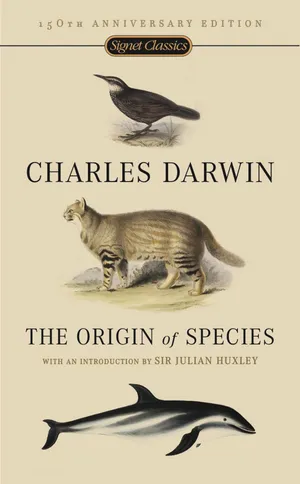
On the Origin of Species, published on November 24, 1859, is the book that broke the world in half. Before Darwin, the overwhelming consensus — scientific, religious, cultural — was that species were fixed, created individually by God, and unchanging. After Darwin, that view was no longer intellectually tenable. The first print run of 1,250 copies sold out on the day of publication.
What strikes modern readers most is not the radicalism of the argument but the patience of it. Darwin does not grandstand. He builds his case brick by meticulous brick: the variation of domestic animals, the struggle for existence, the principle of natural selection, the geological record. He anticipates objections and addresses them with scrupulous fairness, sometimes devoting entire chapters to the strongest arguments against his own theory.
The prose itself is more graceful than its reputation suggests. Darwin writes with a naturalist's eye for wonder — his descriptions of the entangled bank of life, of the intricate co-adaptations of orchids and insects, carry genuine beauty. This is not a cold or mechanical book. It is the work of a man who spent twenty years gathering evidence because he understood exactly how explosive his conclusions would be. The result is one of the most carefully constructed arguments in the history of human thought.
Why This Book Earned Its Place in the Top 100
No single book has more thoroughly transformed humanity's understanding of its place in the natural world. Before Origin, humans stood apart from nature — specially created, fundamentally different from animals. After Origin, we were part of the same tree of life, shaped by the same forces, cousins to everything that breathes. That shift in perspective is arguably the most consequential intellectual event of the last five centuries.
But Origin earns its place here not just for its conclusions but for its method. Darwin's patient accumulation of evidence, his willingness to confront the weaknesses in his own theory, his refusal to overstate his case — these qualities make the book a masterclass in how to think clearly about complex problems. In an era of hot takes and instant opinions, reading Darwin is a corrective. It reminds you what intellectual courage actually looks like: not shouting provocatively, but quietly assembling evidence so overwhelming that the conclusion becomes inescapable.
Who Should Read This Book
- •Anyone who has never actually read it — most people know Darwin's ideas secondhand, and the real book is far more nuanced and compelling than any summary.
- •Students of science or philosophy — Origin is a masterclass in constructing an argument from evidence, applicable far beyond biology.
- •Readers interested in the history of ideas — this is one of the handful of books that genuinely divided human history into before and after.
- •People of faith wrestling with science — Darwin himself struggled deeply with the theological implications, and his honesty about that struggle is visible throughout.
Key Themes and Takeaways
- Natural selection
- The mechanism by which organisms better adapted to their environment tend to survive and produce more offspring.
- Variation and inheritance
- Small differences between individuals accumulate over generations to produce new species.
- The struggle for existence
- Resources are limited, and organisms must compete — with their environment, with predators, and with each other.
- Common descent
- All living things share ancestors, connecting every organism on Earth into a single branching tree of life.
- Gradualism
- Evolution proceeds by slow, incremental changes rather than sudden leaps, requiring immense spans of geological time.
- Scientific humility
- Darwin repeatedly acknowledges the gaps in his knowledge and the strongest objections to his theory.
Cultural and Historical Impact
On the Origin of Species has been continuously in print since 1859, making it one of the longest-running bestsellers in publishing history. It has been translated into at least 29 languages. The book sparked immediate and fierce debate — the famous 1860 Oxford evolution debate between Thomas Huxley and Bishop Samuel Wilberforce became a landmark moment in the history of science versus religion. Darwin's ideas influenced fields far beyond biology, including psychology, sociology, philosophy, and economics. The concept of evolution by natural selection is now the central organizing principle of modern biology. In 2015, the book was voted the most influential academic book ever written in a poll conducted by the Academic Book Trade. Darwin himself revised the text through six editions, each time strengthening his arguments as new evidence accumulated.
Notable Quotes
“There is grandeur in this view of life, with its several powers, having been originally breathed into a few forms or into one; and that, whilst this planet has gone cycling on according to the fixed law of gravity, from so simple a beginning endless forms most beautiful and most wonderful have been, and are being, evolved.”
“It is not the strongest of the species that survives, nor the most intelligent, but the one most responsive to change.”
“A man who dares to waste one hour of time has not discovered the value of life.”
If You Loved The Origin of Species, Read These Next
Ready to read The Origin of Species?
Signet Classics · 576 pages
Buy The Origin of Species on Amazon