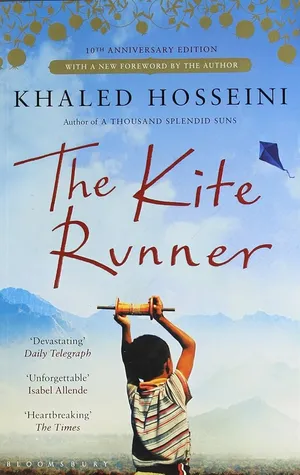
Our Review
Khaled Hosseini's The Kite Runner opens with a line that sounds deceptively simple: "I became what I am today at the age of twelve." What happened at twelve is the novel's gravitational center — an act of cowardice so specific and so devastating that the narrator, Amir, spends the rest of his life trying to outrun it.
Amir and Hassan grow up together in Kabul in the 1970s, inseparable but never equal. Amir is the son of a wealthy Pashtun; Hassan is the son of his father's Hazara servant. They fly kites together, and Hassan is the best kite runner in the city — the one who chases down the fallen kite after a battle. But when Hassan is cornered in an alley by a neighborhood bully and subjected to an act of brutal violence, Amir watches from hiding and does nothing. Worse, he never speaks of it. Worse still, he drives Hassan away.
The novel then follows Amir through the Soviet invasion, his family's flight to America, his father's decline, his marriage, and finally his return to a Taliban-controlled Afghanistan to confront the past he has spent decades avoiding. Hosseini writes with a directness that borders on brutal. The emotional punches do not come from clever technique but from the excruciating clarity with which he renders guilt, shame, and the terrible hope that it might not be too late to become a better person.
The Kite Runner is a book that grabs you by the throat in the first chapter and does not let go until the last page.
Why This Book Earned Its Place in the Top 100
The Kite Runner earns its place because it accomplished something rare: it made millions of Western readers care deeply about Afghanistan. Published in 2003, two years after the September 11 attacks, the novel arrived at a moment when Afghanistan existed in the American imagination almost exclusively as a war zone. Hosseini gave it back its humanity — its kite tournaments, its pomegranate trees, its complex social hierarchies, its music, its food, its people.
But the novel's resonance goes far beyond geopolitics. At its core, this is a story about betrayal and the possibility of redemption, and those themes are universal. Amir's guilt is not abstract — it is the specific, nauseating guilt of someone who had the chance to do the right thing and chose not to. Every reader recognizes that feeling on some scale, and Hosseini's willingness to sit with it unflinchingly is what gives the novel its power.
The Kite Runner also opened the door for an entire wave of literature from the Afghan diaspora, proving that stories from the margins of the Western literary world could command massive global audiences. It remains one of the most emotionally powerful novels of the twenty-first century.
Who Should Read This Book
- •Anyone who has ever carried guilt about a failure of courage — Amir's journey toward atonement is raw, honest, and deeply cathartic.
- •Readers who want to understand Afghanistan beyond headlines — Hosseini paints pre-war Kabul with such warmth and specificity that you will mourn its loss alongside the characters.
- •Fans of emotionally intense literary fiction — this novel does not hold back, and its willingness to devastate the reader is also what makes it so rewarding.
- •Book clubs — the moral questions this novel raises about loyalty, class, and forgiveness generate the kind of discussions that last long after the meeting ends.
Key Themes and Takeaways
- Guilt and redemption
- Amir's cowardice in childhood haunts every decision he makes, and the novel asks whether one good act can atone for a lifetime of evasion.
- Class and ethnicity
- The Pashtun-Hazara divide is woven into every relationship in the novel, revealing how systemic inequality corrupts even genuine affection.
- Father-son relationships
- Amir's desperate need for his father's approval drives the novel's first half, and the echoes of that need shape everything that follows.
- The destruction of Afghanistan
- The novel traces the country's transformation from a vibrant, complex society to a place governed by brutality and fear.
- Loyalty and betrayal
- Hassan's unwavering devotion to Amir makes Amir's betrayal all the more devastating, and the asymmetry defines the entire story.
Cultural and Historical Impact
Published in 2003, The Kite Runner became a word-of-mouth bestseller, eventually selling over 12 million copies in the United States alone and being translated into more than 70 languages. It was the bestselling novel of 2005 in the United States. The 2007 film adaptation, directed by Marc Forster, was critically acclaimed and generated controversy in Afghanistan. The novel was adapted into a successful stage play that has been performed worldwide. Hosseini's success helped establish a new wave of Afghan and Middle Eastern diaspora literature in the Western publishing market. He was named a United Nations Goodwill Ambassador in 2006, partly due to the novel's role in humanizing the Afghan experience for global audiences.
Notable Quotes
“For you, a thousand times over.”
“There is a way to be good again.”
“It may be unfair, but what happens in a few days, sometimes even a single day, can change the course of a whole lifetime, Amir.”
If You Loved The Kite Runner, Read These Next

Ready to read The Kite Runner?
Riverhead Books · 371 pages
Buy The Kite Runner on Amazon