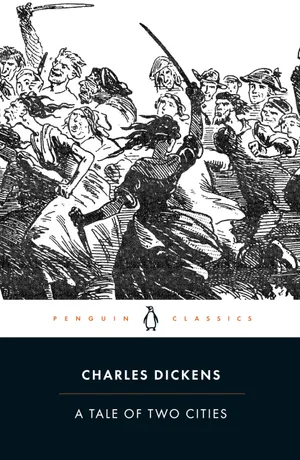
Our Review
"It was the best of times, it was the worst of times" — you know the opening, but the novel that follows is stranger, darker, and more emotionally devastating than its famous first line suggests. Published in 1859, A Tale of Two Cities is Charles Dickens at his most ambitious and most disciplined, trading his usual sprawling subplots for a tightly wound narrative engine that hurtles toward one of the most unforgettable endings in all of fiction.
The story moves between London and Paris in the years surrounding the French Revolution. Charles Darnay, a French aristocrat who has renounced his family's cruelty, builds a quiet life in England. Sydney Carton, a brilliant but dissolute London lawyer, wastes his gifts in cynicism and drink. Both men love Lucie Manette, the daughter of a physician who spent eighteen years in the Bastille. When revolution erupts, their fates converge in a Paris that has traded one form of brutality for another.
Dickens was not primarily interested in the politics of the Revolution. He was interested in what extremity reveals about character. The novel asks whether a wasted life can be redeemed in a single act, whether love can survive history's worst convulsions, and whether justice pursued without mercy becomes indistinguishable from the tyranny it replaced. The answer to that last question, delivered through Madame Defarge's relentless knitting needles, is among the most chilling in Victorian literature.
Why This Book Earned Its Place in the Top 100
A Tale of Two Cities is the bestselling novel of all time, with over 200 million copies sold. That staggering number reflects something real: this is Dickens at his most accessible, his most urgent, and his most willing to break your heart. The novel earns its place not through historical prestige alone but through the sheer force of its emotional architecture.
Sydney Carton's final act is one of the great moments in literature — not because self-sacrifice is a novel idea, but because Dickens earns it. Carton is not a hero in disguise. He is genuinely broken, genuinely lost, and his redemption is not a correction of his character but a transcendence of it. Few readers reach the final pages without tears, and that is not sentimentality — it is the payoff of meticulous characterization.
Beyond Carton, the novel remains vital because its central question never expires: What happens when the oppressed become oppressors? The Revolution scenes anticipate every cycle of political violence since 1789, and Dickens's insistence that cruelty is cruelty regardless of who wields the blade remains as necessary as ever.
Who Should Read This Book
- •Anyone who has never read Dickens — this is his most tightly plotted and emotionally immediate novel, making it the ideal entry point.
- •History lovers — the French Revolution scenes are vivid, terrifying, and historically grounded, bringing the period to visceral life.
- •Readers who enjoy sweeping romantic narratives — the Darnay-Carton-Lucie triangle is one of the most affecting in English literature.
- •Anyone interested in political revolution — Dickens's portrait of justified rage curdling into indiscriminate vengeance has never stopped being relevant.
Key Themes and Takeaways
- Resurrection and redemption
- Characters are recalled to life throughout the novel, and the central question is whether a squandered existence can be redeemed.
- Revolution and its costs
- Dickens sympathizes with the Revolution's causes while unflinchingly portraying how it devoured its own ideals.
- Sacrifice and selflessness
- Carton's final act redefines his entire life, raising the question of whether a single moment can outweigh years of waste.
- Duality and doubles
- London and Paris, Darnay and Carton, mercy and vengeance — the novel is built on pairs that mirror and invert each other.
- Justice versus vengeance
- Madame Defarge embodies the point at which righteous anger becomes something indistinguishable from the evil it sought to destroy.
Cultural and Historical Impact
Published in weekly installments in 1859, A Tale of Two Cities is widely cited as the bestselling novel in history, with estimated sales exceeding 200 million copies. Its opening sentence is the most quoted in English literature. The novel has been adapted for film at least six times, most notably the 1935 MGM production starring Ronald Colman and the 1958 version with Dirk Bogarde. A Broadway musical adaptation premiered in 2008. The novel cemented Dickens's international reputation and remains one of the most widely assigned books in English-language schools. Carton's closing speech — "It is a far, far better thing that I do, than I have ever done" — is among the most recognized lines in world literature.
Notable Quotes
“It was the best of times, it was the worst of times, it was the age of wisdom, it was the age of foolishness.”
“It is a far, far better thing that I do, than I have ever done; it is a far, far better rest that I go to than I have ever known.”
“A wonderful fact to reflect upon, that every human creature is constituted to be that profound secret and mystery to every other.”
If You Loved A Tale of Two Cities, Read These Next
Ready to read A Tale of Two Cities?
Penguin Classics · 489 pages
Buy A Tale of Two Cities on Amazon