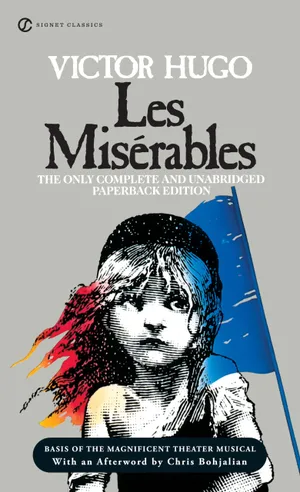
Our Review
Victor Hugo's "Les Misérables" is not so much a novel as it is a world. Spanning decades of French history — from the aftermath of Waterloo through the June Rebellion of 1832 — it tells the story of Jean Valjean, a man imprisoned for nineteen years for stealing a loaf of bread, who is transformed by an act of mercy from a bishop and devotes the rest of his life to doing good, all while being relentlessly pursued by the rigid, law-obsessed Inspector Javert. Around this central chase, Hugo builds an enormous tapestry that encompasses the orphaned Cosette, the doomed Fantine, the revolutionary student Enjolras, the irrepressible street urchin Gavroche, and the thoroughly despicable Thénardiers — each of them embodying a different face of poverty, injustice, and the human capacity for both cruelty and grace.
Hugo was not a writer who believed in restraint. "Les Misérables" contains extended digressions on the Battle of Waterloo, the Paris sewer system, convents, slang, and the nature of progress — and while these passages have tested readers' patience for over a century and a half, they are also part of the novel's grandeur. Hugo was attempting nothing less than a complete portrait of French society, and the digressions are his way of insisting that every layer of that society — from the sewers beneath the streets to the barricades above them — matters.
At its heart, though, this is a novel about the radical power of compassion. Valjean's transformation proves that a human being is never beyond redemption, and the novel argues, with overwhelming emotional force, that mercy is always stronger than judgment, and that love — not law — is the foundation of a just society.
Why This Book Earned Its Place in the Top 100
"Les Misérables" belongs on this list because it is one of the few novels that can honestly claim to have changed the world. Hugo wrote it as an act of social activism, driven by his conviction that literature could make people see injustice they had been trained to ignore. The novel's depictions of poverty, child labor, and the brutality of the penal system were deliberately designed to shock the conscience of a society that tolerated these evils, and they succeeded — the novel influenced social reform movements across Europe and remains a rallying cry for justice today.
But its power is not merely political. Hugo created characters of such archetypal force that they have transcended the novel and entered the collective imagination. Jean Valjean's redemption, Javert's terrible rigidity, Fantine's sacrifice, Cosette's innocence, Gavroche's defiance — these figures resonate because they embody fundamental human experiences that cross every boundary of time and culture.
The novel is also an astonishing feat of literary architecture. Hugo manages to weave personal stories and national history into a coherent whole that feels both intimate and epic. The fact that "Les Misérables" has been successfully adapted as one of the world's most beloved musicals is a testament to the power of its storytelling — but the novel contains depths of thought, digression, and philosophical argument that no adaptation can capture. It demands investment, and it repays that investment a thousandfold.
Who Should Read This Book
- •Readers who love epic, sweeping fiction — 'Les Misérables' is one of the longest and most ambitious novels ever written, and every page serves a purpose.
- •Anyone passionate about social justice — Hugo's anger at poverty and his faith in human redemption are as powerful and relevant today as they were in 1862.
- •Fans of the musical who want to experience the full depth of the story — the novel is richer, darker, and more philosophically complex than any adaptation can convey.
- •History enthusiasts interested in 19th-century France — Hugo's depictions of post-Napoleonic Paris, the sewer system, and the 1832 rebellion are both historically grounded and deeply compelling.
- •Readers who appreciate complex moral arguments — Hugo does not deal in simple good and evil; Javert's devotion to law is sincere, and even the Thénardiers are given their full humanity.
Key Themes and Takeaways
- Redemption and transformation
- Jean Valjean's journey from embittered convict to saintly benefactor is one of literature's most powerful arguments that no human being is beyond the reach of grace.
- Justice versus mercy
- The clash between Valjean and Javert embodies the fundamental tension between a justice system based on punishment and a morality based on compassion.
- The suffering of the poor
- Hugo documents poverty with the fury of a prophet, insisting that a society that allows its people to starve is not merely imperfect but morally bankrupt.
- The power of love and sacrifice
- From Fantine's sacrifice for Cosette to Valjean's for Marius, the novel insists that selfless love is the highest human achievement and the only force capable of redeeming a broken world.
- Revolution and social progress
- The barricade scenes embody Hugo's belief that progress is both necessary and costly — that the arc of history bends toward justice, but only through struggle and sacrifice.
- The weight of the past
- Valjean's inability to escape his criminal record, despite decades of virtuous living, dramatizes how society's labels can imprison a person long after their sentence has ended.
Cultural and Historical Impact
"Les Misérables" was published in 1862 and was an immediate international sensation, selling out its first printing within hours. It has been translated into virtually every major language and has never been out of print. The novel's cultural footprint expanded enormously with the debut of the musical adaptation in 1985 in London (and 1987 on Broadway), which became one of the longest-running musicals in history and has been seen by over 130 million people in 53 countries and 22 languages. The 2012 film version grossed over $440 million worldwide and won three Academy Awards. Hugo's characters — particularly Jean Valjean, Javert, and Cosette — have become cultural archetypes recognizable far beyond the literary world. The novel has been cited as an influence by social reformers, civil rights leaders, and political activists for over 160 years. "Les Misérables" remains one of France's greatest cultural exports and a universal symbol of the struggle for justice and human dignity.
Notable Quotes
“Even the darkest night will end and the sun will rise.”
“To love another person is to see the face of God.”
“There is nothing like a dream to create the future.”
If You Loved Les Misérables, Read These Next
Ready to read Les Misérables?
Signet Classics · 1232 pages
Buy Les Misérables on Amazon