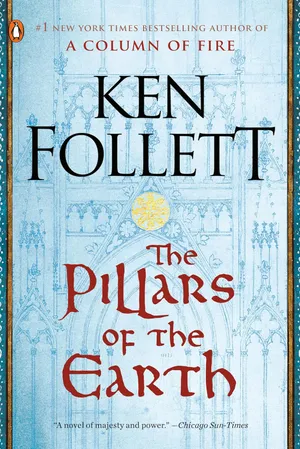
Our Review
Ken Follett's masterpiece opens with a hanging in 1123 England and doesn't let go for over a thousand pages. Set during the civil war known as "the Anarchy" — when King Stephen and Empress Maud tore England apart fighting for the crown — The Pillars of the Earth follows the decades-long construction of a cathedral in the fictional town of Kingsbridge, and uses that cathedral as the axis around which an entire world turns.
Tom Builder is the master mason whose dream of building a cathedral becomes the central pillar of the narrative. Prior Philip is the monk whose political cunning and genuine faith make the project possible. And circling around them are villains — the genuinely terrifying William Hamleigh and the scheming Bishop Waleran — whose cruelty feels historically authentic rather than cartoonish. Follett researched medieval construction with obsessive thoroughness, and the technical details of how stone was quarried, arches were raised, and vaults were engineered become as gripping as any battle scene.
But what makes the novel extraordinary is its scope. Across roughly forty years of narrative, Follett tracks births, deaths, famines, wars, political upheavals, and the slow, grinding transformation of a medieval town, all while maintaining the momentum of a thriller. The cathedral rises stone by stone, and you feel every setback and every triumph as if you were laying the mortar yourself.
Why This Book Earned Its Place in the Top 100
The Pillars of the Earth earns its place by proving that historical fiction at its best can make the distant past feel as immediate and urgent as the present. Follett took a subject that sounds impossibly dry — medieval cathedral construction — and turned it into one of the most compulsively readable novels of the 20th century. That is a genuine literary achievement.
The novel also represents the apex of a particular kind of storytelling: the epic page-turner that respects its readers' intelligence. Follett doesn't dumb down the medieval world. He shows you exactly how feudalism worked, how the Church operated as a political institution, how justice functioned (and didn't), and how ordinary people navigated a world of extraordinary danger and limited options. The result is historical fiction that educates as thoroughly as it entertains.
More than thirty-five years after publication, the novel remains the standard against which all popular historical fiction is measured. Its influence on the genre — sweeping timelines, architectural or technical detail woven into human drama, morally complex casts of dozens — is visible in everything from Hilary Mantel's Wolf Hall to Ken Follett's own subsequent work.
Who Should Read This Book
- •Anyone who loves epic storytelling — this is one of the great page-turners, a novel that spans decades and hundreds of characters without ever losing momentum.
- •History enthusiasts — Follett's research into medieval England is impeccable, and you'll learn an enormous amount about 12th-century life without ever feeling lectured.
- •Readers fascinated by architecture and construction — the technical details of cathedral building are presented with infectious enthusiasm and genuine drama.
- •People who enjoy morally complex villains — William Hamleigh and Waleran Bigod are among the most memorable antagonists in popular fiction.
- •Fans of Game of Thrones who want something rooted in real history — Follett's medieval England is just as brutal, political, and addictive, without the dragons.
Key Themes and Takeaways
- Faith and ambition
- The cathedral represents both genuine spiritual aspiration and the earthly hunger for legacy, and the novel never fully separates the two.
- Power and corruption
- The struggle between church, crown, and feudal lords reveals how institutions meant to serve the people inevitably serve themselves.
- The dignity of craft
- Tom Builder's devotion to his trade argues that the work of making something beautiful is itself a form of meaning.
- Justice and its absence
- In a world without reliable law, the novel asks what happens when cruelty goes unpunished and whether patience itself is a form of resistance.
- Progress against entropy
- Building the cathedral becomes a metaphor for human civilization's constant struggle to create order against forces of destruction.
Cultural and Historical Impact
Published in 1989, The Pillars of the Earth has sold over 27 million copies worldwide and been translated into over 30 languages. It was named Follett's most popular novel in a 2007 reader survey and remains the most borrowed novel from British libraries in the historical fiction category. The novel was adapted into a television miniseries in 2010, starring Ian McShane and Matthew Macfadyen, and a board game and video game followed. The book revived massive popular interest in medieval architecture and history, and tourism to real medieval cathedrals increased measurably after its publication. Follett published a sequel, World Without End, in 2007, and the Kingsbridge series has since expanded to four novels.
Notable Quotes
“The most expensive part of building is the mistakes.”
“Nothing is built on stone; all is built on sand, but we must build as if the sand were stone.”
“A liar should have a good memory.”
If You Loved The Pillars of the Earth, Read These Next
Ready to read The Pillars of the Earth?
NAL · 973 pages
Buy The Pillars of the Earth on Amazon