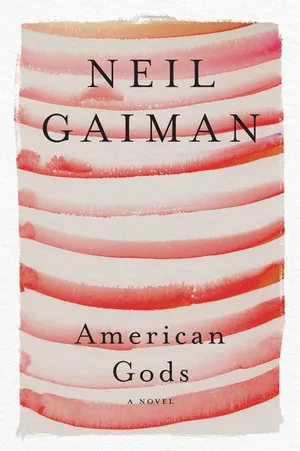
Our Review
Shadow Moon is released from prison a few days early because his wife has died in a car accident. On the plane home, he meets a con man who calls himself Mr. Wednesday — a one-eyed old hustler who offers Shadow a job as his bodyguard and driver. What follows is a road trip across the American heartland that gradually reveals itself to be a war between gods.
Neil Gaiman's premise is both simple and vast: every group of immigrants who ever came to America brought their gods with them. Odin, Anansi, Czernobog, Easter, the jinn of the Arabian desert — they all exist, diminished and forgotten, scraping by in a country that has moved on to worshipping new deities: Media, Technology, the Internet, the Stock Market. Wednesday is rallying the old gods for a final battle against the new, and Shadow — grieving, lost, and strangely passive — finds himself at the center of a conflict that will decide what Americans truly worship.
American Gods is part road novel, part mythology textbook, part meditation on what America is and how it devours the cultures it absorbs. Gaiman's prose is deceptively simple — clean sentences that land with unexpected weight — and his vision of America as a graveyard of abandoned beliefs is both haunting and deeply original. The novel's greatest achievement is making you see the sacred lurking inside the mundane: in roadside attractions, truck stops, small towns, and the spaces between highways where anything might be hiding.
Why This Book Earned Its Place in the Top 100
American Gods earns its place by doing something no other novel has done quite as well: it uses mythology to explain America to itself. Gaiman's central insight — that America is a country that imports gods and then forgets them, endlessly chasing the next object of worship — is not just clever; it's genuinely illuminating. After reading this novel, you will never drive through a small American town without wondering what forgotten deity might be living above the hardware store.
The book also represents the pinnacle of a certain kind of genre-defying fiction. It is fantasy, but not epic fantasy. It is literary fiction, but with gods and magic. It is a road novel, a mystery, a love story, and a piece of cultural criticism simultaneously. Gaiman refuses to choose a lane, and the result is a book that feels like nothing else.
American Gods also proved that intelligent, mythologically literate fantasy could command a massive mainstream audience. It won the Hugo, the Nebula, and the Bram Stoker Award simultaneously — a sweep that had never been achieved before — and its success paved the way for a generation of literary fantasy that refuses to apologize for taking the genre seriously.
Who Should Read This Book
- •Anyone fascinated by mythology — Gaiman weaves Norse, African, Slavic, Egyptian, and dozens of other mythological traditions into a single, coherent American narrative.
- •Road trip enthusiasts — the novel's journey through small-town America is as vivid and atmospheric as any Kerouac, with better plotting.
- •Readers who want fantasy with intellectual depth — this is fantasy that thinks seriously about immigration, belief, identity, and what makes a country a country.
- •Fans of genre-blending fiction — if you resist being told what shelf a book belongs on, this novel was written for you.
- •People interested in American culture and identity — Gaiman, a British immigrant himself, sees America with the clarity of an outsider and the affection of someone who chose to stay.
Key Themes and Takeaways
- Immigration and cultural memory
- The old gods are metaphors for the traditions immigrants carry and America gradually erodes.
- Belief and worship
- The novel argues that what a society worships defines it, and that the shift from ancient gods to modern obsessions reveals something fundamental about American values.
- Identity and belonging
- Shadow's search for purpose mirrors the immigrant experience of finding one's place in a country that promises everything and delivers selectively.
- The sacred and the mundane
- Gaiman finds divinity in rest stops, diners, and motels, suggesting that the mythological has never left — we've just stopped looking.
- Sacrifice and con artistry
- Wednesday's scheme blurs the line between genuine faith and manipulation, asking whether belief that is engineered is still real.
Cultural and Historical Impact
Published in 2001, American Gods won the Hugo Award, the Nebula Award, the Bram Stoker Award, and the Locus Award — a genre-award sweep unprecedented at the time. The novel has sold millions of copies worldwide and been translated into over 30 languages. A tenth-anniversary "Author's Preferred Text" was published in 2011 with approximately 12,000 additional words. Starz adapted the novel into a television series that ran from 2017 to 2021, starring Ricky Whittle and Ian McShane. The novel is widely credited with elevating Neil Gaiman from cult favorite to mainstream literary figure and is frequently taught in university courses on American literature, mythology, and genre fiction.
Notable Quotes
“I believe that all men are just overgrown boys with deep problems communicating.”
“People populate the darkness; with ghosts, with gods, with electrons, with tales.”
“Every hour wounds. The last one kills.”
If You Loved American Gods, Read These Next

Ready to read American Gods?
William Morrow Paperbacks · 541 pages
Buy American Gods on Amazon