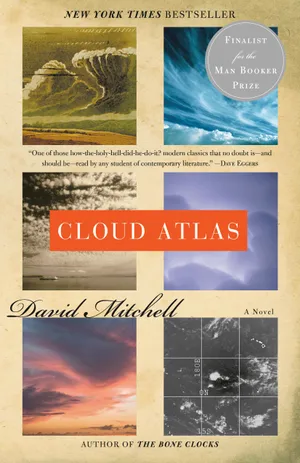
Our Review
Cloud Atlas is six novels in one, nested inside each other like Russian dolls. A 19th-century notary crosses the Pacific and encounters slavery. A disgraced young composer in 1930s Belgium writes letters to his lover while working for a dying genius. A journalist in 1970s California investigates a nuclear power plant conspiracy. A present-day publisher is imprisoned in a nursing home. A genetically engineered servant in a dystopian future Korea discovers the truth about her existence. And in a post-apocalyptic Hawaii, a goatherd encounters the last remnants of technological civilization.
David Mitchell begins each story, interrupts it at a cliffhanger, begins the next, and so on until the sixth — the only one told complete — after which he resolves each story in reverse order. The structure sounds like a gimmick, but it isn't. Each narrative is connected to the others through recurring themes, echoing imagery, and characters who may or may not be reincarnations of each other. A birthmark appears across centuries. A piece of music composed in one story is discovered in another. A manuscript read in one era was written in another.
The result is a novel that argues, through its very structure, that human experience repeats itself across time — that the same conflicts between power and compassion, exploitation and empathy, destruction and creation play out endlessly. Mitchell writes each section in a different genre and a different style, and the virtuosity is breathtaking. This is one of the most ambitious novels of the 21st century, and it delivers on its ambitions.
Why This Book Earned Its Place in the Top 100
Cloud Atlas earns its place through sheer ambition and the extraordinary skill with which that ambition is realized. Mitchell didn't just write one good novel — he wrote six, each in a different genre and register, and then wove them into a unified whole that is greater than the sum of its parts. The structural innovation alone would be impressive; that it also works emotionally, with each story landing its own unique punch, is remarkable.
The novel's central argument — that the boundaries between past, present, and future are less solid than we assume, and that the choices individuals make ripple across centuries — is both intellectually compelling and deeply felt. Mitchell doesn't just assert connectedness; he demonstrates it through the reading experience itself, as you begin to see patterns, echoes, and rhymes across the six narratives.
Cloud Atlas also proved that experimental fiction could be commercially successful. The novel became an international bestseller, was translated into dozens of languages, and was adapted into a major film. It showed publishers and readers alike that ambition, complexity, and popularity are not mutually exclusive — that readers will follow you anywhere if the storytelling is good enough.
Who Should Read This Book
- •Readers who love ambitious, structurally inventive fiction — if you want a novel that challenges how stories can be told, this is essential reading.
- •People who enjoy multiple genres — each nested narrative is a different genre, from historical adventure to noir thriller to dystopian sci-fi, and all are executed with skill.
- •Anyone fascinated by connectedness and patterns — the echoes between stories reward close reading and generate genuine wonder.
- •Fans of David Mitchell's other work — this is his magnum opus, the book where all his gifts converge.
- •Readers who want to be surprised — the structure means you never know what's coming next, and the transitions between eras are thrilling.
Key Themes and Takeaways
- The interconnectedness of human experience
- The nested structure argues that the same moral struggles recur across centuries and civilizations.
- Power and exploitation
- Each narrative features some form of the strong preying on the weak — slavery, corporate greed, totalitarianism — suggesting this dynamic is humanity's defining challenge.
- Reincarnation and recurrence
- The recurring birthmark and echoing characters suggest that souls or patterns persist across time, though Mitchell leaves the metaphysics ambiguous.
- The power of storytelling
- Each narrative is discovered and read by characters in the next, arguing that stories are how human experience survives and transmits across time.
- Individual choice against systemic evil
- In every era, a character chooses compassion or resistance against an unjust system, and the novel argues these small choices matter even when they seem futile.
Cultural and Historical Impact
Published in 2004, Cloud Atlas was shortlisted for the Booker Prize and won the British Book Awards Literary Fiction Award. It has been translated into over 30 languages and sold millions of copies worldwide. The 2012 film adaptation by the Wachowskis and Tom Tykwer, starring Tom Hanks, Halle Berry, and Hugh Grant in multiple roles across the six stories, was one of the most ambitious literary adaptations ever attempted, with a budget of over $100 million. The novel is widely taught in university courses on contemporary fiction, narrative structure, and postmodernism, and it is frequently cited by critics as one of the defining novels of the 21st century. Mitchell's subsequent novels continue to explore the same interconnected universe, making Cloud Atlas the keystone of an expanding literary project.
Notable Quotes
“Our lives are not our own. We are bound to others, past and present, and by each crime and every kindness, we birth our future.”
“Travel far enough, you meet yourself.”
“My life amounts to no more than one drop in a limitless ocean. Yet what is any ocean, but a multitude of drops?”
If You Loved Cloud Atlas, Read These Next
Ready to read Cloud Atlas?
Random House Trade Paperbacks · 509 pages
Buy Cloud Atlas on Amazon