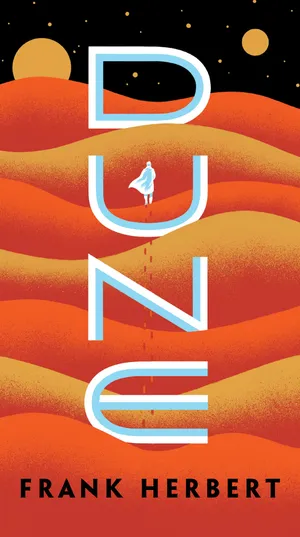
Our Review
The planet Arrakis is a desert hell — waterless, scoured by sandstorms, stalked by colossal sandworms that can swallow a mining crawler whole. It is also the most valuable planet in the universe, because it is the only source of melange, a spice that extends human life, expands consciousness, and makes interstellar travel possible. Whoever controls Arrakis controls the spice. Whoever controls the spice controls the known universe.
When Duke Leto Atreides is ordered by the Emperor to take stewardship of Arrakis from the brutal Harkonnens, he knows it's a trap. He goes anyway, bringing his concubine Jessica — a member of the mysterious Bene Gesserit sisterhood — and his son Paul, a young man who may be the culmination of a centuries-long breeding program designed to produce a super-being. The trap springs. The Duke falls. And Paul, cast into the desert with his mother, must survive among the Fremen — the fierce desert people who have been waiting for a messiah.
Frank Herbert spent six years researching and writing Dune, and the depth shows on every page. The ecology of Arrakis is fully realized. The political machinations between houses, guilds, and religious orders are as layered as anything in Machiavelli. And at the novel's center is a profound warning about charismatic leaders: Paul Atreides is not simply a hero. He is a catastrophe in the making — a young man whose genuine abilities are leveraged by prophecy, desperation, and the human hunger for a savior into something far more dangerous than any villain.
Why This Book Earned Its Place in the Top 100
Dune is the most influential science fiction novel ever written after the works of H.G. Wells. Herbert didn't just build a world — he built an ecosystem, a political system, a religious system, and an economic system, and he showed how they all depend on each other. No science fiction novel before Dune had attempted that level of systemic complexity, and few since have achieved it.
The novel earns its top-100 spot for its ideas alone. Herbert was writing about ecological collapse, resource wars, and the dangers of messianic thinking in 1965 — decades before climate change, Middle Eastern oil politics, and cult-of-personality leadership became the defining concerns of our era. Dune does not feel like a sixty-year-old book. It feels like it was written next year.
But Dune is not merely prescient. It is also a deeply compelling human story about a young man who gains everything the world says he should want — power, prophecy, adoration — and discovers that getting what you want can be the greatest tragedy of all. Paul's journey is one of the most complex and morally ambiguous arcs in all of fiction, and Herbert's refusal to let it be a simple hero's journey is what elevates Dune from great adventure to genuine literature.
Who Should Read This Book
- •Readers who love world-building — Arrakis is the most fully realized fictional planet in literature, and the political, ecological, and religious systems Herbert built are endlessly fascinating.
- •Anyone interested in ecology and environmental science — Dune was the first major novel to treat ecology as a science-fiction subject, and its insights remain relevant.
- •People who distrust messianic narratives — Herbert's deconstruction of the 'chosen one' myth is the novel's deepest and most important theme.
- •Political junkies — the machinations between House Atreides, House Harkonnen, the Emperor, the Spacing Guild, and the Bene Gesserit are as intricate as any political thriller.
- •Fans of the recent Denis Villeneuve films who want the full story — the movies are excellent, but the novel's internal monologues and political depth cannot be fully captured on screen.
Key Themes and Takeaways
- Ecology and resource politics
- Arrakis is a parable for oil-dependent economies, and Herbert shows how control of a single resource shapes civilizations.
- The danger of charismatic leaders
- Paul's rise to messiah status is presented not as triumph but as tragedy — Herbert warned that humanity's desire for saviors is its greatest weakness.
- Religion as political tool
- The Bene Gesserit's Missionaria Protectiva — seeding prophecies on primitive worlds for future exploitation — reveals how faith can be manufactured and weaponized.
- Colonialism and indigenous resistance
- The Fremen's struggle against imperial exploitation parallels real-world colonial histories, and their weaponization of the desert itself is their greatest act of resistance.
- Prescience and free will
- Paul's ability to see the future traps rather than liberates him, raising questions about whether foreknowledge is a gift or a prison.
- Human potential and its limits
- The Bene Gesserit, the Mentats, and the Guild Navigators each represent different paths of human evolution, and the novel asks which path leads to survival.
Cultural and Historical Impact
Published in 1965, Dune won both the Hugo Award and the inaugural Nebula Award — the only novel to win both in the same year at that time. It has sold over 20 million copies worldwide and is the bestselling science fiction novel in history. David Lynch's 1984 film adaptation, while commercially unsuccessful, became a cult classic. Denis Villeneuve's two-part adaptation (2021 and 2024) grossed over $1.1 billion combined and brought the novel to a massive new audience. Herbert wrote five sequels, and the expanded Dune universe now encompasses over 20 novels. The book's influence extends beyond fiction — it shaped real-world thinking about ecology, resource management, and Middle Eastern politics. The word "sandworm" and the phrase "the spice must flow" have entered popular culture.
Notable Quotes
“I must not fear. Fear is the mind-killer. Fear is the little-death that brings total obliteration.”
“He who controls the spice controls the universe.”
“The mystery of life isn't a problem to solve, but a reality to experience.”
If You Loved Dune, Read These Next
Ready to read Dune?
Ace Books · 688 pages
Buy Dune on Amazon