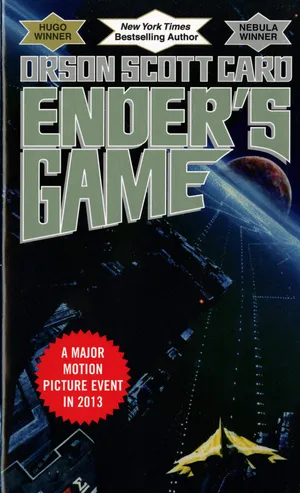
Our Review
Andrew "Ender" Wiggin is six years old when the International Fleet takes him from his family and sends him to Battle School, an orbital military academy where Earth's most gifted children are trained to fight the Buggers — an alien species that nearly destroyed humanity in two previous invasions. The adults running the school believe Ender may be the commander who can win the next war. They also believe that to forge him into that commander, they must isolate him, push him past his limits, and systematically strip away every support system he builds.
The Battle Room — a zero-gravity arena where teams of children fight tactical games — is one of the most brilliantly conceived settings in science fiction. Card uses it to show Ender's genius not as raw power but as the ability to see problems from angles no one else considers. Ender doesn't just win; he redefines the rules of engagement. But every victory costs him. The isolation wears him down. The violence he's capable of terrifies him. And the question that haunts the novel — is the military justified in destroying a child's innocence to save a species? — never gets a comfortable answer.
The ending of Ender's Game is one of the most famous reveals in science fiction, and it reframes everything that came before with devastating moral clarity. What Ender discovers about the nature of his training, and about the enemy he's been taught to hate, turns a brilliant military thriller into a profound meditation on empathy, violence, and the cost of dehumanizing others.
Why This Book Earned Its Place in the Top 100
Ender's Game earns its place by achieving something extraordinarily difficult: it tells a story about a child soldier that is both exhilarating and morally devastating. Card makes you root for Ender's tactical brilliance — the Battle Room sequences are genuinely thrilling — while simultaneously building a case that what the adults are doing to this child is monstrous. The tension between those two responses is the novel's engine, and it never resolves into easy answers.
The book is also one of the most psychologically astute novels in the genre. Ender's loneliness, his guilt about his own capacity for violence, his desperate desire to be good despite being trained for destruction — these are not genre tropes but genuinely complex character work. Card understood that the most interesting thing about a military genius is not what he can do but what it costs him.
Ender's Game has been required reading at the United States Marine Corps University and has been widely used in leadership training programs, which says something about the seriousness with which its ideas about command, empathy, and the ethics of warfare are taken. It crossed from genre fiction into the mainstream curriculum because its questions are real and permanent.
Who Should Read This Book
- •Young readers encountering science fiction for the first time — this is one of the great gateway novels, accessible to teenagers but rich enough to reward adult re-reading.
- •Anyone interested in military strategy and leadership — the tactical scenarios are brilliantly constructed and have been used in actual military education.
- •Readers who care about the ethics of war — the novel's central question about what we sacrifice to achieve security is as relevant now as in 1985.
- •People who love morally complex fiction — the ending forces a complete reassessment of everything you've read, and the moral implications are genuinely haunting.
- •Fans of smart, fast-paced sci-fi — the novel's pace is relentless, but it never sacrifices depth for speed.
Key Themes and Takeaways
- The ethics of child soldiers
- The military's calculated destruction of Ender's childhood raises questions about whether any cause justifies the exploitation of children.
- Empathy as weapon and weakness
- Ender's ability to understand his enemies completely is what makes him both the perfect commander and a deeply suffering human being.
- Dehumanization of the enemy
- The novel's climax reveals the catastrophic consequences of teaching a population to see another species as less than worthy of understanding.
- Isolation and leadership
- The adults' deliberate isolation of Ender argues that great leadership comes at an inhuman personal cost.
- The boundary between games and reality
- The Battle Room and the final simulation blur the line between play and warfare, asking when a game stops being a game.
Cultural and Historical Impact
Published in 1985, Ender's Game won both the Hugo Award and the Nebula Award — and Card's sequel, Speaker for the Dead, won both awards the following year, making him the only author to win both major science fiction prizes two years running. The novel has sold millions of copies and is taught in schools and military academies worldwide. The United States Marine Corps Professional Reading List includes it as recommended reading for leadership development. A 2013 film adaptation starred Asa Butterfield and Harrison Ford. The novel has inspired extensive scholarly analysis and remains one of the most debated works in science fiction for both its literary merit and the controversies surrounding its author's personal views. The Ender universe has expanded to over a dozen novels and novellas.
Notable Quotes
“In the moment when I truly understand my enemy, understand him well enough to defeat him, then in that very moment I also love him.”
“I think it's impossible to really understand somebody, what they want, what they believe, and not love them the way they love themselves.”
“Perhaps it's impossible to wear an identity without becoming what you pretend to be.”
If You Loved Ender's Game, Read These Next


Ready to read Ender's Game?
Tor Books · 324 pages
Buy Ender's Game on Amazon