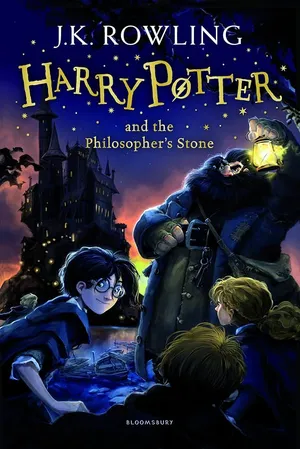
Our Review
On the surface, the setup is simple enough: an orphaned boy discovers he is a wizard, escapes his miserable life with cruel relatives, and enters a hidden school of magic. But what J.K. Rowling did with this premise in 1997 changed children's publishing permanently and created the most successful literary franchise in history.
Harry Potter lives under the stairs at 4 Privet Drive, bullied by the Dursleys, who have spent a decade trying to stamp the magic out of him. On his eleventh birthday, a giant named Hagrid shows up and tells Harry the truth: his parents were murdered by the dark wizard Voldemort, and Harry survived the killing curse with nothing but a lightning-bolt scar. At Hogwarts School of Witchcraft and Wizardry, Harry discovers friendship (Ron Weasley, Hermione Granger), rivalry (Draco Malfoy), and a mystery involving a three-headed dog and a philosopher's stone.
What Rowling got right was not the magic — it was the emotional architecture. Harry's deepest desire, revealed by the Mirror of Erised, is not power or wealth but his dead parents standing beside him. That longing drives the entire series and gives even this first, relatively lighthearted installment a gravity that separates it from its imitators. The book is a perfect children's adventure. It is also a story about the most ordinary and devastating human wish: to belong.
Why This Book Earned Its Place in the Top 100
Harry Potter and the Sorcerer's Stone earns its place not merely because of its commercial success — though that success is staggering — but because it reshaped the literary landscape of an entire generation. Before Harry Potter, children's publishing was considered a quiet, modest corner of the industry. After it, children's books could be cultural events on the scale of blockbuster films.
More importantly, the series got millions of children to read. Not just to start reading, but to demand 800-page novels, to line up at midnight for a book, to form communities around literature at an age when screens were already competing for their attention. No other book in the past fifty years has done more for literacy, and the Sorcerer's Stone is where it began.
But strip away the phenomenon, and the book itself remains remarkably well-crafted. Rowling's plotting is meticulous — details planted in chapter one pay off in chapter seventeen. Her characters are vivid and emotionally real. Hogwarts, with its moving staircases and talking portraits, is one of the most fully imagined settings in all of fantasy. It is a book that children devour and that adults return to with undiminished pleasure.
Who Should Read This Book
- •Everyone who somehow missed it — there is a reason this book conquered the world, and it holds up beautifully for first-time adult readers.
- •Parents looking for the perfect read-aloud — the Sorcerer's Stone is calibrated to delight both the reader and the listener.
- •Fans of fantasy world-building — Hogwarts is the gold standard, and this first book lays its foundation with masterful economy.
- •Readers who love stories about outcasts finding where they belong — Harry's journey from cupboard to castle is an archetype executed to perfection.
- •Anyone who wants to understand modern pop culture — Harry Potter is embedded in the DNA of twenty-first-century storytelling.
Key Themes and Takeaways
- Belonging and found family
- Harry's deepest arc is not defeating evil but finding the family and home that were stolen from him.
- The power of love as protection
- Lily Potter's sacrifice creates a literal shield around Harry — love as the strongest magic is the series' foundational premise.
- Good versus evil and moral choice
- Dumbledore teaches that it is our choices, not our abilities, that determine who we are — a moral framework the entire series is built upon.
- Class and prejudice in the wizarding world
- The pure-blood obsession mirrors real-world racism and class snobbery, introduced here through the Malfoys and their contempt for Muggle-borns.
- The corruption of the desire for immortality
- Voldemort's pursuit of the Philosopher's Stone reveals that the wish to conquer death is the root of his evil.
Cultural and Historical Impact
Published on June 26, 1997, with an initial UK print run of just 500 copies, Harry Potter and the Sorcerer's Stone has since sold over 120 million copies worldwide and been translated into 85 languages. The seven-book series has collectively sold over 600 million copies, making it the bestselling book series in history. The eight-film franchise grossed over $7.7 billion at the global box office. The Wizarding World of Harry Potter theme parks attract millions of visitors annually. The book launched a generation of young readers and is credited with revitalizing children's publishing. First edition copies of the original 500-copy UK print run are now valued at over $80,000. The series won numerous awards, including the Hugo Award, and the cultural vocabulary it introduced — Muggle, Quidditch, Hogwarts — has entered everyday language worldwide.
Notable Quotes
“It does not do to dwell on dreams and forget to live.”
“It takes a great deal of bravery to stand up to our enemies, but just as much to stand up to our friends.”
“The truth. It is a beautiful and terrible thing, and should therefore be treated with great caution.”
If You Loved Harry Potter and the Sorcerer's Stone, Read These Next
Ready to read Harry Potter and the Sorcerer's Stone?
Scholastic · 309 pages
Buy Harry Potter and the Sorcerer's Stone on Amazon