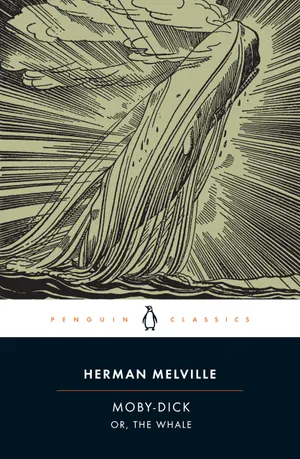
Our Review
"Call me Ishmael." Three words, and you're aboard the Pequod, sailing under the command of a man who has declared war on a whale — and through it, on the universe itself. Herman Melville published Moby-Dick in 1851, and it was a commercial and critical disaster. Melville died in 1891 a forgotten man. It took the twentieth century to recognize that he had written the Great American Novel.
Moby-Dick is ostensibly about a whaling voyage. Captain Ahab, who lost his leg to the great white whale, has bent the entire crew of the Pequod to a single monomaniacal purpose: vengeance. Ishmael, our narrator, is a philosophical drifter who signed on for adventure and found himself inside an obsession that will consume everything it touches.
But the novel is also — and this is where it either loses readers or converts them for life — a compendium, an encyclopedia, a sermon, a comedy, a tragedy, and a scientific treatise. There are entire chapters on cetology, on the whiteness of the whale, on the precise technique of rendering blubber. Melville stuffed everything he knew about the world into this book, and what emerged was not a novel in any conventional sense but a cosmos between covers.
The result is wild, uneven, sometimes tedious, and ultimately staggering. Moby-Dick is literature as expedition — long, unpredictable, and impossible to forget once you've survived it.
Why This Book Earned Its Place in the Top 100
Moby-Dick earns its place because no other American novel attempts so much or reaches so high. It is simultaneously a seafaring adventure, a philosophical meditation, a workplace documentary, a Shakespearean tragedy, and a prose poem about the terror of unknowable nature. That it fails to be all of these things perfectly is part of its genius. Perfection would have made it smaller.
Captain Ahab is one of literature's great creations — not because he is sympathetic, but because he is recognizable. Anyone who has ever been consumed by a grievance they knew was destroying them, yet could not relinquish, knows something of Ahab. Melville gave obsession its definitive portrait.
The novel also matters because of what it says about America itself. The Pequod is a ship of all nations, commanded by a lunatic who mistakes his personal wound for a cosmic injustice. The crew follows because his certainty is intoxicating. The parallel to democratic societies led astray by charismatic monomania is impossible to miss, and it has only grown more legible with time.
Finally, the prose itself justifies the journey. Melville writes passages of such thunderous beauty that they alter your sense of what English can do.
Who Should Read This Book
- •Ambitious readers looking for a life-changing challenge — Moby-Dick rewards persistence with passages of astonishing power that you will carry with you permanently.
- •Anyone fascinated by obsession — Ahab is the literary archetype, and Melville's portrait of monomania has never been surpassed.
- •Lovers of the natural world — the whaling chapters are the most detailed, awe-filled description of a vanished industry and its relationship to nature ever written.
- •Readers who want to understand American literature — this is its foundation stone, the novel from which everything else flows.
Key Themes and Takeaways
- Obsession and monomania
- Ahab's relentless pursuit of the white whale is the definitive literary portrait of how a single fixation can devour an entire life.
- Humanity versus nature
- The whale is indifferent to Ahab's rage, and that indifference is the novel's most terrifying statement about the natural world.
- The unknowable
- The whiteness of the whale chapter meditates on the horror of a universe that refuses to yield its meaning.
- American democracy and its dangers
- The Pequod's multiethnic crew, led by a tyrant they freely chose to follow, is a pointed allegory for democratic societies.
- Friendship and human connection
- Ishmael and Queequeg's bond — tender, cross-cultural, and life-saving — provides the novel's warmest counterpoint to Ahab's isolation.
- Fate and free will
- Every character aboard the Pequod has chosen to be there, yet the voyage feels foreordained from the first page.
Cultural and Historical Impact
Published in 1851, Moby-Dick sold fewer than 3,500 copies in Melville's lifetime and went out of print. Its rediscovery in the 1920s — driven by Carl Van Doren, Raymond Weaver, and others — is one of literary history's great reversals. Today it is widely considered the greatest American novel ever written. It has been adapted into the iconic 1956 John Huston film starring Gregory Peck, a 2010 miniseries, an opera, and countless cultural references from Star Trek to Jaws. The novel inspired Patrick Stewart's one-man stage adaptation and Ron Howard's In the Heart of the Sea. "Call me Ishmael" is the most famous opening line in American literature. The word "Moby-Dick" itself has become shorthand for any impossible, self-destructive pursuit.
Notable Quotes
“Call me Ishmael.”
“I know not all that may be coming, but be it what it will, I'll go to it laughing.”
“It is not down on any map; true places never are.”
If You Loved Moby-Dick, Read These Next

Ready to read Moby-Dick?
Penguin Classics · 720 pages
Buy Moby-Dick on Amazon