Our Review
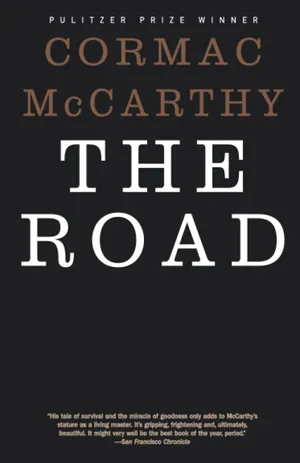
The Road is the most terrifying book Cormac McCarthy ever wrote, and McCarthy spent his career writing terrifying books. Published in 2006, it follows a nameless father and his young son as they push a shopping cart through a post-apocalyptic America. The world has been destroyed — the cause is never specified — and what remains is ash, silence, and roving bands of cannibals. There is almost no food. There is no law. The sun is hidden behind a permanent gray sky.
The plot, such as it is, consists of the father and son walking south toward the coast, hoping without evidence that something better awaits. Along the way, they scavenge for food, hide from other survivors, and have conversations so spare and so tender that they will shatter you. The boy asks his father if they are "the good guys." The father says yes. The boy asks how they can tell. The father says they carry the fire. This exchange, in a book stripped of almost everything, carries the weight of all human morality.
McCarthy's prose has never been barer. Gone are the baroque sentences of Blood Meridian and Suttree. The Road is written in short, declarative fragments, punctuated by descriptions of desolation so vivid they feel hallucinatory. There are no quotation marks. There are almost no proper nouns. The effect is of reading something carved into bone. This is a book about the end of the world that is really about the only thing that matters: the love between a parent and a child.
Why This Book Earned Its Place in the Top 100
The Road earns its place because it does something that should be impossible: it takes the most exhausted genre in fiction — the post-apocalyptic survival story — and makes it feel entirely new by stripping it down to its emotional core. There are no exciting action sequences, no clever rebuilding of civilization, no explanation of what happened. There is only a father trying to keep his son alive and good in a world that has ceased to reward either quality.
The book's power comes from its absolute refusal to offer false comfort. McCarthy does not sentimentalize the father-son relationship. The father is capable of violence. The boy's innocence is not portrayed as wisdom but as a vulnerability that the world is trying to destroy. Yet the book is not nihilistic. The boy's insistence on compassion — his desire to help strangers even when helping strangers could mean death — is presented as something irreducible, something that survives even the end of everything. The Road is McCarthy's most human book, and for a writer often accused of coldness, it is his most devastating argument that love matters.
Who Should Read This Book
- •Parents — this book will reach inside your chest and rearrange things. The father's desperate love for his son is the most primal and recognizable emotion in literature.
- •Readers who think literary fiction cannot be gripping — The Road is as tense as any thriller, with genuine danger on every page.
- •Fans of Cormac McCarthy or post-apocalyptic fiction — this is the genre's masterpiece, the book against which all others are measured.
- •Anyone grappling with despair — paradoxically, this bleakest of books contains one of literature's most powerful arguments for hope.
Key Themes and Takeaways
- Parental love in extremis
- The father's love for his son is the only force that gives meaning to a world that has lost all other sources of meaning.
- Good and evil after civilization
- When law, religion, and society have been destroyed, what remains of morality? The boy's insistence on goodness suggests it is innate.
- Carrying the fire
- The father and son describe themselves as people who 'carry the fire' — a metaphor for maintaining humanity and moral purpose in the face of annihilation.
- Survival and its costs
- Staying alive requires terrible choices, and the book asks whether survival without moral purpose is worth anything at all.
- The end of the natural world
- McCarthy's dead landscape — ashen forests, lifeless rivers, a sunless sky — is an ecological nightmare that resonates with contemporary environmental anxiety.
Cultural and Historical Impact
The Road was published in 2006 and won the Pulitzer Prize for Fiction in 2007. Oprah Winfrey selected it for her book club, introducing it to millions of readers who might never have picked up McCarthy otherwise. The book debuted at #1 on the New York Times bestseller list. It was adapted into a feature film in 2009, starring Viggo Mortensen. Critics have called it one of the greatest novels of the 21st century. The book has been translated into dozens of languages and has sold millions of copies worldwide. It is regularly cited in discussions of climate change and environmental collapse as a literary representation of worst-case scenarios. McCarthy's stripped-down prose style in The Road influenced a generation of literary fiction writers.
Notable Quotes
“You forget what you want to remember, and you remember what you want to forget.”
“Nobody wants to be here and nobody wants to leave.”
“Each the other's world entire.”
If You Loved The Road, Read These Next
Ready to read The Road?
Vintage International · 287 pages
Buy The Road on Amazon