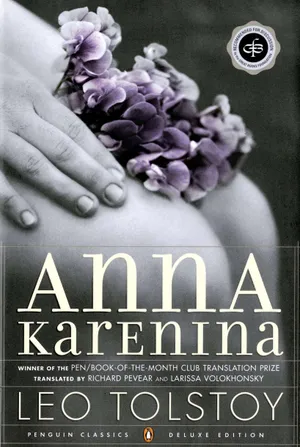
Our Review
Leo Tolstoy's "Anna Karenina" opens with one of the most famous lines in world literature — "Happy families are all alike; every unhappy family is unhappy in its own way" — and then proceeds to prove the point across eight hundred magnificent pages. The novel tells two parallel stories: Anna Karenina, a beautiful, intelligent, married woman who begins a passionate affair with the dashing Count Vronsky, and Konstantin Levin, a landowner struggling to find meaning in work, faith, and marriage. Anna's story is a devastating downward spiral; Levin's is a difficult, uncertain ascent toward something like grace. Together, they form Tolstoy's complete vision of human life.
What makes "Anna Karenina" extraordinary — what makes many readers and writers consider it the greatest novel ever written — is Tolstoy's almost supernatural ability to render the texture of lived experience. No other writer has ever captured the way human beings actually think, feel, and behave with such comprehensive fidelity. A horse race, a country harvest, a conversation over dinner, the first moment of holding a newborn child — Tolstoy makes every scene feel as if it is happening to you, right now, in your own body.
Anna herself is one of fiction's most complex and sympathetic characters. Tolstoy does not judge her affair — he makes us understand it completely, feel its intoxicating pull, and then shows us, with terrible inevitability, the social machinery that grinds her down. Her tragedy is that she lives in a world that grants men the freedom it denies women, and she is too honest and too passionate to pretend otherwise.
Why This Book Earned Its Place in the Top 100
"Anna Karenina" belongs on this list because many of the world's greatest writers — from Dostoevsky to Nabokov to Faulkner — have called it the greatest novel ever written, and having read it, it is very difficult to disagree. Tolstoy's achievement here is not a matter of a single brilliant technique or a single powerful theme; it is the sheer totality of the vision. This novel contains everything — love, betrayal, politics, farming, horse racing, philosophy, parenthood, death, faith — and renders all of it with equal mastery and equal attention.
The dual structure of the novel is its greatest innovation. Anna's passionate tragedy and Levin's quiet spiritual search are not merely parallel plots; they are Tolstoy's argument about the two fundamental approaches to life. Anna seeks meaning through romantic passion and finds it leads to destruction. Levin seeks meaning through work, family, and faith and finds something that might be called happiness — not ecstatic, not dramatic, but sustainable and real.
The novel also matters because of its unflinching treatment of a woman trapped by a society that punishes her for the same behavior it condones in men. Anna's fate is not the result of moral failing but of a social order built on double standards, and Tolstoy's sympathy for her — even as he clearly believes she has made a fatal mistake — gives the novel its moral complexity and its emotional power.
Who Should Read This Book
- •Readers who want to experience the novel at its absolute highest level — if prose fiction has a summit, this is a strong candidate.
- •Anyone interested in the complexities of love, marriage, and infidelity — Tolstoy explores these subjects with more nuance and psychological depth than any other writer.
- •Fans of sweeping, immersive fiction — at 800+ pages, this is a novel you can live inside, and every page rewards close attention.
- •People interested in Russian history and culture — the novel is a vivid portrait of Russian aristocratic society on the cusp of massive change.
- •Readers who appreciate the interplay of the personal and the political — Levin's agrarian philosophy and Anna's social predicament are equally compelling.
Key Themes and Takeaways
- The nature of love and desire
- Tolstoy distinguishes between passionate romantic love, which consumes, and the quieter love of family and commitment, which sustains.
- Society's double standards
- Anna is punished for an affair that Vronsky and other men conduct with impunity, exposing the hypocrisy at the heart of aristocratic morality.
- The search for meaning
- Levin's parallel storyline is a profound exploration of how a thinking person finds purpose in a world that offers no easy answers.
- Family and its discontents
- The novel's famous opening line sets up its investigation into what makes families work or fail, and the answers are never simple.
- Authenticity versus social performance
- Anna's tragedy stems partly from her refusal to maintain the hypocritical facades that her society demands, while those who conform survive.
- Faith and doubt
- Levin's spiritual journey — from intellectual atheism to a tentative, hard-won faith — mirrors Tolstoy's own lifelong wrestling with religious belief.
Cultural and Historical Impact
"Anna Karenina" was published serially from 1875 to 1877 and was immediately recognized as a masterwork. Dostoevsky called it "flawless as a work of art." It has been translated into virtually every major language and has never been out of print. The novel has been adapted into more than a dozen major film and television versions, including a celebrated 2012 film directed by Joe Wright starring Keira Knightley. Its opening line is one of the most quoted in all of literature. The novel profoundly influenced the development of literary realism worldwide and is a standard text in university literature courses around the globe. Tolstoy's exploration of Anna's psychology is considered a landmark in the literary depiction of female consciousness, and the novel has been claimed by feminist critics as a key text in understanding how patriarchal societies police women's sexuality and autonomy.
Notable Quotes
“Happy families are all alike; every unhappy family is unhappy in its own way.”
“He stepped down, trying not to look long at her, as if she were the sun, yet he saw her, like the sun, even without looking.”
“If you look for perfection, you'll never be content.”
If You Loved Anna Karenina, Read These Next
Ready to read Anna Karenina?
Penguin Classics · 864 pages
Buy Anna Karenina on Amazon