Our Review
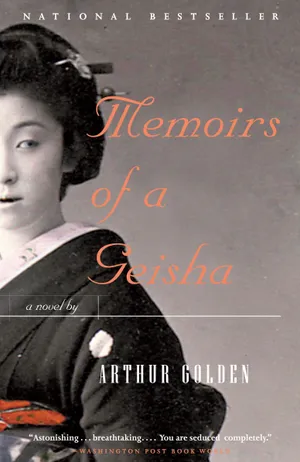
Arthur Golden spent ten years writing and rewriting Memoirs of a Geisha, and the labor shows — not in heaviness, but in the meticulous, luminous detail of a world most Western readers had never encountered. Published in 1997, the novel follows Chiyo Sakamoto, a girl from a poor fishing village who is sold into a geisha house in Kyoto's Gion district in the early 1930s, and who transforms herself into Sayuri, one of the most celebrated geisha of her era.
The world Golden builds is one of elaborate ritual, beauty, and cruelty. Sayuri's training is grueling — she must master dance, music, conversation, and the thousand small arts of making powerful men feel important. The geisha house operates on debts and rivalries. Hatsumomo, the house's reigning beauty, views Sayuri as a threat and wages a quiet war of sabotage that spans years. Mameha, an older geisha, becomes Sayuri's mentor and protector.
At the center of the story is Sayuri's lifelong love for the Chairman, a man she first encounters as a child and who shows her a moment of kindness that becomes the organizing principle of her life. The novel follows her through the rise and fall of the geisha world, through World War II and its aftermath, and through the elaborate machinations required to bring her close to the man she loves.
Golden writes about the geisha's world with the precision of an anthropologist and the sensibility of a romantic. The result is a novel that is simultaneously an education and an enchantment — a window into a vanishing culture rendered with extraordinary care.
Why This Book Earned Its Place in the Top 100
Memoirs of a Geisha earns its place because it opens a world. Before Golden's novel, the geisha existed in the Western imagination largely as a stereotype — an exotic figure glimpsed in photographs, reduced to a silhouette of painted face and silk kimono. Golden shattered that flatness by presenting the geisha's world from the inside, with all its complexity, hierarchy, beauty, and pain.
The novel also earns its place as a story of female survival and agency within a system designed to limit both. Sayuri is not a passive victim. She is strategic, resilient, and fiercely intelligent. Her navigation of the geisha world requires a kind of brilliance that the men around her never fully recognize — and that is precisely the novel's commentary on how power operates through the people who are denied it.
The writing itself is consistently beautiful. Golden has a gift for images — water, light, the texture of fabric, the movement of a fan — that make the reader feel physically present in a Kyoto that no longer exists. The novel is a feat of sustained imaginative inhabitation, and for millions of readers it remains one of the most transporting reading experiences of their lives.
Who Should Read This Book
- •Readers fascinated by Japanese culture — this is one of the most detailed and immersive fictional portrayals of the geisha world ever written.
- •Anyone who enjoys richly atmospheric historical fiction — Golden's prewar Kyoto is a fully realized sensory world.
- •Fans of coming-of-age stories with strong female protagonists — Sayuri's intelligence and resilience drive the narrative even when the world around her tries to reduce her to an ornament.
- •Romance readers who want literary depth — the love story is slow-burning, complicated, and ultimately deeply satisfying.
Key Themes and Takeaways
- Beauty as currency
- In the geisha world, physical beauty is a literal economic asset, and the novel explores the power and vulnerability that come with it.
- Female agency within constraint
- Sayuri's story is about finding ways to exercise will and intelligence within a system that denies women formal power.
- Desire and performance
- The geisha must perform desire without ever fully surrendering to it, and the line between performance and reality blurs throughout.
- Memory and storytelling
- The memoir frame reminds us that Sayuri is constructing her own narrative, choosing what to reveal and what to conceal.
- Water as metaphor
- Sayuri's name means 'small lily,' and water imagery runs throughout the novel, symbolizing both flow and containment.
Cultural and Historical Impact
Published in 1997, Memoirs of a Geisha spent two years on the New York Times bestseller list and has sold over 10 million copies worldwide. It was translated into more than 30 languages. The 2005 film adaptation, directed by Rob Marshall and starring Ziyi Zhang, grossed over $160 million worldwide and won three Academy Awards for its visual design. The novel sparked renewed Western interest in geisha culture and Japanese history. It also generated controversy: Mineko Iwasaki, the geisha who had served as Golden's primary informant, sued him for breach of confidentiality and later published her own memoir. The debate over cultural representation and authorial authority that followed the novel's success anticipated broader conversations about whose stories may be told by whom.
Notable Quotes
“Adversity is like a strong wind. I don't mean just that it holds us back from places we might otherwise go. It also tears away from us all but the things that cannot be torn, so that afterward we see ourselves as we really are.”
“At the temple there is a poem called 'Loss' carved into the stone. It has three words, but the poet has crossed them out.”
“We lead our lives like water flowing down a hill, going more or less in one direction until we splash into something that forces us to find a new course.”
If You Loved Memoirs of a Geisha, Read These Next

Ready to read Memoirs of a Geisha?
Vintage · 434 pages
Buy Memoirs of a Geisha on Amazon