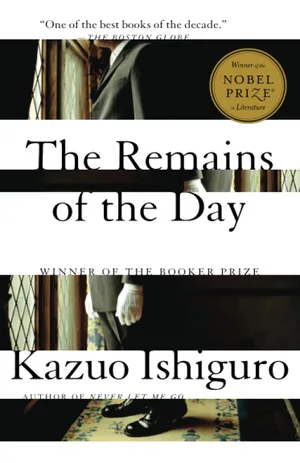
Our Review
Stevens is the perfect butler. He has devoted his entire life to serving Lord Darlington at Darlington Hall, and he has done so with a commitment to "dignity" and "greatness" that has shaped every decision he has ever made — including the decision not to love Miss Kenton, the housekeeper who was, for years, clearly and painfully in love with him.
Now it is 1956. Lord Darlington is dead, the house has been purchased by an American, and Stevens is driving through the English countryside on a short motoring trip to visit Miss Kenton — now Mrs. Benn — ostensibly to discuss her possible return to service. Along the way, he remembers. And in remembering, he begins to understand what he has lost.
Ishiguro's masterpiece is a novel about repression so complete that the narrator cannot even recognize it in himself. Stevens speaks in elaborate, formal circumlocutions that circle around his feelings without ever touching them directly. The reader must decode what Stevens cannot say — that he loved Miss Kenton, that Lord Darlington's Nazi sympathies compromised everything Stevens believed in, that he sacrificed his life for a version of duty that was, in the end, not worth the price.
The novel is very funny in a dry, devastating way, and it is also one of the saddest books ever written. The final scene — Stevens sitting on a pier as the lights come on — is a moment of recognition so complete and so quiet that it can make you weep.
Why This Book Earned Its Place in the Top 100
The Remains of the Day is one of the most perfectly constructed novels in the English language. Every sentence serves the whole. Every evasion in Stevens's narration is precisely calibrated to reveal what he is hiding from himself. The gap between what Stevens says and what he means is the novel itself, and Ishiguro maintains that gap with absolute, unwavering control for 245 pages.
The book earns its place because its subject — the cost of emotional repression — is universal. Stevens is a butler, but his story is everyone's. Who among us has not sacrificed something genuine for the sake of a role we thought we had to play? Who has not looked back and seen, too late, the moments when we chose duty over feeling and lost something irretrievable?
The novel is also a quiet masterpiece of political commentary. Stevens's devotion to Lord Darlington — who hosted Nazi sympathizers and championed appeasement — mirrors the way ordinary people enable dangerous ideologies by deferring to authority and refusing to think independently. The personal and the political are fused so seamlessly that you cannot separate them, and that fusion is the mark of genuinely great fiction.
Who Should Read This Book
- •Readers who appreciate precise, controlled prose — Ishiguro's sentences are masterclasses in the art of saying one thing and meaning another.
- •Anyone interested in English social history — the novel captures the twilight of the great English country house with melancholy precision.
- •People who have ever suppressed their feelings for the sake of duty or propriety — Stevens's story will resonate with uncomfortable recognition.
- •Fans of quiet, emotionally devastating fiction — this novel will not shout at you; it will break your heart in a whisper.
- •Those who loved Never Let Me Go — the thematic DNA is shared, and reading both novels together deepens each one immeasurably.
Key Themes and Takeaways
- Emotional repression
- Stevens's inability to acknowledge his own feelings is the novel's central tragedy, and Ishiguro makes the reader feel what Stevens cannot express.
- Duty and its costs
- The novel asks whether a life devoted entirely to service — to the point of erasing the self — can be called a life well lived.
- Memory and self-deception
- Stevens's recollections are carefully edited to protect his self-image, and the gaps in his narrative reveal more than his words.
- The decline of the English aristocracy
- Darlington Hall's change of ownership mirrors the broader collapse of the class system that gave Stevens's life its structure and meaning.
- Complicity and moral blindness
- Stevens's loyalty to a lord who enabled fascism raises questions about the moral responsibility of those who 'just follow orders.'
Cultural and Historical Impact
Published in 1989, The Remains of the Day won the Booker Prize and cemented Kazuo Ishiguro's reputation as one of the finest writers in the English language. The novel has sold millions of copies and been translated into over 30 languages. The 1993 Merchant Ivory film adaptation starring Anthony Hopkins and Emma Thompson was nominated for eight Academy Awards and is regarded as one of the finest literary adaptations ever produced. In 2017, Ishiguro was awarded the Nobel Prize in Literature, with the Swedish Academy noting his novels' ability to uncover "the abyss beneath our illusory sense of connection with the world." The Remains of the Day is consistently ranked among the greatest novels of the 20th century.
Notable Quotes
“Indeed — why should I not admit it? — in that moment, my heart was breaking.”
“What is the point of worrying oneself too much about what one could or could not have done to control the course one's life took? Surely it is enough that the likes of you and I at least try to make our small contribution count for something true and worthy.”
“The evening's the best part of the day. You've done your day's work. Now you can lie back and enjoy it.”
If You Loved The Remains of the Day, Read These Next



Ready to read The Remains of the Day?
Vintage International · 245 pages
Buy The Remains of the Day on Amazon