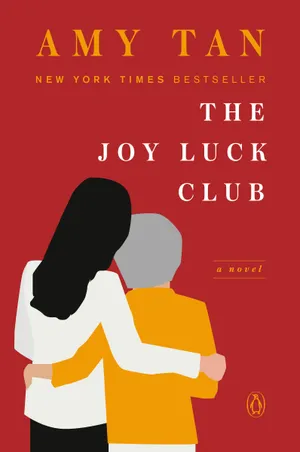
Our Review
Amy Tan's debut novel is structured like a mahjong game — four sides, sixteen stories, and a pattern that only becomes clear when you see the whole table. Four Chinese immigrant mothers and their four American-born daughters take turns narrating, and the result is a mosaic of loss, love, misunderstanding, and recognition that is both deeply Chinese and deeply American.
The mothers — Suyuan, An-mei, Lindo, and Ying-ying — carry stories from their past lives in China that they have never fully told their daughters: forced marriages, abandoned children, wars survived, identities shed. The daughters — Jing-mei, Rose, Waverly, and Lena — have grown up in San Francisco, fluent in English, steeped in American culture, and bewildered by mothers whose love expresses itself through criticism, silence, and what feels like impossible expectation.
The novel's emotional center is the gap between what the mothers mean and what the daughters hear. A mother who pushes her daughter to play piano is not trying to control her — she is trying to give her the future she herself was denied. A daughter who rebels is not ungrateful — she is suffocating under love she cannot decode. Tan renders this mutual incomprehension with such precision that readers from every background recognize the dynamic. The Joy Luck Club is about what gets lost in translation — not between languages, but between generations.
Why This Book Earned Its Place in the Top 100
The Joy Luck Club cracked open a space in American literature that had been almost entirely vacant. Before Tan's novel, the Chinese American immigrant experience was virtually invisible in mainstream fiction. After it, an entire generation of Asian American writers found a readership ready to listen. That alone would justify its place on this list.
But the novel's reach extends far beyond any single community. The mother-daughter dynamic Tan depicts — the impossible closeness, the mutual frustration, the love that cannot find the right words — is universal. Every reader who has ever struggled to understand a parent from a different world, or a child who inhabits a world you cannot enter, will find themselves in these pages.
Tan's formal innovation matters too. The interlocking stories, the shifting perspectives, the way a detail from one narrative illuminates another — the structure mirrors the mahjong table around which the Joy Luck Club meets: each piece meaningful in itself, but the full pattern visible only from above. It is a novel that rewards rereading because the connections deepen every time. And its final pages — Jing-mei traveling to China to meet the twin sisters her mother was forced to abandon — deliver one of the most emotionally devastating endings in contemporary fiction.
Who Should Read This Book
- •Anyone who has a complicated relationship with a parent — Tan captures the ache of loving someone you cannot fully understand better than almost any writer alive.
- •Readers interested in the Chinese American immigrant experience — this remains the definitive fictional treatment of that world.
- •Book clubs looking for rich discussion material — the interlocking perspectives and cultural themes generate endless conversation.
- •Fans of novels told through interconnected stories — if you loved Olive Kitteridge or A Visit from the Goon Squad, you will appreciate Tan's structure.
- •Second-generation immigrants of any background — the tension between inherited identity and adopted culture is rendered with painful accuracy.
Key Themes and Takeaways
- The mother-daughter divide
- Every mother-daughter pair enacts a different version of the same fundamental struggle: how to transmit love across a cultural and generational chasm.
- Immigration and identity
- The mothers carry China inside them like an open wound; the daughters are American in ways that feel, to their mothers, like rejection.
- Silence and storytelling
- The stories the mothers do not tell are as important as the ones they do — and the consequences of that silence shape their daughters' entire lives.
- Sacrifice and expectation
- Every mother sacrificed something enormous to give her daughter a better life, and that sacrifice creates an emotional debt the daughters can never fully repay.
- Heritage and belonging
- The novel asks whether you can belong to a culture you have never lived in — and whether you can fully belong to one that does not see you as its own.
Cultural and Historical Impact
Published in 1989, The Joy Luck Club spent 40 weeks on the New York Times bestseller list, was translated into 35 languages, and has sold over 4 million copies. Wayne Wang's 1993 film adaptation, with a screenplay co-written by Tan, became a critical and commercial success, grossing $33 million and becoming one of the most celebrated Asian American films ever made. The novel is one of the most widely taught works of contemporary fiction in American high schools and universities. It opened the door for Asian American literature in mainstream publishing and is credited with inspiring writers like Celeste Ng, Viet Thanh Nguyen, and Min Jin Lee. The book remains a touchstone for conversations about immigration, assimilation, and intergenerational communication.
Notable Quotes
“I wanted my children to have the best combination: American circumstances and Chinese character. How could I know these two things do not mix?”
“We are lost, she and I, unseen and not seeing, unheard and not hearing, unknown by others.”
“I think about two things — I think about what it means to lose something you never knew you had.”
If You Loved The Joy Luck Club, Read These Next
Ready to read The Joy Luck Club?
Penguin Books · 332 pages
Buy The Joy Luck Club on Amazon