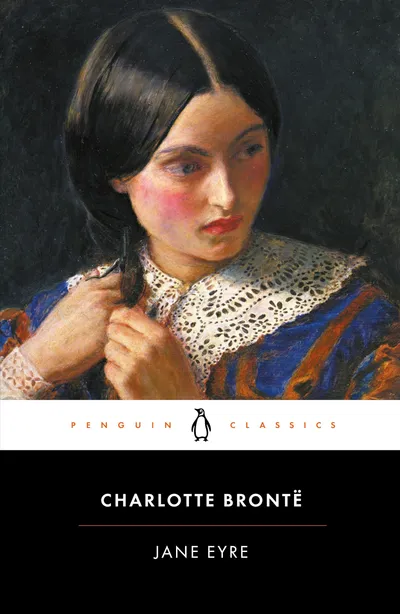
Our Review
Charlotte Brontë's "Jane Eyre" is a novel that should, by all rights, feel dated — a Victorian romance about a governess and her brooding employer. Instead, it feels as urgent and alive as the day it was published in 1847, and the reason is its heroine. Jane Eyre is one of the most fully realized, fiercely independent characters in all of English literature: plain, poor, orphaned, and absolutely unwilling to compromise her dignity or her principles for anyone.
The novel follows Jane from her abusive childhood with the Reed family, through the privations of Lowood School, to her position as governess at Thornfield Hall, where she falls in love with the enigmatic, mercurial Edward Rochester. Their romance is electrifying — built not on physical beauty or social convention but on the meeting of two equally strong and equally wounded minds. When the terrible secret of Rochester's past is revealed, Jane's response is one of literature's great acts of moral heroism: she chooses integrity over passion, even though it nearly destroys her.
What makes "Jane Eyre" revolutionary is its narrative voice. Jane speaks directly to the reader with an intimacy and frankness that was unprecedented for its time. She insists on her own worth — intellectually, emotionally, spiritually — in a society that told her she had none. Her famous declaration, "I am no bird; and no net ensnares me," is not merely a romantic statement but a political one, asserting a woman's right to selfhood nearly a century before women won the vote.
Why This Book Earned Its Place in the Top 100
"Jane Eyre" deserves its place on this list because it was one of the first novels in the English language to place a woman's interior life — her thoughts, her desires, her moral reasoning — at the absolute center of the narrative, and to insist that this interior life was as important and as complex as any man's. Brontë did not write a passive heroine waiting to be rescued; she wrote a woman who rescues herself, who demands equality in love, and who would rather suffer alone than accept a relationship built on dishonesty or dependence.
The novel also matters as a work of pure storytelling. Brontë's plot is masterfully constructed, blending Gothic atmosphere, psychological realism, and genuine suspense. The revelation of Bertha Mason in the attic remains one of fiction's most shocking twists, and the novel's final act — Jane's wandering, her discovery of family, and her return to Rochester on her own terms — is as emotionally satisfying as any ending in literature.
Its influence on subsequent fiction is immeasurable. Every strong-willed heroine in English literature owes something to Jane Eyre, and the novel essentially invented the template of the Gothic romance that persists to this day. It is both a feminist landmark and a supremely entertaining novel — a combination that is rarer than it should be.
Who Should Read This Book
- •Readers who love passionate, intelligent romance — Jane and Rochester's relationship is built on mutual respect and intellectual fire, not mere physical attraction.
- •Anyone interested in feminist literature — Jane's insistence on her own autonomy and equality was revolutionary in 1847 and remains powerful today.
- •Fans of Gothic fiction — Thornfield Hall, with its dark corridors and terrible secrets, is one of literature's most atmospheric settings.
- •People who appreciate strong narrative voice — Jane's direct, honest address to the reader creates an intimacy that few novels have matched.
- •Readers who loved 'Pride and Prejudice' and want something darker and more psychologically intense — Brontë shares Austen's intelligence but adds Gothic fire.
Key Themes and Takeaways
- Female independence and self-worth
- Jane's refusal to accept any relationship that diminishes her dignity makes the novel a proto-feminist manifesto embedded in a love story.
- Class and social mobility
- Jane's position as a governess — neither servant nor family — exposes the rigid class hierarchies of Victorian England and the precariousness of women without wealth.
- Passion versus moral duty
- The central conflict forces Jane to choose between overwhelming love and her own principles, and Brontë insists that integrity cannot be sacrificed for passion.
- The right to be seen and heard
- Jane's narrative voice is itself a theme — her insistence on telling her own story is an act of claiming space in a world that would silence her.
- Religion and morality
- Through characters like Mr. Brocklehurst and St. John Rivers, Brontë critiques religious hypocrisy while affirming a personal, compassionate faith.
- Confinement and freedom
- From the red room to Lowood to Thornfield's attic, the novel is structured around spaces of confinement and the fierce desire to break free of them.
Cultural and Historical Impact
"Jane Eyre" was published in 1847 under the pseudonym Currer Bell and was an immediate bestseller, praised by critics including William Makepeace Thackeray. It has never been out of print. The novel has been adapted into more than 20 film and television versions, including a notable 2011 film starring Mia Wasikowska and Michael Fassbender. Jean Rhys's 1966 novel "Wide Sargasso Sea," which tells the story of Bertha Mason, is one of the most celebrated literary responses to a classic novel ever written. Jane Eyre is consistently ranked among the greatest heroines in fiction, and the "madwoman in the attic" has become a central concept in feminist literary criticism, thanks to Sandra Gilbert and Susan Gubar's landmark 1979 study. The novel remains one of the most widely read and taught works of Victorian literature worldwide.
Notable Quotes
“I am no bird; and no net ensnares me: I am a free human being with an independent will.”
“I would always rather be happy than dignified.”
“Reader, I married him.”
If You Loved Jane Eyre, Read These Next
Ready to read Jane Eyre?
Penguin Classics · 532 pages
Buy Jane Eyre on Amazon