Our Review
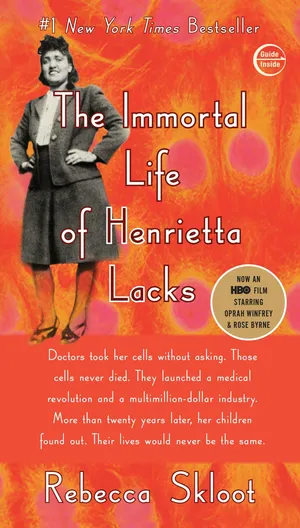
In 1951, a young Black woman named Henrietta Lacks went to Johns Hopkins Hospital with cervical cancer. During her treatment, a sample of her tumor cells was taken without her knowledge or consent. Henrietta died within months, at the age of thirty-one. Her cells did not. They became the first human cells to survive and multiply indefinitely in a laboratory — a line scientists named HeLa — and they went on to become one of the most important tools in the history of medicine.
HeLa cells helped develop the polio vaccine. They were sent into space. They were used in research on cancer, AIDS, gene mapping, and countless other breakthroughs. They have been bought and sold by the billions. And for decades, the Lacks family knew nothing about any of it. They could not afford health insurance while a multi-billion-dollar industry profited from their mother's biology.
Rebecca Skloot spent over a decade researching this story, and she tells it on three interleaving tracks: the science of HeLa cells and their extraordinary contribution to medicine; the life and death of Henrietta Lacks, a vibrant, loving woman erased from her own legacy; and the story of the Lacks family, particularly Henrietta's daughter Deborah, who spent her life trying to understand what had happened to her mother. The book is a masterpiece of narrative nonfiction — part scientific detective story, part meditation on race, ethics, and the human body as property.
Why This Book Earned Its Place in the Top 100
The Immortal Life of Henrietta Lacks earns its place because it is the rare book that operates simultaneously as great science writing, great social justice writing, and great storytelling. Skloot achieved what few nonfiction writers manage: she made cellular biology gripping, she made a forgotten woman visible, and she exposed a profound ethical failure without turning the story into a simple morality tale.
The book forces readers to confront deeply uncomfortable questions. Who owns your body? When a tissue sample taken from your body leads to scientific breakthroughs worth billions, do you — or your family — have any claim to the profits or even the knowledge? These were not hypothetical questions for the Lacks family, who learned about HeLa cells from a journalist rather than from any of the researchers who had used them.
Skloot also tells a story about race and medicine that America needs to hear. The history of medical experimentation on Black bodies without consent — from the Tuskegee syphilis study to Henrietta Lacks — is not ancient history. It is the reason many Black Americans distrust the medical establishment today. Skloot renders that history with the specificity and emotional weight it demands. This is a book that changes how you think about science, ethics, and whose stories get told.
Who Should Read This Book
- •Anyone interested in the ethics of medical research — Skloot raises questions about consent, ownership, and race that remain unresolved and urgently relevant.
- •Science enthusiasts who want to understand HeLa cells and their extraordinary impact on modern medicine — the science writing here is lucid and fascinating.
- •Readers who care about social justice — the story of the Lacks family is a case study in how systemic racism operates through institutions that claim to be neutral.
- •Fans of narrative nonfiction — Skloot's interweaving of science, biography, and family drama is a model of the genre.
- •Medical professionals and students — this book should be required reading for anyone who works with human tissue or conducts research involving human subjects.
Key Themes and Takeaways
- Consent and bodily autonomy
- Henrietta's cells were taken and commercialized without her knowledge, raising fundamental questions about who owns human biological material.
- Race and medical exploitation
- The Lacks story is inseparable from the history of medical experimentation on Black Americans, a legacy of abuse that continues to shape health outcomes and trust.
- Scientific progress and its human cost
- HeLa cells saved millions of lives, but the woman who produced them died in poverty, and her family was denied the benefits of her contribution.
- Immortality — biological and memorial
- Henrietta's cells are literally immortal, but for decades the woman herself was forgotten; Skloot's book restores her humanity.
- The journalist's responsibility
- Skloot is transparent about her own role in the story, raising questions about who has the right to tell whose story and on what terms.
Cultural and Historical Impact
Published in 2010, The Immortal Life of Henrietta Lacks spent over six years on the New York Times bestseller list and has sold more than 3 million copies. It was adapted into an HBO film in 2017 starring Oprah Winfrey as Deborah Lacks. The book catalyzed a national conversation about bioethics, consent, and racial disparities in medicine. In 2013, the NIH reached an agreement with the Lacks family granting them some control over access to HeLa cell genome data. Johns Hopkins, which had long benefited from HeLa research, named a building in Henrietta's honor. The book is now widely assigned in biology, ethics, journalism, and African American studies courses. It is credited with bringing the issue of informed consent in medical research to mainstream public awareness and with finally giving Henrietta Lacks the recognition she was denied in life.
Notable Quotes
“She's the most important person in the world and her family living in poverty. If our mother is so important to science, why can't we get health insurance?”
“Like I always say — if you gonna go into history, you can't do it with a hate attitude. You got to remember, times was different.”
“Scientists don't like to think of HeLa cells as being little bits of Henrietta because it's much easier to do science when you dissociate your materials from the people they come from.”
If You Loved The Immortal Life of Henrietta Lacks, Read These Next

Ready to read The Immortal Life of Henrietta Lacks?
Crown · 381 pages
Buy The Immortal Life of Henrietta Lacks on Amazon