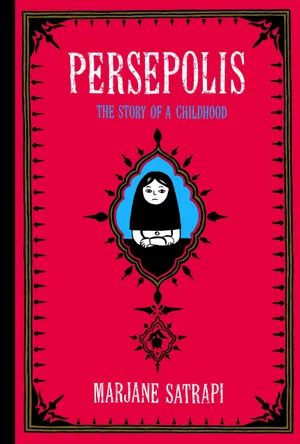
Our Review
Persepolis is a memoir drawn in stark black-and-white panels that tells the story of Marjane Satrapi's childhood and adolescence in Iran during and after the 1979 Islamic Revolution. It sounds heavy — and it is — but what makes Satrapi's work extraordinary is that she tells this story through the eyes of a sharp, funny, rebellious child who does not yet understand the full horror of what is happening around her.
Young Marji idolizes Bruce Lee and wants to be a prophet. She argues with God in her bedroom. She watches her uncle arrested, her neighbors bombed, her teachers replaced by ideologues. The genius of the book's perspective is that Marji processes political catastrophe the way children actually do: with confusion, with rage, with inappropriate humor, and with a fierce attachment to the people she loves.
The second half follows Satrapi's teenage years in Vienna, where her parents send her for safety, and her difficult return to Iran. The loneliness of exile, the impossibility of fitting in anywhere, and the guilt of surviving when others did not — Satrapi captures all of this with a visual style so deceptively simple that it takes your breath away. Every panel is stripped to its emotional essence. There is nowhere to hide in these drawings, and that is precisely the point.
Why This Book Earned Its Place in the Top 100
Persepolis proved that the graphic novel form could handle the most serious subject matter — war, revolution, exile, identity — with the same depth and nuance as traditional literary memoir. Before Persepolis, many readers still dismissed comics as juvenile. Satrapi's work demolished that prejudice permanently.
But the book's importance goes beyond formal innovation. It gave Western readers a deeply personal, profoundly humanizing window into Iranian life at a moment when Iran was understood almost entirely through political caricature. Satrapi showed that behind the headlines were families who loved punk rock and philosophy, who argued about Marxism over dinner, who were as complicated and modern and funny as any family in Paris or New York.
The stark black-and-white art is not a limitation but a choice. It strips away distraction and forces you to see the people. A mother weeping. A child pretending to be brave. A country tearing itself apart. Satrapi's refusal to render these moments in photorealistic detail somehow makes them more real, not less. The abstraction becomes universal. This is one of the essential memoirs of the twentieth century, in any medium.
Who Should Read This Book
- •Anyone who thinks graphic novels can't be serious literature — Persepolis will change your mind in the first twenty pages.
- •Readers interested in Iran and Middle Eastern history — this is the most accessible and humanizing account of the Islamic Revolution available.
- •Teenagers and young adults — Satrapi's young protagonist makes political history feel personal and immediate in a way textbooks never achieve.
- •Fans of memoir and autobiography — the emotional honesty here rivals any written memoir on this list.
- •Readers who appreciate visual storytelling — Satrapi's stark, deceptively simple panels are masterclasses in economy and emotional precision.
Key Themes and Takeaways
- Revolution and its betrayal
- Satrapi shows how the hope of revolution was co-opted by fundamentalists who imposed a new tyranny in place of the old one.
- Childhood under authoritarianism
- The child's-eye perspective reveals how political oppression distorts the most ordinary aspects of growing up.
- Exile and identity
- Satrapi's years in Vienna dramatize the painful nowhere-space of the immigrant who belongs fully to neither world.
- Gender and resistance
- The mandatory veil becomes a symbol of state control over women's bodies, and Satrapi's defiance is both political and personal.
- The power of visual testimony
- Satrapi chose black-and-white comics to tell her story because the form's starkness mirrors the moral clarity she demands.
Cultural and Historical Impact
Published in France in 2000 (English translation in 2003), Persepolis has sold over 2 million copies worldwide and been translated into dozens of languages. It was adapted into an animated film in 2007 that was nominated for the Academy Award for Best Animated Feature and won the Jury Prize at the Cannes Film Festival. The book is widely taught in schools and universities across Europe and North America, though it has also been frequently challenged and banned in some American school districts. Persepolis is credited with legitimizing the graphic memoir as a literary form and with reshaping Western perceptions of Iran. It paved the way for graphic memoirs like Fun Home and March to receive mainstream critical attention.
Notable Quotes
“In life you'll meet a lot of jerks. If they hurt you, tell yourself that it's because they're stupid. That will help keep you from reacting to their cruelty.”
“I want to be justice, love and the wrath of God all in one.”
“The filter of my grandmother's stories made everything seem simple.”
If You Loved Persepolis, Read These Next

Ready to read Persepolis?
Pantheon · 341 pages
Buy Persepolis on Amazon