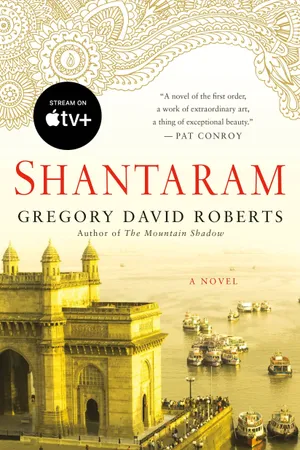
Our Review
Lin, the narrator of Shantaram, is an Australian heroin addict and convicted bank robber who escapes from prison and flees to Bombay with a forged passport. What happens next is one of the most sprawling, chaotic, exhilarating novels of the 21st century. Lin lives in a slum, runs an unlicensed medical clinic, falls in love with a mysterious Swiss-American woman named Karla, joins the Bombay mafia, fights in Afghanistan, and gets thrown into an Indian prison where conditions make his Australian cell look like a hotel. The novel runs to nearly a thousand pages and feels like it could run for a thousand more.
Gregory David Roberts based the novel on his own extraordinary life — he really did escape from an Australian prison, really did live in a Bombay slum, really did work for the mafia — and that autobiographical foundation gives the book a visceral authenticity that pure fiction rarely achieves. The sights, sounds, and especially the smells of Bombay pour off every page. The monsoon rains, the cholera outbreaks, the cramped rooms above chai stalls, the organized chaos of millions of people living on top of each other — Roberts makes you feel it in your body.
Shantaram is messy, excessive, sometimes self-indulgent, and occasionally overwritten. It is also utterly impossible to put down. The love story aches, the friendships feel real, and the philosophical digressions — while divisive — are the product of a mind that has genuinely suffered and genuinely thought about suffering.
Why This Book Earned Its Place in the Top 100
Shantaram earns its place through sheer force of experience. Most novels are products of imagination; this one is the product of a life lived at extremes, and the difference is palpable on every page. Roberts didn't research Bombay — he lived in its slums, ran with its criminals, endured its prisons, and loved its people. The result is a novel that feels less written than survived.
The book also represents something increasingly rare in contemporary fiction: genuine maximalism. In an era of spare, minimalist literary novels, Shantaram is unapologetically huge, stuffed with characters, subplots, philosophical asides, and emotional extremes. It trusts the reader to come along on a journey that has no interest in efficiency, and that generosity — that willingness to be too much — is precisely what makes it memorable.
Beyond craft, Shantaram offers one of the most vivid and empathetic portrayals of India in English-language fiction. Roberts writes about Bombay not as an exotic backdrop but as a living, breathing world with its own logic, dignity, and beauty. The novel challenged Western readers to see India's complexity rather than its poverty, and for many, it was transformative.
Who Should Read This Book
- •Travelers and wanderers — Shantaram is one of the great travel novels, and it will make you want to book a flight to Mumbai immediately.
- •Readers who love big, maximalist novels — if you want a book you can live inside for weeks, this delivers like few others.
- •Anyone fascinated by India — Roberts' portrayal of Bombay is one of the most vivid and loving in English literature.
- •People who enjoy true-crime-adjacent narratives — the mafia sections are gripping and carry the weight of lived experience.
- •Readers who don't mind philosophical digression — Roberts has things to say about love, suffering, and meaning, and if you're open to it, some of it is genuinely profound.
Key Themes and Takeaways
- Redemption and reinvention
- Lin's journey from escaped convict to slum doctor to mafia soldier is a meditation on whether people can genuinely change.
- The complexity of India
- Bombay is not a backdrop but a character, and Roberts insists on its dignity, beauty, and impossible contradictions.
- Love and obsession
- Lin's relationship with Karla explores the line between genuine connection and destructive fixation.
- Crime and morality
- Working for the mafia forces Lin to confront whether good intentions can justify complicity in violence.
- Suffering as teacher
- Roberts argues that suffering — in prison, in poverty, in heartbreak — is not meaningless but instructive, though the novel never romanticizes it.
Cultural and Historical Impact
Published in 2003, Shantaram became a global bestseller, selling over 6 million copies in nearly 40 languages. It spent extended periods on the New York Times bestseller list and became particularly popular among backpackers and travelers, earning a reputation as "the book everyone reads in India." Johnny Depp optioned the film rights, and after years in development, Apple TV+ released a television adaptation in 2022 starring Charlie Hunnam. The novel inspired a sequel, The Mountain Shadow (2015), and has been credited with boosting tourism to Mumbai, particularly to the Colaba district and Leopold Cafe, which features prominently in the story. Roberts wrote much of the novel twice — his first manuscript was destroyed by prison guards — making the completed work itself a story of perseverance.
Notable Quotes
“Some feelings sink so deep into the heart that only loneliness can help you find them again.”
“The truth is that there are no good men, or bad men. It is the deeds that have goodness or badness in them. There are good deeds, and bad deeds. Men are just men — it is what they do, or refuse to do, that links them to good and evil.”
“For this is what we do. Put one foot forward and then the other. Lift our eyes to the snarl and smile of the world once more. Think. Act. Feel. Add our little consequence to the tides of good and evil that flood and drain the world.”
If You Loved Shantaram, Read These Next

Ready to read Shantaram?
St. Martin's Griffin · 936 pages
Buy Shantaram on Amazon